In large distribution businesses, procurement inefficiency rarely begins with supplier shortage.
It begins when supplier communication volume outgrows the organization’s ability to convert incoming information into timely commercial decisions.
This is a pattern increasingly visible across wholesale and trading operations that manage large vendor ecosystems across regions, currencies, and product categories. As supplier participation grows, procurement teams often assume they are becoming commercially stronger. In reality, many become slower, more fragmented, and less responsive — not because opportunities are absent, but because opportunities are buried inside unstructured communication.
Lektik recently encountered this exact challenge while designing a procurement modernization initiative for a multinational wholesale distribution group operating across electronics, consumer appliances, accessories, and IT peripherals.
The business sourced inventory from more than 3,800 suppliers across Asia, Europe, and the Middle East, with procurement and sales coordination spread across Dubai, Hong Kong, India, Turkey, and a UK sales office. Its active product catalog had grown to over 420,000 SKUs.
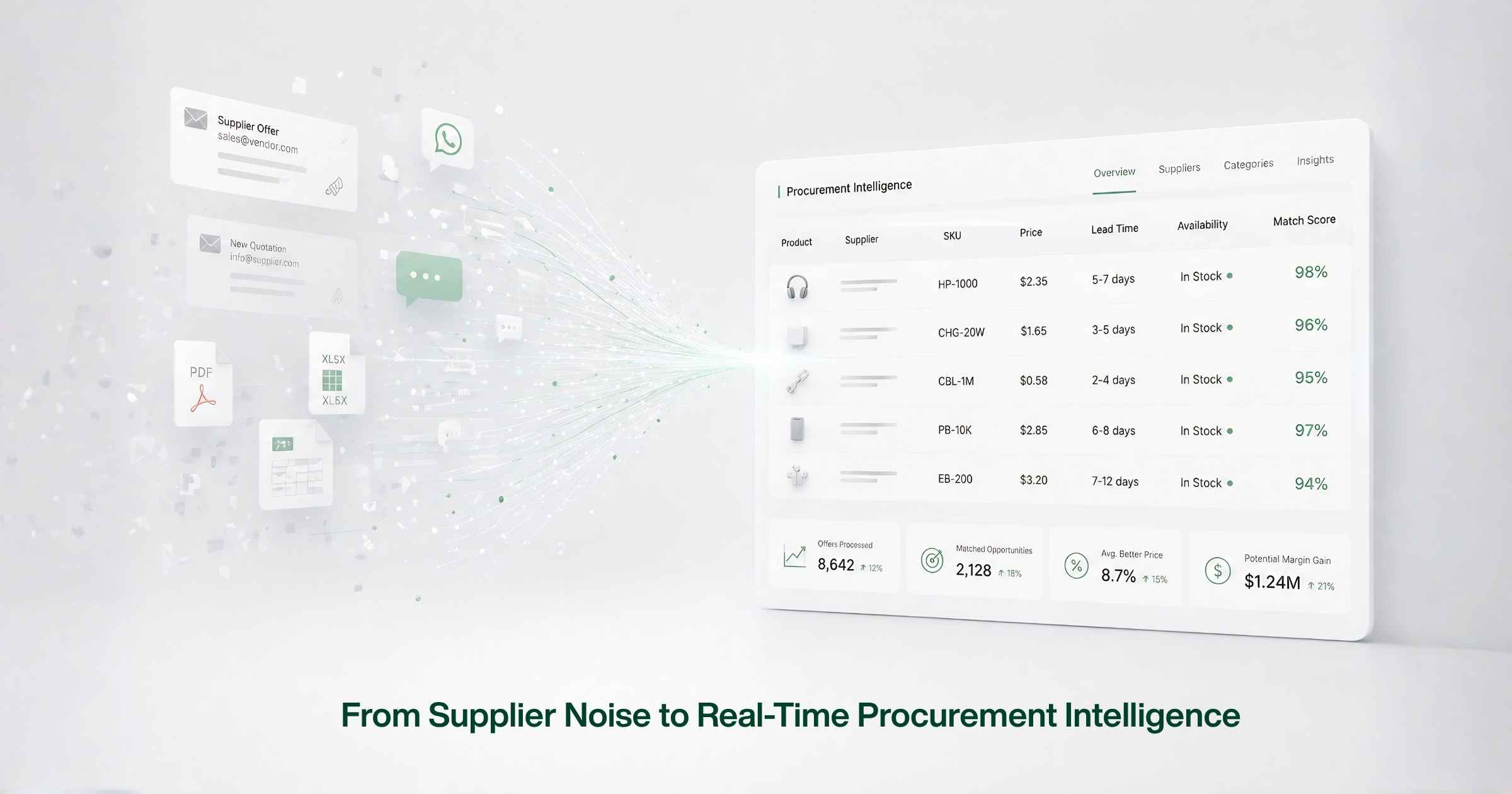
On any given day, the procurement function was receiving between 600 and 900 supplier offers in the form of vendor emails, WhatsApp business messages, forwarded PDF catalogs, Excel stock sheets, scanned quick offers, and multilingual communication in English, Chinese, Arabic, and Turkish.
Supplier access was not the issue.
Usable supplier intelligence was.
When Procurement Becomes an Inbox Management Exercise
As the sourcing network expanded, the procurement team found itself spending more time handling communication than making buying decisions.
Buyers were manually opening attachments, comparing rows across spreadsheets, converting currencies, checking whether supplier descriptions aligned with internal SKU references, and searching older communications to understand historical vendor pricing before making even routine commercial judgments.
A single product opportunity could arrive in three or four different forms.
One supplier may quote “Apple Airpods Pro 2 USB-C” in an Excel row. Another may send “APRO2 HK stock” over WhatsApp. A third may attach a PDF catalog with only regional model references.
To the buying team, these appeared as separate communication events requiring manual interpretation.
To the business, they were potentially the same commercial opportunity — but there was no structured system capable of recognizing that in real time.
This led to a recurring set of operational inefficiencies.
Competitive supplier offers were frequently buried in communication volume before they could be acted upon. Procurement comparison effort became repetitive because no retained intelligence existed across previous reviews. Sales teams had little immediate visibility into whether fresh incoming offers matched active customer demand. Leadership had no consolidated view of vendor behavior, category-level pricing shifts, or recurring sourcing advantages because all commercial information remained trapped inside inboxes, spreadsheets, and informal communication threads.
The organization was not lacking supplier data.
It was lacking a procurement intelligence layer between supplier communication and buyer decision-making.
Why Conventional Procurement Tooling Does Not Solve This
In many environments, the first instinct is to address this through incremental tooling — ERP connectors, supplier portals, standardized forms, or additional manpower.
These measures rarely solve the underlying issue because they operate on a flawed assumption: that suppliers will adapt their communication behavior to fit the buyer’s internal systems.
They do not.
Suppliers continue to work through the channels that are fastest and most natural to them — emails, forwarded files, spreadsheets, message attachments, shorthand text, multilingual notes, and inconsistent naming conventions.
Which means the procurement challenge is not fundamentally a dashboard problem or a workflow problem.
It is a data usability problem.
Until incoming supplier communication is transformed into structured, comparable, decision-ready records, every downstream procurement activity remains dependent on manual interpretation.
Re-Engineering the Procurement Intake Layer
Lektik approached the transformation by redesigning procurement not as a reporting workflow, but as a live intelligence pipeline.
The first phase focused on centralizing all fragmented supplier interactions into a unified communication intake layer.
Incoming offers from Outlook inboxes, Gmail inboxes, WhatsApp business channels, PDF uploads, and Excel stock files were routed into a single processing environment. Each communication was preserved with source metadata including vendor identity, language, timestamps, attachment type, and source channel.
This immediately removed procurement dependency on scattered inbox ownership and local spreadsheet storage.
But centralization alone was not enough.
The larger requirement was to make every incoming communication commercially usable.
To achieve this, each supplier interaction was passed through an AI-led structuring engine designed to extract the operational fields buyers repeatedly needed but were manually hunting for:
product descriptions, supplier SKUs, available quantities, quoted cost, currencies, shipping terms, lead times, payment conditions, and offer validity windows.
Even loosely formatted supplier notes such as short WhatsApp quotations or partially structured PDF attachments could now be converted into normalized procurement records.
What previously entered the organization as communication now entered as data.
Building Match Intelligence Across 420,000 SKUs
One of the most time-consuming procurement tasks had been product interpretation.
Supplier naming conventions were highly inconsistent, and exact text matches were rare. The same item could be described differently by region, vendor shorthand, or model notation.
This meant procurement comparison could not be solved through simple keyword indexing.
Lektik introduced a product match-resolution layer capable of mapping incoming supplier descriptions against the client’s 420,000-SKU internal catalog using a combination of fuzzy matching, semantic embedding similarity, historical alias references, and anchor identifiers such as UPC/EAN codes where available.
This significantly reduced the buyer effort previously required to determine whether multiple incoming offers were actually referencing the same sellable product.
Supplier messages were no longer isolated text events.
They became comparable commercial records connected to the organization’s internal product universe.
Moving from Communication Processing to Decision Prioritization
Once incoming supplier offers were being captured, structured, and matched in real time, procurement teams no longer needed to review communication volume blindly.
The next layer of transformation focused on ranking commercial relevance.
Lektik implemented a procurement decision engine that automatically evaluated supplier opportunities based on landed cost assumptions, currency normalization, payment flexibility, lead time, and vendor reliability history.
Rather than manually sifting through hundreds of messages to decide what deserved attention, buyers could now work from prioritized opportunity queues.
This became even more powerful when connected to active sales inquiries.
If a supplier offer entered the system for a product already in customer demand, the relevant procurement and sales teams were immediately notified.
This changed the role of procurement from passive quotation review to active opportunity response.
Supplier communication was no longer information waiting to be read.
It became a trigger for commercially relevant action.
Creating Leadership Visibility from Previously Invisible Data
The final gap was management intelligence.
Before the transformation, leadership had no structured way to answer questions such as:
Which vendors consistently create the best landed margin? Which categories are seeing downward price movement? Which supplier regions are showing the highest quote responsiveness? Where are repeated buying opportunities being missed?
Because the underlying supplier data was never entering the organization in an analyzable form.
A centralized procurement intelligence dashboard was introduced to expose vendor activity patterns, category-wise price movements, recurring demand matches, supplier responsiveness, and margin-sensitive sourcing opportunities.
For the first time, management teams could analyze procurement communication not simply as operational traffic, but as a strategic decision dataset.
The Business Shift That Followed
Within months, the organization saw a significant reduction in manual quote comparison effort, materially faster identification of commercially viable supplier opportunities, and a centralized searchable intelligence layer across thousands of vendor interactions.
More importantly, procurement decision-making moved away from inbox-driven manual review and toward a far more responsive, data-backed operating model directly connected to buying speed and revenue responsiveness.
The transformation did not come from adding more suppliers.
It came from making supplier communication operationally usable.
Closing Perspective
Many procurement environments today are not constrained by lack of data. They are constrained by the inability to convert fragmented data into decisions at the speed business now requires.
That distinction matters.
Because organizations that continue treating supplier emails, spreadsheets, PDFs, and message threads as human-only review inputs will scale communication complexity faster than they scale procurement efficiency.
The competitive advantage will increasingly belong to businesses that build an intelligence layer between supplier communication and buyer action.
This is where procurement stops being an administrative function and starts becoming a real-time commercial decision system.
And that shift is no longer optional. Read Part 2 → Predictive Procurement Decision Layer - Procurement Intelligence