Cybersecurity threats move faster than ever in 2026. Startups deploy updates daily, SaaS platforms continuously expand their integrations, and product teams ship features at high speed. But despite this rapid evolution, many businesses still rely on traditional penetration testing models built for a much slower digital environment.
For modern businesses, the challenge is no longer just getting a penetration test done. The real challenge is whether cybersecurity workflows can keep up with product velocity, operational demands, and evolving attack surfaces.
For business owners, startup founders, and product leaders, cybersecurity for businesses is no longer just a compliance checkbox. It directly affects customer trust, enterprise readiness, operational continuity, and long-term scalability.
What Is Traditional Penetration Testing?
Penetration testing, often called a “pentest,” is a cybersecurity assessment where security professionals simulate real-world attacks to identify vulnerabilities in systems, applications, APIs, networks, or infrastructure.
Traditional penetration testing typically involves:
- Manual testing engagements
- Fixed assessment timelines
- Static PDF reports
- Long remediation cycles
- Limited follow-up validation
While this approach remains valuable in many industries, it often struggles to support fast-moving startups and modern digital businesses.
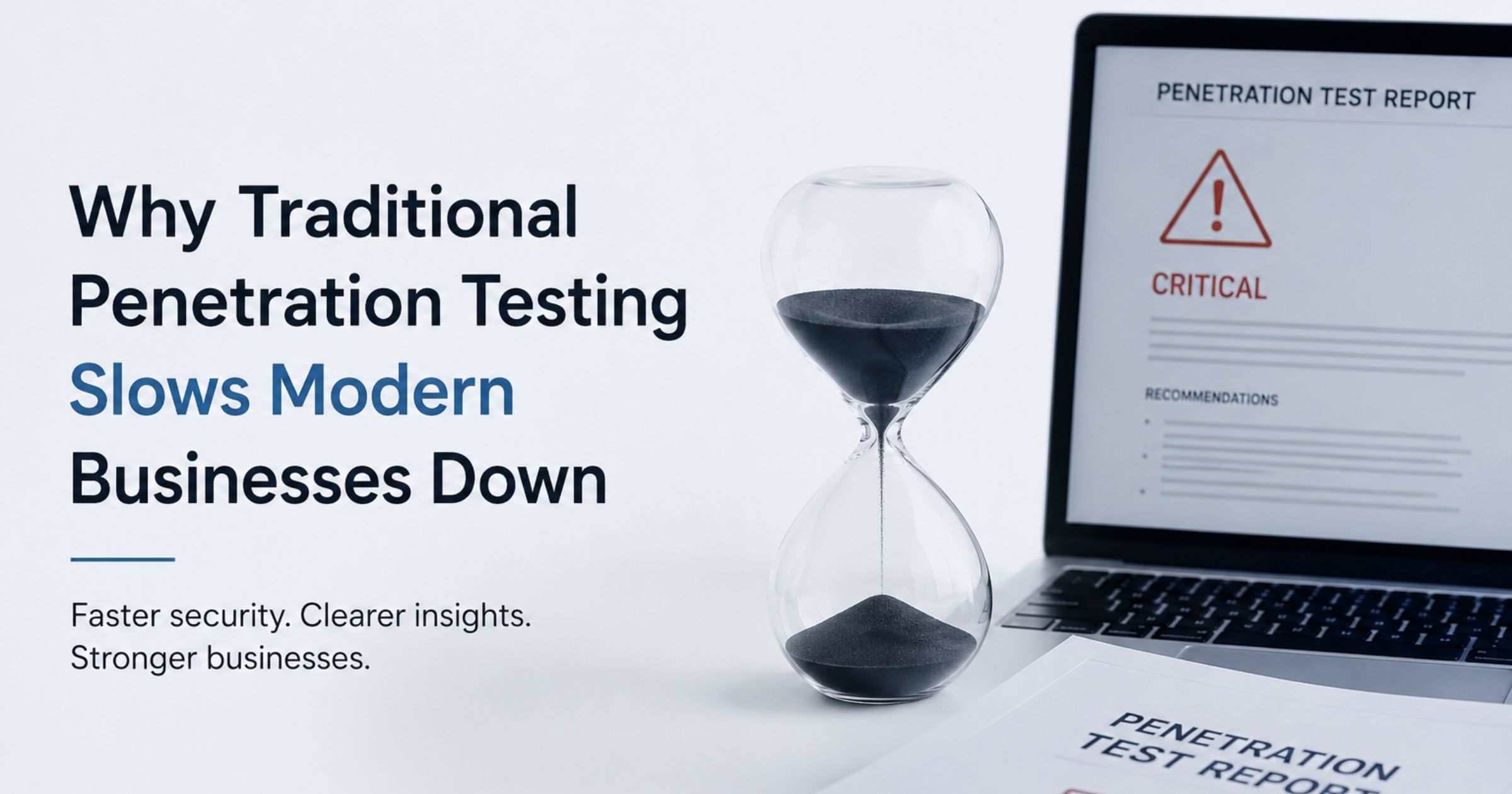
Why Traditional Penetration Testing Slows Modern Businesses Down
The biggest issue with traditional penetration testing is timing.
By the time many businesses receive their final security report:
- Infrastructure may already have changed
- New features may already be deployed
- Vulnerabilities may no longer reflect the live environment
- Engineering teams may have shifted priorities
This creates a disconnect between vulnerability discovery and actual remediation.
For startups and SaaS businesses operating on agile development cycles, slow security workflows can become operational bottlenecks.
Common Business Challenges With Traditional Pentesting
1. Slow Reporting Cycles
Some engagements take weeks before findings are delivered, slowing remediation efforts and delaying decision-making.
2. Technical Reports That Non-Security Teams Can’t Interpret
Many reports are written primarily for cybersecurity professionals, making it difficult for founders, product managers, and operations teams to understand actual business risk.
3. Security Becoming a Last-Step Activity
In many organizations, penetration testing happens only before launch or during compliance reviews instead of being integrated into continuous development workflows.
4. Limited Retesting and Validation
After vulnerabilities are fixed, businesses often struggle to validate remediation quickly without restarting lengthy engagement processes.
Why Startup Cybersecurity Companies Are Evolving Faster
Modern businesses need cybersecurity workflows that move at operational speed.
This is one reason many startup cybersecurity companies are shifting toward:
- Faster penetration testing cycles
- Continuous security validation
- Integrated security automation
- Readable reporting structures
- CI/CD-integrated testing workflows
Instead of treating cybersecurity as a once-a-year activity, many organizations now treat security as an ongoing operational capability.
This shift is especially important for:
- SaaS startups
- Venture-backed companies
- AI product teams
- Fintech platforms
- Mobile-first businesses
- Cloud-native applications
Why Business-Friendly Security Reporting Matters
Cybersecurity findings only create value when teams can act on them.
One of the biggest issues in traditional penetration testing is communication. Security reports are often dense, technical, and difficult for cross-functional teams to prioritize effectively.
Business leaders need to understand:
- Which vulnerabilities matter most
- What operational risks exist
- How issues affect customers or infrastructure
- What needs immediate remediation
- What can wait
This is one reason why the cybersecurity industry is increasingly moving toward risk-based reporting models.
Ventures like NetNex reflect this evolving direction by focusing on faster attacker-style penetration testing workflows, simplified reporting structures, and remediation-focused validation approaches. The broader industry trend is clear: cybersecurity outputs are becoming more aligned with operational decision-making rather than purely technical analysis.
Automation Is Changing Cybersecurity Operations
Modern engineering teams already automate deployment, monitoring, analytics, and infrastructure management. Cybersecurity is following the same path.
Security automation now plays a major role in:
- Vulnerability scanning
- Mobile application security testing
- API monitoring
- CI/CD pipeline validation
- Threat detection workflows
- Continuous compliance checks
As businesses scale, manual-heavy security processes become increasingly difficult to maintain.
This is especially true for organizations managing multiple applications, cloud services, or rapid release cycles.
Work done with Quokka demonstrated how automated vulnerability assessment frameworks integrated directly into CI/CD pipelines can significantly reduce manual operational effort while improving speed and scalability across mobile application security workflows.
The larger industry movement is toward integrating security directly into development operations rather than treating it as a separate downstream process.
Cyber Security for Business Is Becoming an Operational Priority
Many founders assume cybersecurity is only necessary once a company reaches enterprise scale. In reality, smaller businesses are increasingly targeted because:
- Security processes are often immature
- Teams move quickly under pressure
- SaaS usage expands rapidly
- Access management becomes fragmented
- Security ownership is unclear
Cybersecurity incidents can affect:
- Customer trust
- Investor confidence
- Product availability
- Enterprise partnerships
- Regulatory exposure
- Revenue continuity
For modern businesses, cybersecurity is no longer only an IT concern, it is a business resilience concern.
The Growing Importance of Endpoint Protection Software for Small Teams
As startups adopt remote work and distributed operations, endpoint security becomes increasingly important.
Laptops, employee devices, cloud-connected systems, and remote access points often become attack entry points for businesses with limited security infrastructure.
This is why many growing companies are now investing in:
- Endpoint protection software for small teams
- Multi-factor authentication
- Device monitoring
- Access management systems
- Cloud security controls
Strong endpoint protection helps reduce exposure from phishing attacks, credential theft, malware, and unauthorized access.
For startups without large internal IT departments, lightweight and scalable endpoint protection solutions are becoming essential operational tools.
The Future of Penetration Testing
The future of penetration testing is likely to become:
- Faster
- More automated
- Continuously validated
- Integrated into development workflows
- Easier for business teams to understand
Traditional penetration testing still has an important role, especially for regulatory and compliance-driven environments. But for startups and fast-scaling businesses, modern cybersecurity strategies increasingly prioritize agility, operational alignment, and continuous risk visibility.
Security is gradually evolving from a periodic audit activity into an integrated business capability.
FAQs About Startup Cybersecurity and Penetration Testing
How to choose a cybersecurity service provider for a new business?
When evaluating cybersecurity providers, startups should look for:
- Fast response and remediation workflows
- Clear, readable reporting
- Experience with startup environments
- Continuous validation capabilities
- CI/CD and cloud security understanding
- Scalable security operations
The best cybersecurity partners align technical findings with operational business impact instead of focusing only on technical complexity.
Where to find expert cybersecurity consulting for startups?
Many startups work with specialized cybersecurity firms, security-focused venture studios, cloud security consultants, or modern penetration testing providers that understand agile development environments.
Businesses should prioritize consultants who understand:
- SaaS infrastructure
- Startup scaling challenges
- Cloud-native applications
- Product development workflows
- Security automation
What is cybersecurity for business?
Cyber security for business refers to the processes, technologies, and strategies used to protect company systems, customer data, infrastructure, applications, and operations from cyber threats.
It includes:
- Penetration testing
- Vulnerability management
- Endpoint protection
- Access control
- Cloud security
- Threat monitoring
- Security automation
Why are startup cybersecurity companies growing rapidly?
Startup cybersecurity companies are growing because businesses now require:
- Faster security validation
- Cloud-native security solutions
- AI-driven monitoring
- Automated workflows
- Startup-friendly security operations
- Scalable protection models
Traditional enterprise security models often struggle to support modern agile business environments.
What is endpoint protection software for small teams?
Endpoint protection software helps secure employee devices such as laptops, desktops, and mobile devices from cyber threats like malware, phishing, ransomware, and unauthorized access.
For startups and distributed teams, endpoint protection helps improve operational security without requiring large internal IT teams.