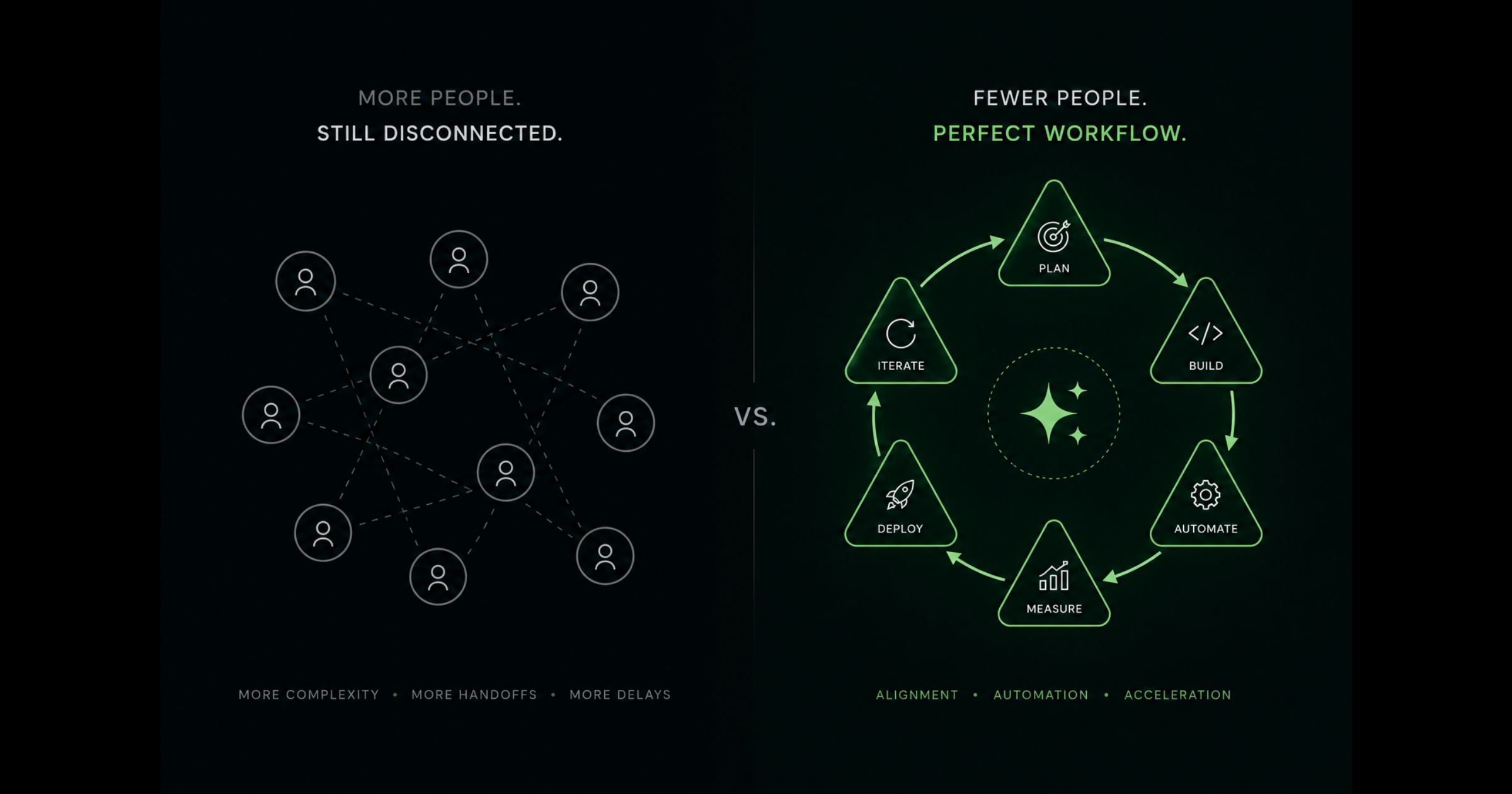
For years, the default startup playbook was simple:
Raise capital. Hire aggressively. Build larger engineering teams. Scale through headcount.
The assumption was that more developers meant faster execution.
But over the last few years, something interesting has started happening across the startup ecosystem.
Some of the fastest-moving companies today are operating with surprisingly small teams.
Products are launching faster. Features are shipping quicker. Operations are becoming more efficient. And in many cases, these companies are outperforming businesses with engineering teams several times larger.
The difference is not just talent.
It is workflow design.
More specifically, it is the rise of AI-native workflows.
Modern startups are no longer thinking about AI as a feature they add later. They are building their entire operational model around it — from software development and automation to internal execution and product delivery.
And that shift is quietly redefining what scaling a company looks like.
The Old Scaling Model Is Becoming Expensive
Traditional startup scaling was built around one core belief:
Growth problems are solved by adding more people.
Need to ship faster? Hire developers. Need to handle operations? Add managers. Need to increase output? Expand teams.
For a long time, this worked.
But as companies grew, another problem emerged.
Larger teams created larger systems.
Communication layers increased. Approvals slowed down. Meetings multiplied. Operational overhead expanded.
At a certain point, engineering velocity often started decreasing instead of improving.
Many founders discovered that doubling team size did not necessarily double execution speed.
Sometimes it slowed it down.
This is one of the biggest reasons modern startups are now rethinking how engineering and operational systems should function.
Especially in a market where speed matters more than ever.
AI-Native Companies Think Differently About Execution
The companies moving fastest today are not simply “using AI tools.”
They are redesigning how work happens.
That distinction matters.
An AI-native workflow means AI is integrated directly into the execution layer of the business itself.
Instead of adding AI occasionally, these companies use it continuously across operations.
Engineering teams now use AI-assisted development to reduce repetitive coding tasks and accelerate debugging. Internal workflows are automated to reduce manual coordination. Product documentation is generated faster. Testing cycles are shortened. Operational reporting becomes near-instant.
The result is not just efficiency.
It is leverage.
A smaller team suddenly gains the operational output of a much larger organization.
And for startups, leverage changes everything.
Why Smaller Teams Are Suddenly Moving Faster
One of the biggest advantages smaller teams have is focus.
There are fewer communication layers. Fewer dependencies. Fewer approval chains.
Decisions happen quickly.
When combined with AI-native systems, this creates a powerful operational advantage.
Instead of spending engineering hours on repetitive execution, developers can focus on higher-value thinking:
- product strategy,
- architecture,
- customer experience,
- experimentation,
- and innovation.
This is where AI-powered software development is having the biggest impact.
Not by replacing engineers, but by removing operational friction around them.
The best teams are not becoming smaller because they want fewer people.
They are becoming leaner because modern workflows allow them to achieve more with less operational drag.
The Real Advantage Is Speed of Iteration
In startup environments, the companies that learn fastest often win fastest.
That is why execution speed matters so much.
A startup that ships updates weekly will usually outperform one that takes months to release improvements.
AI-native workflows dramatically improve iteration cycles.
Teams can prototype faster, test ideas earlier, gather feedback sooner, and refine products continuously.
This changes how businesses scale.
Instead of making large, slow bets, companies can make smaller, faster decisions repeatedly.
For founders, this creates a significant strategic advantage:
- lower burn rates,
- faster learning cycles,
- better market responsiveness,
- and more efficient resource allocation.
In uncertain markets, adaptability often becomes more valuable than size.
Larger Teams Are No Longer the Default Competitive Advantage
There was a time when large engineering departments signaled strength.
Today, many founders are realizing that operational efficiency matters more than organizational size.
A lean AI-native startup can now compete with companies that previously held advantages through scale alone.
Why?
Because modern AI workflows compress execution time.
Tasks that once required entire teams can now be partially automated or accelerated through intelligent systems.
Documentation generation. Internal coordination. Code assistance. Testing workflows. Operational reporting. Customer support automation.
The cumulative effect is enormous.
And this is exactly why many modern startups are choosing to stay intentionally lean for longer periods of growth.
Not because they lack ambition — but because lean systems often scale better.
AI-Native Workflows Are Changing Founder Priorities
Founders today are operating in a very different environment than even five years ago.
The pressure is no longer just about growth.
It is about:
- scaling efficiently,
- extending runway,
- improving operational efficiency,
- reducing unnecessary overhead,
- and increasing execution speed.
Hiring large engineering teams is expensive, time-consuming, and increasingly difficult to sustain early on.
As a result, many startups are now prioritizing:
- AI automation,
- lean operational systems,
- intelligent workflow design,
- AI-powered development environments,
- and scalable execution infrastructure.
The companies adopting these systems early are creating an operational advantage that compounds over time.
Because once workflows become AI-native, the organization itself becomes faster.
This Shift Is Bigger Than Engineering
One of the biggest misconceptions around AI-native companies is that the transformation only affects software development.
In reality, the shift touches the entire business.
Modern AI-native companies are streamlining:
- customer operations,
- marketing workflows,
- reporting systems,
- lead qualification,
- internal knowledge management,
- support systems,
- and operational analytics.
This creates alignment between teams while reducing manual workload across the organization.
The outcome is not just faster engineering.
It is faster business execution overall.
And in competitive industries, organizational speed becomes a major advantage.
The Best Companies Are Using AI to Amplify Human Capability
There is a lot of discussion around whether AI will replace teams.
But the strongest companies are approaching this differently.
They are using AI to amplify human capability, not eliminate it.
Creativity still matters. Strategic thinking still matters. Product vision still matters. Human judgment still matters.
What AI changes is the amount of operational friction surrounding execution.
That is why smaller, highly capable teams are suddenly producing outsized results.
AI-native workflows allow talented people to spend more time solving meaningful problems instead of navigating operational inefficiencies.
And that may become one of the defining competitive advantages of modern companies over the next decade.
What Founders Should Be Thinking About Now
The question for founders is no longer: “How quickly can we hire?”
The better question is: “How intelligently can we scale?”
Because the companies that move fastest in the next generation of business will likely not be the ones with the largest teams.
They will be the ones with the most efficient systems.
That means:
- integrating AI into operational workflows,
- reducing execution bottlenecks,
- automating repetitive processes,
- improving delivery speed,
- and designing organizations that remain agile as they grow.
The startups that understand this early will likely build stronger operational foundations while remaining lean enough to adapt quickly.
And in a market moving this fast, adaptability may become one of the most valuable assets a company can have.
Final Thoughts
The future of scaling companies is changing quietly but rapidly.
Bigger teams no longer automatically mean faster execution.
In many cases, smaller AI-native teams are proving they can move faster, operate more efficiently, and build with greater agility than traditional organizations built around headcount-heavy models.
The advantage is no longer just about resources.
It is about operational intelligence.
And as AI-native workflows continue reshaping software development, automation, and business execution, the companies that learn to combine lean teams with intelligent systems will likely define the next era of modern scaling.
FAQ
What are AI-native workflows?
AI-native workflows are operational systems where artificial intelligence is integrated directly into daily business processes, software development, automation, and execution workflows to improve efficiency and scalability.
Why are smaller engineering teams becoming more effective?
Smaller teams often have less communication overhead and can move faster when supported by AI-powered development tools, workflow automation, and intelligent operational systems.
How does AI improve software development speed?
AI can accelerate coding, debugging, testing, documentation, deployment workflows, and internal coordination, allowing teams to ship products faster and reduce repetitive work.
Why are startups adopting AI-native operations?
Startups use AI-native workflows to improve productivity, reduce operational costs, scale efficiently, accelerate product delivery, and stay competitive in fast-moving markets.
Can AI replace engineering teams?
AI is currently most effective as a productivity amplifier rather than a replacement. The strongest companies use AI to improve engineering output and operational efficiency while keeping human creativity and strategy central.
What industries benefit most from AI-native workflows?
Industries like SaaS, fintech, ecommerce, logistics, healthcare technology, marketing technology, and digital services benefit significantly from AI-powered automation and operational workflows.
What is the biggest advantage of lean engineering teams?
Lean engineering teams can often move faster, adapt quickly, reduce operational complexity, improve decision-making speed, and scale more efficiently with AI-assisted workflows.