Security Isn't a Technology Problem Anymore. It's a Governance Problem.
Most organizations believe they take security seriously.
They invest in cloud platforms. They deploy cybersecurity tools. They require passwords. Some implement multi-factor authentication.
Yet many businesses operate with a surprising level of uncertainty.
Former employees still have active accounts.
Nobody can confidently explain who has access to critical systems.
Third-party vendors retain permissions long after projects end.
Sensitive company data exists across dozens of disconnected applications.
The uncomfortable reality is this:
Most organizations are not operating on governance. They are operating on trust.
And as businesses become increasingly digital, that trust becomes an operational liability.
For founders and business leaders, the real security challenge is no longer preventing attacks. It is maintaining control.
The Real Problem Founders Face
The common assumption is that security failures happen because organizations lack technology.
In reality, most modern software platforms already provide sophisticated security capabilities.
Platforms such as Microsoft 365, Google Workspace, AWS, Azure, HubSpot, GitHub, and Zoho offer:
- Multi-factor authentication
- Role-based access controls
- Audit trails
- Encryption
- Activity monitoring
- Security alerts
The tools exist.
The issue is that most organizations never operationalize them effectively.
Security becomes an IT responsibility.
Governance becomes nobody's responsibility.
As a result, risk accumulates quietly across the business.
The Flawed Assumptions Behind Most Security Strategies
Many organizations unknowingly operate on assumptions that no longer hold true.
Assumption 1: Security Is an IT Function
Technology teams can manage systems.
They cannot govern business decisions.
Questions such as:
- Who should have access?
- Which vendors are approved?
- What customer data should be retained?
- Which AI tools can employees use?
are governance decisions, not technical decisions.
When ownership is unclear, risk grows.
Assumption 2: More Security Tools Equal More Security
Organizations frequently respond to security concerns by purchasing additional software.
Yet many already possess underutilized capabilities within their existing platforms.
Without governance, new tools often create additional complexity rather than additional protection.
The result is a larger technology stack with the same underlying vulnerabilities.
Assumption 3: Cyber Threats Are the Biggest Risk
Sophisticated cyberattacks capture headlines.
Operational failures create far more day-to-day exposure.
Examples include:
- Shared user accounts
- Excessive permissions
- Weak employee offboarding
- Unapproved AI tool usage
- Dormant vendor accounts
- Lack of access reviews
Individually, these seem minor.
Collectively, they represent a significant governance risk.
A Governance-First Framework for Modern Organizations
Instead of viewing security as a technology initiative, founders should view it as an operational governance system.
A simple framework can help.
The Four Layers of Security Governance
1. Identity Governance
The first question every organization should answer is:
Who has access to what?
Key practices include:
- Individual user accounts only
- Multi-factor authentication by default
- Role-based permissions
- Regular access reviews
- Immediate offboarding processes
Identity governance forms the foundation of organizational control.
Without it, visibility disappears quickly.
2. Vendor Governance
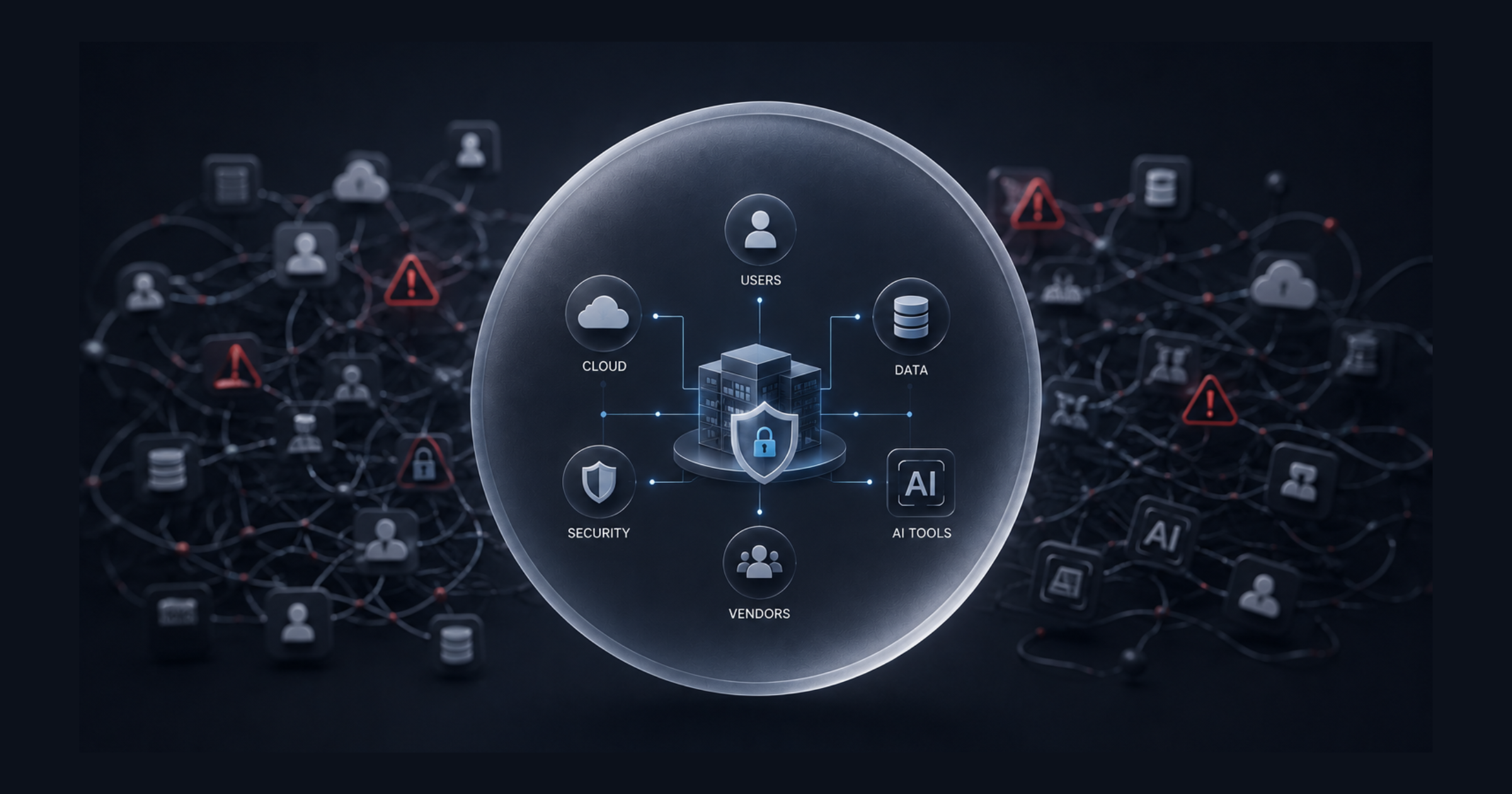
Modern companies rely on dozens or even hundreds of external platforms.
This creates a growing network of dependencies.
Maintain visibility into:
- SaaS applications
- Cloud providers
- AI platforms
- Consultants and contractors
- Third-party integrations
Organizations often know what they purchased.
They rarely know what remains connected.
3. Data Governance
Data governance is becoming one of the most important aspects of operational security.
Businesses should understand:
- What data exists
- Where it is stored
- Who can access it
- How long it is retained
- Whether it is duplicated across systems
The inability to answer these questions creates both security and compliance risks.
4. AI Governance
AI adoption is accelerating faster than most governance programs.
Employees are already using AI tools whether leadership has formally approved them or not.
Organizations need clear policies around:
- Approved AI platforms
- Sensitive data handling
- Acceptable use cases
- Human review requirements
- Vendor evaluation standards
AI governance is quickly becoming a core component of enterprise security governance.
Why Security Governance Is Becoming a Competitive Advantage
Many founders still view governance as an operational overhead.
Increasingly, it is becoming a business advantage.
Customers, investors, partners, and regulators are asking more sophisticated questions.
They want to understand:
- How data is protected
- How access is managed
- How AI is governed
- How vendors are evaluated
Organizations that can answer confidently build trust faster.
Organizations that cannot often face longer sales cycles, higher compliance costs, and increased operational risk.
Governance is no longer just about protection.
It is becoming a signal of organizational maturity.
Practical Implications for Founders and Operators
If you are evaluating your organization's security posture, start with governance before technology.
Ask:
- Can we identify every system our employees use?
- Do we know who has access to each system?
- Are vendor permissions reviewed regularly?
- Do we have documented AI usage policies?
- Can we locate our most sensitive business data?
If the answer to any of these questions is unclear, the issue is likely governance rather than technology.
The objective is not perfect security.
The objective is operational control.
Security Governance Is the New Operating Discipline
The future of security will not be defined by who buys the most tools.
It will be defined by who governs their digital operations most effectively.
Technology platforms will continue to improve.
Threats will continue to evolve.
AI adoption will continue to accelerate.
What will increasingly separate resilient organizations from vulnerable ones is governance.
Not because governance prevents every risk.
But because governance creates visibility, accountability, and control.
And in modern organizations, control is ultimately what security is meant to provide.