For decades, enterprise software has followed the same formula.
Build a platform. Create dashboards. Add reports. Train employees to use it.
Then build another platform.
Today, the average enterprise runs dozens of applications across operations, finance, HR, sales, customer service, and analytics. Yet despite billions invested in digital transformation, many teams still spend more time navigating software than accomplishing work.
That is beginning to change.
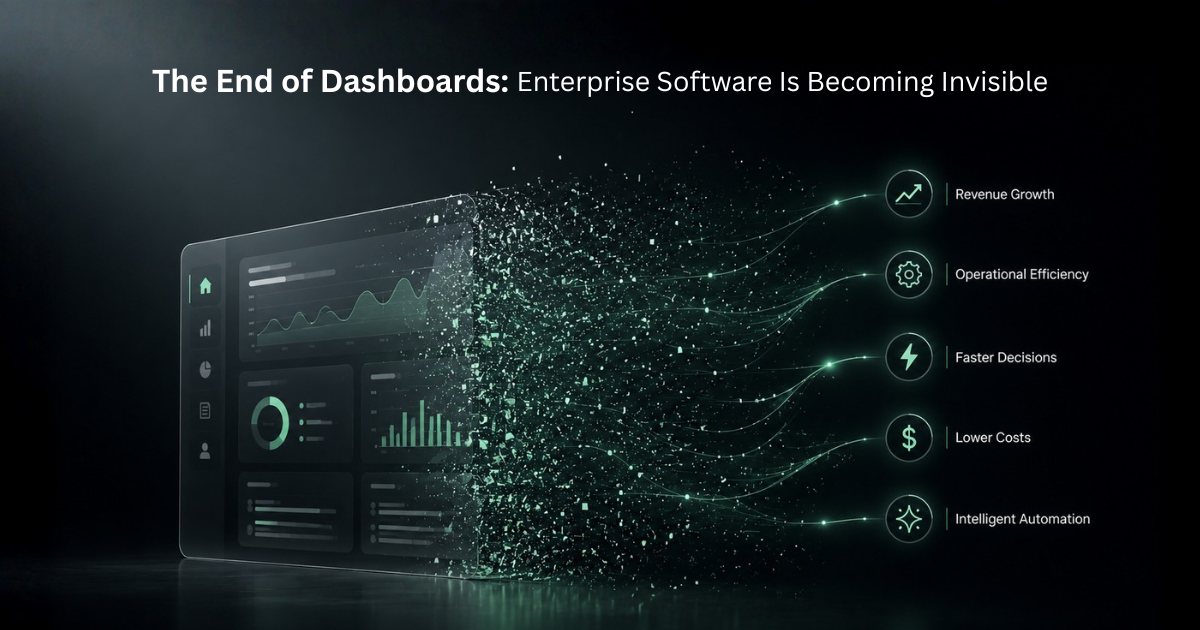
The future of enterprise software is invisible.
Within the next five years, many of the most valuable enterprise systems will operate quietly in the background, powered by AI agents, automation, and ambient computing. Employees won't need to constantly switch between applications, build reports, or manage workflows manually.
The software will simply understand intent and execute.
And for business owners, startup founders, and enterprise leaders, this shift could become one of the most important technology transitions since cloud computing.
The Interface Was Never the Product
Enterprise software has traditionally relied on human intervention.
Need a report?
Log in.
Need customer information?
Open another application.
Need approval?
Navigate a workflow.
Every dashboard, menu, and login screen exists because software historically lacked context.
The interface became a translation layer between people and systems.
But advances in Enterprise AI are changing that equation.
Instead of asking users to learn software, software is learning to understand users.
The result is a new category of intelligent systems where outcomes matter more than interactions.
What Invisible Enterprise Software Actually Means
Invisible software is not simply a chatbot added to an existing platform.
It is software that operates within existing workflows, understands context, and completes tasks without requiring users to navigate a separate application.
Think of it this way:
Traditional software asks:
"What would you like to do?"
Invisible software asks:
"What are you trying to achieve?"
The difference sounds subtle, but it changes everything.
Powered by AI agents, intelligent automation, and natural language interfaces, these systems can:
- Gather information across multiple platforms
- Execute multi-step workflows
- Trigger approvals
- Generate reports
- Monitor operations
- Recommend actions
all without requiring employees to manually coordinate the process.
A Real-World Example Every CEO Will Recognize
Imagine you're preparing for an investor meeting.
You need an answer to a simple question:
"Which operational risks could impact revenue over the next quarter?"
Today, obtaining that answer might involve:
- Reviewing ERP reports
- Checking inventory systems
- Speaking with operations managers
- Gathering financial forecasts
- Consolidating information manually
Several employees may spend hours producing a report.
Now imagine asking an AI-powered business assistant the same question.
Within seconds, the system:
- Pulls data from multiple enterprise platforms
- Identifies operational bottlenecks
- Estimates financial exposure
- Highlights affected customers
- Recommends corrective actions
No dashboards.
No meetings.
No manual reporting.
Just an answer.
That is invisible enterprise software in practice.
Why AI Agents Are Accelerating This Shift
One of the biggest technology trends shaping the future of enterprise software is the rise of AI agents.
Unlike traditional automation tools, AI agents can reason across systems, make decisions based on context, and execute complex workflows autonomously.
For example, a sales leader could request:
"Identify the highest-probability opportunities for this quarter and create follow-up actions."
An AI agent can:
- Analyze CRM data
- Review customer interactions
- Identify buying signals
- Draft outreach emails
- Schedule meetings
- Update records automatically
The employee focuses on strategy.
The AI handles execution.
This is why many analysts believe AI agents will become a foundational layer of future enterprise operations.
Why Traditional Enterprise Software Is Becoming a Liability
Most organizations don't have a software problem.
They have a workflow problem.
Employees spend significant portions of their day:
- Switching between tools
- Searching for information
- Creating reports
- Updating systems
- Managing approvals
Every additional click introduces friction.
Every additional dashboard introduces complexity.
The problem isn't that software lacks capability.
The problem is that employees are forced to operate the software instead of the software operating itself.
As businesses adopt AI-powered workflows, success will increasingly be measured by outcomes:
- Faster cycle times
- Lower operating costs
- Reduced errors
- Improved customer experiences
- Faster decision-making
The future belongs to outcome-driven systems, not engagement-driven software.
Invisible Software Is Already Here
This shift isn't theoretical.
Healthcare organizations are using ambient AI systems that automatically document patient interactions, saving physicians more than an hour every day.
Financial institutions are deploying AI-driven workflows that reduce reporting cycles from weeks to minutes.
Operations teams are using intelligent automation to process claims, approvals, and compliance reviews with minimal human intervention.
Across industries, the same pattern is emerging:
The system of record remains.
The workflow layer disappears.
And that's where much of the efficiency gain comes from.
The Governance Challenge Business Leaders Can't Ignore
As software becomes less visible, governance becomes more important.
Invisible systems require organizations to rethink:
Security
AI agents often access multiple systems simultaneously. Strong identity management and least-privilege access become critical.
Accountability
Businesses need clear audit trails showing what actions AI systems took and why.
Human Oversight
Not every decision should be automated. High-impact decisions still require human review and approval.
Compliance
Organizations must ensure AI-driven processes remain compliant with industry regulations and internal policies.
The companies that successfully deploy enterprise AI won't be the ones with the most automation.
They'll be the ones with the strongest governance frameworks.
What Enterprise Software Will Look Like by 2030
The most successful enterprise software platforms of the next decade may have fewer screens than today's applications.
Employees won't spend their day navigating dashboards.
Instead, they'll interact with embedded intelligence that works across systems, surfaces insights automatically, and executes workflows proactively.
The interface will become secondary.
The outcome will become primary.
Organizations that embrace this shift early will operate faster, scale more efficiently, and create competitive advantages that are difficult to replicate.
The Bottom Line
The future of enterprise software is invisible because the best technology doesn't demand attention.
It removes friction.
AI agents, intelligent automation, and ambient computing are transforming software from something employees use into something that quietly works on their behalf.
For founders, business owners, and enterprise leaders, the question is no longer whether this transition will happen.
The question is whether your organization is building toward it today.
Because the companies that architect for invisible software now won't spend the next decade trying to retrofit it later.