In the first part of this article, we explored why enterprise AI is fundamentally different from consumer AI. The next challenge is operational resilience. Production AI agents must distinguish memory from business state, recover from failures without disrupting workflows, integrate securely with enterprise systems, and make every decision transparent and auditable. These capabilities determine whether an AI agent can move beyond a successful demo and deliver reliable business outcomes at scale.
Memory Isn't Business State
One of the most common architectural mistakes in enterprise AI is treating an agent's memory as the system of record.
They serve entirely different purposes.
Memory helps an AI agent understand context. It remembers previous conversations, user preferences, earlier decisions, and information gathered during a workflow. It provides continuity, allowing the agent to pick up where it left off instead of starting from scratch.
Business state, on the other hand, represents the organization's source of truth. Customer records, inventory levels, financial balances, contract statuses, and compliance data belong in enterprise systems such as CRMs, ERPs, and operational databases.
Confusing the two creates significant business risk.
Imagine an AI agent remembers that a customer refund was approved, but the ERP update failed because of an API timeout. From the agent's perspective, the refund exists. From the business's perspective, it doesn't.
The result is inconsistent data, failed reconciliations, customer dissatisfaction, and compliance issues.
The role of an AI agent is to use memory for reasoning-not to replace enterprise systems that manage authoritative business data.
Key Takeaway
Memory helps an AI think.
Business systems establish the truth.
Production AI depends on keeping these responsibilities separate.
Building for Failure, Not Perfection
Production systems don't operate in ideal conditions.
APIs become unavailable. Databases experience latency. External services fail. Network requests time out. AI models occasionally produce incomplete or incorrect outputs.
These aren't edge cases, they're part of everyday enterprise operations.
The difference between a demo and a production system is that production systems are designed with failure as an expected operating condition.
That means enterprise AI agents require mechanisms to recover gracefully without compromising the integrity of the workflow.
Retry Logic
Simply retrying a failed operation isn't enough.
Imagine an agent attempting to create an invoice.
If the original request actually succeeded but the confirmation message was lost, retrying blindly could create duplicate invoices.
Production systems, therefore, rely on idempotent operations, requests that can safely be repeated without producing unintended consequences.
Recovery Workflows
Some failures require more than another attempt.
If an external system remains unavailable, the workflow may need to:
- Pause execution
- Notify a human operator
- Escalate the issue
- Resume automatically once dependencies recover
This ability to suspend and resume work is one of the defining characteristics of enterprise-grade AI agents.
Continuous Evaluation
Production AI should also monitor its own performance.
Organizations increasingly evaluate agents against predefined quality metrics, allowing them to detect degraded performance before it affects business operations.
Reliable AI isn't built by assuming everything will work.
It's built by planning for the moments when it doesn't.
Executive Insight
Every distributed system fails.
The organizations succeeding with AI are the ones engineering recovery, not expecting perfection.
Connecting AI to Enterprise Systems
An AI agent becomes valuable only when it can interact with the systems where work actually happens.
That means connecting with:
- Customer Relationship Management (CRM) platforms
- Enterprise Resource Planning (ERP) systems
- Internal databases
- Knowledge repositories
- APIs
- Identity and access management platforms
- Document management systems
This integration layer is often the largest engineering effort in an AI deployment.
Most enterprise applications were built for human users navigating interfaces, not autonomous agents executing workflows at machine speed.
Unlike people, AI agents don't pause to question whether a value looks unusual or whether a workflow "feels" incorrect.
They simply execute instructions.
That's why production integrations require far more than API connectivity.
They require:
- Authentication and authorization
- Permission management
- Data validation
- Rate limiting
- Transaction management
- Rollback mechanisms
- Security controls
Without these safeguards, a highly capable AI agent can quickly become a highly efficient source of operational errors.
Enterprise AI succeeds when it respects existing business systems, not when it attempts to replace them.
Explainability Is Just as Important as Intelligence
Traditional software monitoring answers operational questions.
Is the application online?
How long did a request take?
Did an API return an error?
Enterprise AI introduces a different question.
Why did the agent make this decision?
Answering that requires an entirely new layer of observability.
Organizations need visibility into:
- The reasoning path followed by the agent
- Which tools were invoked
- Which knowledge sources influenced the response
- Confidence levels
- Intermediate decisions
- Human interventions
- Final actions taken
This information becomes essential for debugging, governance, compliance, and continuous improvement.
If a customer disputes an automated decision six months later, the business must be able to reconstruct exactly what happened.
Without comprehensive observability, enterprise AI becomes difficult to trust, difficult to improve, and nearly impossible to govern.
Key Takeaway
Monitoring tells you what happened.
Observability tells you why it happened.
Enterprise AI requires both.
Why Great AI Demos Fail in Production
Every impressive AI demo answers one question:
Can the model complete this task?
Production environments ask many more.
- What happens if the CRM is unavailable?
- What if two workflows modify the same record simultaneously?
- What if required information is missing?
- What if the model generates an invalid parameter?
- What if approval is required?
- What if a workflow pauses for three days?
- What if regulations require every decision to be audited?
These aren't AI questions.
They're software engineering questions.
A polished demo often hides this complexity because every dependency has been carefully controlled.
Production environments remove those safeguards.
This explains why organizations can achieve impressive pilot results while struggling to scale AI across the enterprise.
The challenge isn't proving that AI can solve a problem.
It's proving that the surrounding system can reliably support that AI every day, under real operating conditions.
Production AI Readiness Checklist
Before moving an AI agent into production, enterprise teams should ask:
✔ Can the workflow survive interruptions and resume later?
✔ Is workflow state stored independently of the language model?
✔ Are memory and business data clearly separated?
✔ Are retries safe and idempotent?
✔ Are high-risk decisions routed through human approvals?
✔ Are integrations governed by security and permission controls?
✔ Can every decision be traced and explained?
✔ Is the entire workflow observable and auditable?
✔ Can failures be recovered without data loss?
✔ Can the system scale without introducing operational risk?
If the answer to several of these questions is "no," the organization is likely deploying a proof of concept, not a production-ready AI system.
The Future of Enterprise AI Is Better Engineering
As organizations move beyond chatbots and copilots, AI agents will become responsible for increasingly complex business operations.
The competitive advantage will not come from having access to the same foundation models as everyone else.
It will come from building the infrastructure that allows those models to operate reliably inside enterprise environments.
The companies that succeed won't necessarily have the smartest AI.
They'll have the most resilient architecture.
Because ultimately, enterprise AI isn't judged by how impressive it looks in a demonstration.
It's judged by how reliably it performs on day 100, not day one.
Executive Takeaway
The language model is only one component of an enterprise AI agent.
The real engineering challenge begins after the model generates its first response.
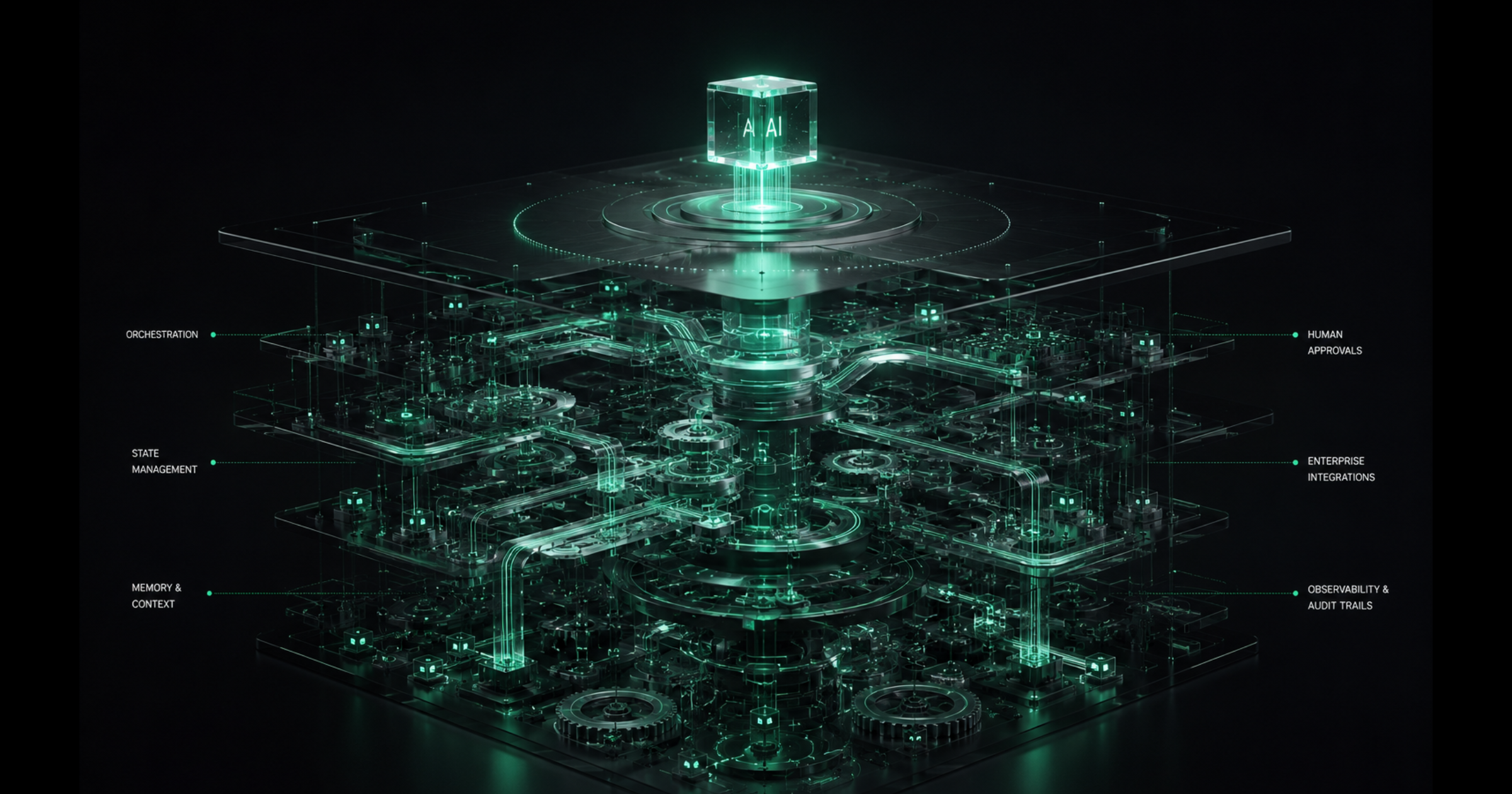
Production-ready AI depends on durable state, orchestration, memory management, enterprise integrations, human governance, failure recovery, observability, and security.
Organizations that recognize this are moving beyond isolated AI experiments and building systems capable of delivering measurable business outcomes at scale.
Enterprise AI isn't fundamentally an AI problem.
It's a distributed systems problem, with AI at its core.
Frequently Asked Questions
Is prompt engineering enough to build a production AI agent? No. Prompt engineering improves how a model responds to individual requests, but production AI also requires orchestration, persistent state, memory management, governance, enterprise integrations, recovery mechanisms, and auditability.
What's the difference between memory and business state? Memory stores conversational context and task history to help an AI agent reason effectively. Business state represents authoritative enterprise data maintained in systems such as CRMs, ERPs, and operational databases. Memory should support decisions, not replace the system of record.
Why do enterprise AI projects fail after successful pilots? Many pilots prove that a model can complete a task. Production systems must also manage integrations, governance, human oversight, failure recovery, scalability, and compliance. These engineering challenges, not model capability, are often what prevent organizations from moving beyond proof of concept.
Do AI agents always need human approval? No. Low-risk activities can often execute autonomously. Human approval is most valuable for high-impact actions such as financial transactions, contract changes, customer-facing commitments, or updates to enterprise systems.
What makes enterprise AI different from traditional workflow automation? Traditional automation executes predefined sequences of steps. Enterprise AI agents make dynamic decisions, select tools, reason across changing contexts, and adapt workflows in real time, requiring more sophisticated orchestration and governance.
Why is observability important for AI agents? Standard application monitoring reports system health and performance. AI observability explains how decisions were made, which tools were used, what information influenced the outcome, and how workflows progressed. This transparency is essential for debugging, compliance, governance, and building long-term trust in enterprise AI systems.