Every enterprise AI conversation eventually reaches the same conclusion:
"We need more data."
But for most organizations, that isn't the real problem.
Large enterprises have spent years, often decades collecting customer records, financial transactions, operational metrics, contracts, support tickets, product information, and internal documentation. They have invested heavily in ERP systems, CRM platforms, data warehouses, business intelligence tools, and cloud infrastructure.
The data already exists.
What doesn't exist is a shared understanding of how that data relates.
A customer record sits in one system. Contracts live somewhere else. Financial data is stored in another application. Product information resides in yet another database. Each system understands its own world, but none understands the business as a whole.
This is why many AI initiatives struggle to move beyond simple search or document summarization. AI can only reason with the context it has, and most enterprises haven't built that contextual layer.
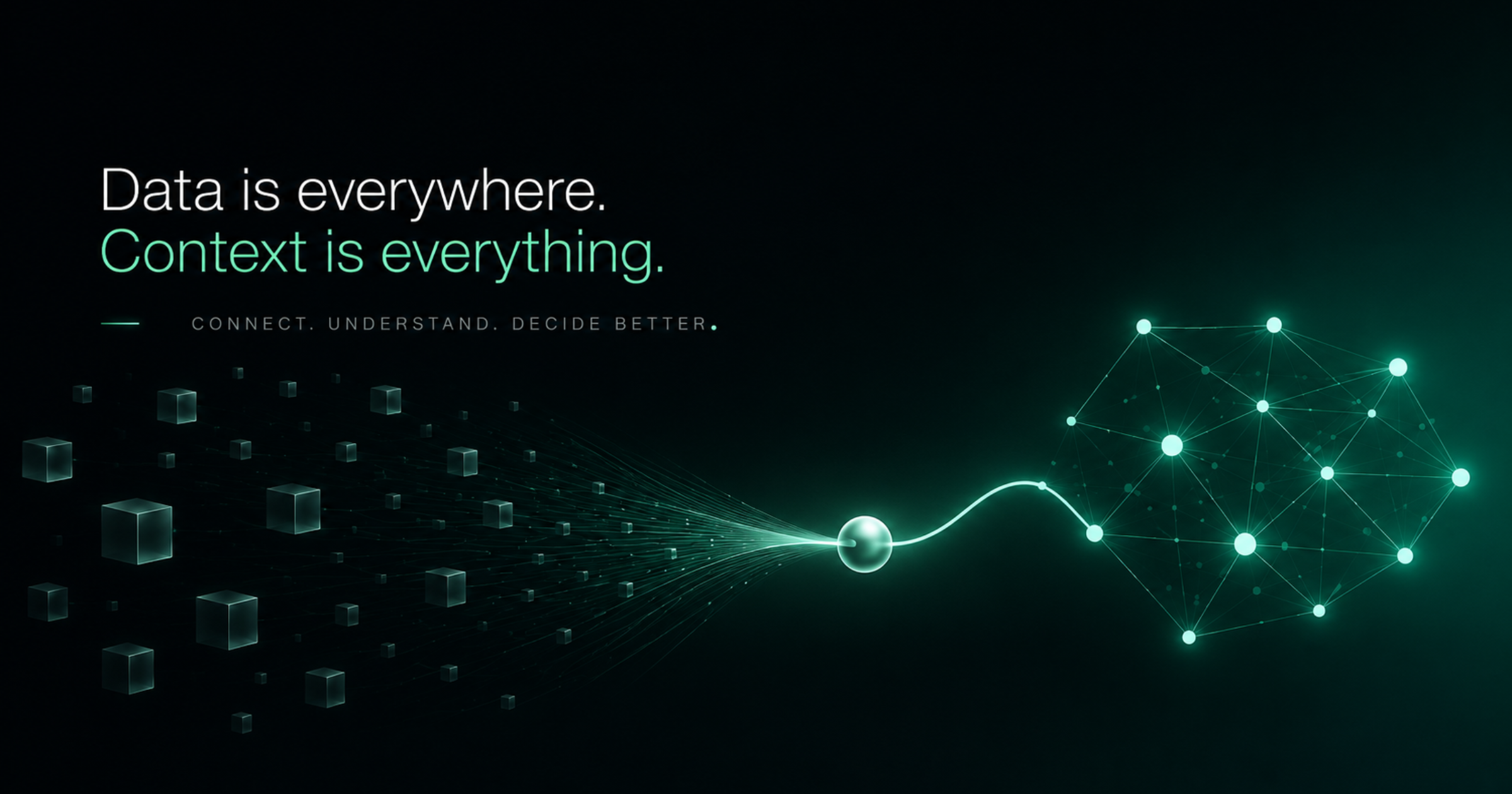
The future of enterprise AI isn't about collecting more information. It's about connecting the information you already have.
The Missing Layer in Enterprise AI
Most enterprise software was designed to record transactions.
Today's AI is expected to support decisions.
Those are fundamentally different objectives.
Imagine an executive asking:
"Why did customer retention decline in the Northeast last quarter?"
The answer rarely lives in one database.
It may involve:
- CRM opportunities
- Customer support interactions
- Marketing campaigns
- Product usage
- Pricing adjustments
- Delivery delays
- Supplier disruptions
- Contract renewals
Every system holds a piece of the story.
None of them understands the complete narrative.
This raises an increasingly common question businesses ask when adopting AI:
Why isn't enterprise data enough for AI?
Because AI needs more than information, it needs relationships.
Without understanding how customers, products, suppliers, contracts, employees, and business processes connect, AI retrieves isolated facts instead of meaningful business insights.
Why Traditional RAG Isn't Enough
Retrieval-Augmented Generation (RAG) has become one of the most popular architectures for enterprise AI because it grounds language models using enterprise documents.
For many use cases, it's highly effective.
Examples include:
- Finding company policies
- Summarizing documentation
- Answering HR questions
- Searching contracts
- Retrieving technical documentation
But enterprises rarely stop there.
Business leaders ask more complex questions.
Questions like:
- Which suppliers are affecting our highest-value customers?
- Which applications support this business process?
- Which products are impacted by delayed manufacturing?
- Which customer accounts are most at risk because of recent service issues?
These aren't document questions.
They're relationship questions.
Documents contain information.
Businesses operate through relationships.
This naturally leads to another important question:
What's the difference between RAG and a Knowledge Graph?
Traditional RAG retrieves relevant documents based on semantic similarity.
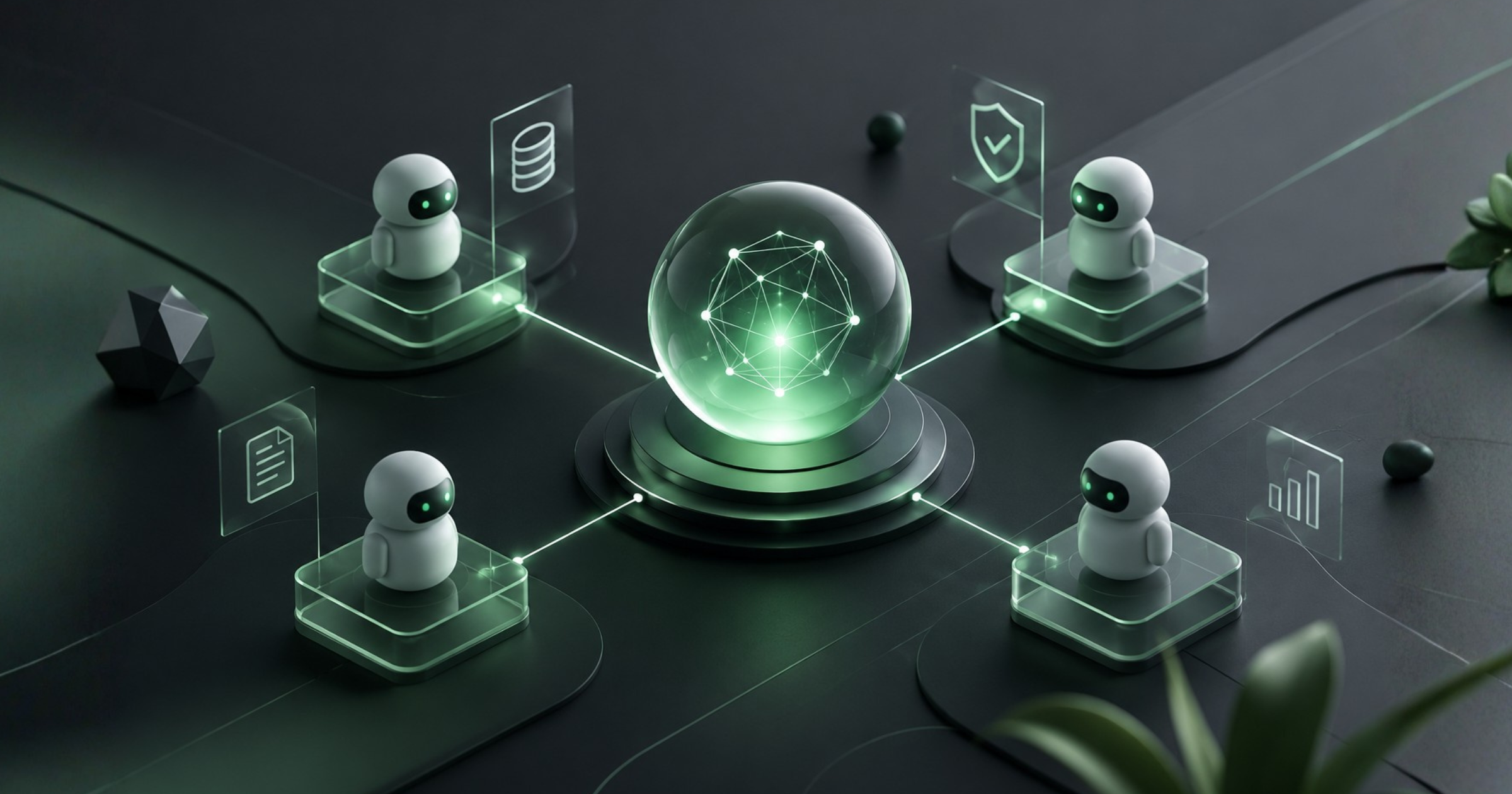
A Knowledge Graph represents entities, such as customers, suppliers, products, employees, locations, and business processes, and the relationships between them.
Rather than retrieving disconnected documents, AI can navigate connected business knowledge.
The two approaches aren't competitors. In many enterprise architectures, they complement one another. RAG provides relevant content, while Knowledge Graphs provide the context needed to interpret that content accurately.
Context Is What Makes AI Useful
Data tells you what happened.
Context explains why it happened.
Consider a customer record.
Without context, AI sees:
- Customer ID
- Purchase history
- Contact information
With context, AI understands:
- Active contracts
- Regional sales teams
- Open support cases
- Parent and subsidiary relationships
- Recent product issues
- Payment history
- Renewal dates
- Strategic account importance
That's the difference between retrieving information and supporting decisions.
Another common enterprise question is:
Why is context important in enterprise AI?
Because context gives business meaning to data.
It allows AI to understand dependencies, organizational structure, ownership, business processes, and relationships that don't exist inside individual documents or databases.
Without context, AI answers questions.
With context, AI understands the business.
Knowledge Graphs Connect Enterprise Knowledge
Knowledge Graphs organize enterprise information around entities and their relationships.
Instead of treating systems as isolated silos, they create a connected representation of how an organization operates.
Customers connect to contracts.
Contracts connect to products.
Products connect to suppliers.
Suppliers connect to manufacturing.
Manufacturing connects to logistics.
Logistics connects to customer experience.
That connected network becomes the foundation upon which AI can reason.
Rather than asking:
"Show me invoices."
An executive can ask:
"Which delayed suppliers are affecting customers with contracts renewing next quarter?"
The answer requires relationships-not keywords.
Knowledge Graphs provide those relationships.
Decision Intelligence Starts with Connected Data
Business intelligence explains the past.
Decision Intelligence helps organizations determine what to do next.
Instead of asking:
- What happened?
Organizations begin asking:
- Why did it happen?
- What caused it?
- What will it impact?
- What action should we take?
These questions require AI to understand how multiple business systems interact.
This often leads to another search query organizations ask:
What is Decision Intelligence?
Decision Intelligence combines connected enterprise data, business rules, AI, and contextual reasoning to help organizations make more informed operational and strategic decisions.
It moves beyond reporting by helping businesses understand cause, impact, and recommended actions.
Enterprise AI Needs Organizational Memory
Every company has organizational knowledge.
It exists inside people.
Inside meetings.
Inside documentation.
Inside decades of operational decisions.
Very little of it exists in a form AI can understand.
When experienced employees leave, much of that context disappears with them.
Knowledge Graphs help organizations preserve that organizational memory by representing relationships between systems, processes, and business entities in a structured way that AI can use.
That context becomes increasingly valuable as enterprises adopt AI assistants, copilots, and autonomous agents.
Bringing Enterprise Context Together with IkyaData
Understanding the value of connected enterprise knowledge is one challenge.
Building it is another.
This is where IkyaData, developed by Lektik, fits into the enterprise AI landscape.
Rather than asking organizations to replace existing systems, IkyaData creates a unified intelligence layer across enterprise data sources, allowing businesses to query information through natural language while preserving the relationships that give that information meaning.
Instead of moving data into another silo, the focus is on connecting what's already there.
The result is AI that understands enterprise context rather than simply retrieving isolated records.
Learn more about IkyaData here:
As the team behind IkyaData, Lektik works with enterprises to design AI solutions that are grounded in connected business knowledge rather than disconnected datasets. The objective isn't simply to deploy AI; it is to make AI genuinely useful for enterprise decision-making.
The Competitive Advantage Isn't More Data
Most enterprises already possess the raw material needed for AI.
The challenge is making that information understandable.
Organizations that continue treating enterprise systems as isolated repositories will struggle to move beyond basic AI use cases.
Organizations that invest in connected knowledge, contextual relationships, and decision intelligence will build AI capable of supporting meaningful business decisions.
The future of enterprise AI belongs to organizations that understand one simple truth:
Your enterprise doesn't need more data. It needs more context.
Frequently Asked Questions
What is enterprise context?
Enterprise context is the business meaning that connects data across systems. It includes relationships between customers, products, suppliers, employees, contracts, processes, and organizational structures, allowing AI to understand how information fits together.
Why isn't more enterprise data enough for AI?
Most enterprises already have sufficient data. The challenge is that information is distributed across disconnected systems. Without understanding the relationships between those systems, AI retrieves isolated facts rather than meaningful business insights.
What is the difference between RAG and a Knowledge Graph?
RAG retrieves relevant documents using semantic search.
Knowledge Graphs organize entities and their relationships, enabling AI to reason across connected enterprise knowledge.
Many enterprise AI platforms use both approaches together.
How do Knowledge Graphs improve AI?
Knowledge Graphs help AI understand relationships between business entities, improve retrieval accuracy, reduce hallucinations, support explainability, and enable complex multi-system reasoning.
What is Decision Intelligence?
Decision Intelligence combines AI, connected enterprise data, business rules, analytics, and contextual reasoning to help organizations make better operational and strategic decisions.
Can Knowledge Graphs work with existing enterprise systems?
Yes. Knowledge Graphs are designed to connect information across existing systems such as ERP, CRM, HR, finance, operations, and document repositories without necessarily replacing those platforms.
How does IkyaData support enterprise AI?
IkyaData provides a connected intelligence layer across enterprise systems, allowing organizations to ask natural language questions while preserving business context, relationships, and organizational knowledge. Learn more at https://www.ikyadata.com/.
What role does Lektik play in enterprise AI?
Lektik builds enterprise AI products and digital solutions that help organizations transform disconnected enterprise information into connected, decision-ready intelligence. IkyaData is one example of this approach, enabling businesses to make better use of the data they already own.