Enterprise AI Isn't an AI Problem. It's a Distributed Systems Problem with AI Inside It.
Executive Summary
Enterprise AI agents are rapidly moving from prototypes to production. Yet many organizations still evaluate them based on how impressive they look in a demo rather than how reliably they perform in the real world.
A production AI agent isn't simply a language model responding to prompts. It's an orchestrated system that must maintain context, coordinate multiple services, recover from failures, integrate with enterprise systems, respect governance policies, and produce an auditable trail for every decision it makes.
This is why so many AI initiatives stall after successful pilots. The challenge isn't building an intelligent model, it's engineering everything around it.
The organizations creating lasting value with AI aren't investing only in better prompts. They're investing in resilient architectures that allow AI agents to operate safely, reliably, and at enterprise scale.
The Demo Ends Where the Real Engineering Begins
Everyone is talking about AI agents. Almost nobody is talking about the engineering required to keep them alive in production.
A demo AI agent answers a question.
A production AI agent survives uncertainty.
It handles API failures at 2 a.m. It resumes workflows after infrastructure outages. It remembers the context of conversations that started days ago. It pauses when a human approval is required, retries failed operations without creating duplicate transactions, and logs every decision for future audits.
Those capabilities rarely appear in product demonstrations, yet they determine whether an AI initiative succeeds or quietly disappears after a pilot.
This explains why organizations often mistake model capability for production readiness.
A language model may perform exceptionally well during controlled testing, but once it becomes part of a live business process, it inherits every challenge of modern distributed software systems network failures, inconsistent data, concurrent updates, security requirements, compliance obligations, and operational complexity.
The intelligence of the model becomes only one component of a much larger engineering challenge.
Executive Insight
Enterprise AI projects don't usually fail because the model is incapable.
They fail because the surrounding architecture wasn't designed for production.
Why Prompt Engineering Is Only One Piece of Enterprise AI
Prompt engineering has become one of the most discussed aspects of generative AI.
It deserves attention, but not disproportionate attention.
A prompt influences how a model responds to a single request.
Enterprise AI, however, is rarely a single request.
Real business processes involve dozens of interconnected decisions spread across multiple systems, users, and workflows. An agent may retrieve customer information, verify inventory, request approval, update an ERP, notify another department, generate documentation, and continue the workflow hours or even days later.
Each of those steps introduces additional operational complexity.
A perfectly optimized prompt cannot solve:
- Workflow orchestration
- State persistence
- Retry management
- Human approvals
- Integration failures
- Governance
- Security controls
- Auditability
As workflows become longer, reliability becomes more important than prompt quality.
Even small failure rates compound rapidly when agents execute multiple decisions sequentially. A workflow consisting of twenty successful individual actions can still fail if only one critical step breaks.
This is why enterprise AI engineering increasingly focuses on orchestration rather than prompt optimization.
What Actually Powers a Production AI Agent?
Behind every successful enterprise AI deployment is an architecture that users never see.
While the language model provides reasoning capabilities, the surrounding infrastructure enables the system to operate reliably under real business conditions.
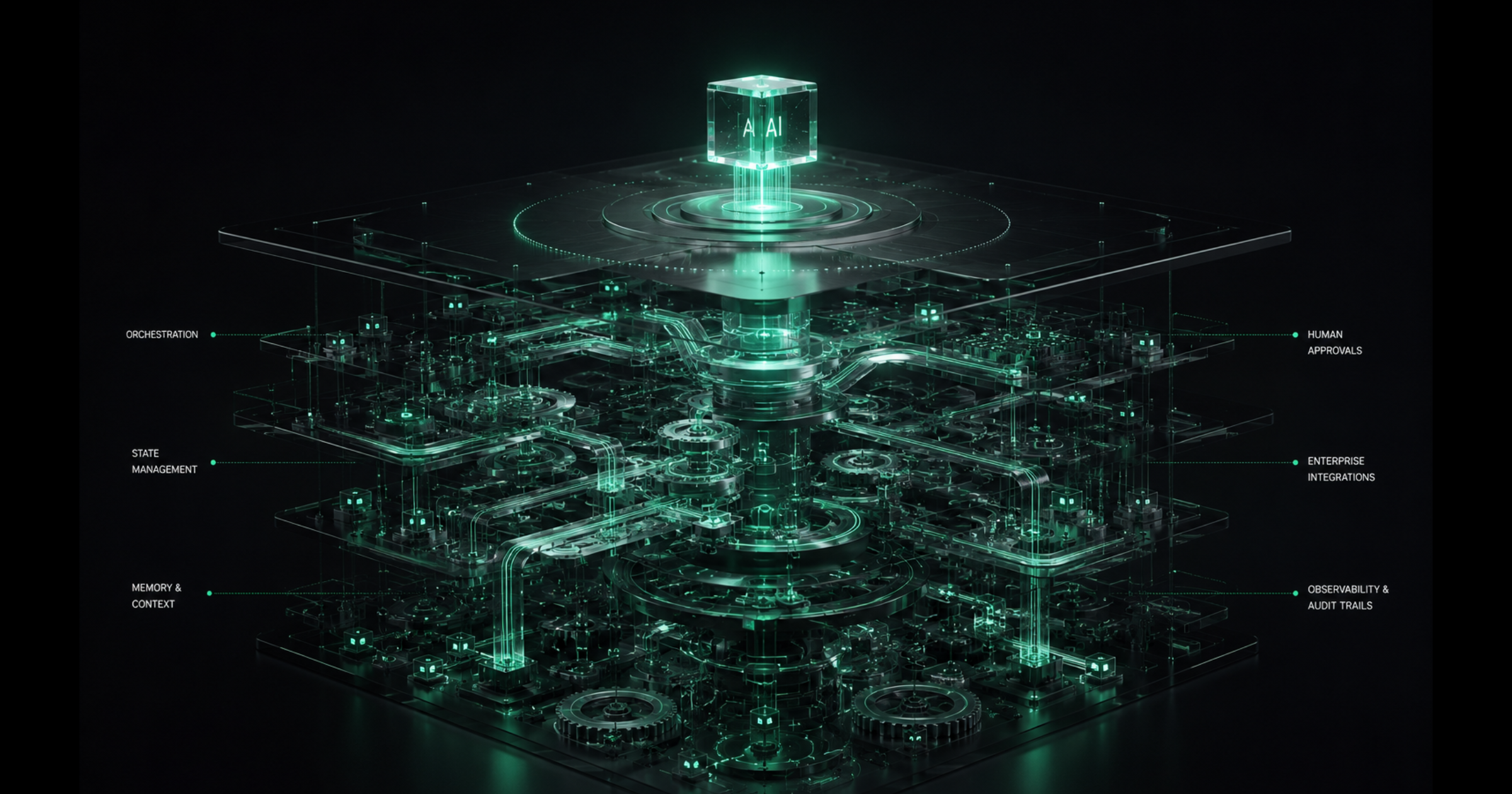
A typical production AI agent includes several foundational layers.
1. State Management
The agent needs to understand:
- Where a workflow currently is
- What has already happened
- Which decisions have been made
- What still needs to happen
Without persistent state, every interruption forces the workflow to start over.
2. Workflow Orchestration
An orchestration engine determines:
- Which tool should execute next
- Which API should be called
- When to retry failures
- When to escalate to humans
- How different agents collaborate
Rather than simply generating text, enterprise agents coordinate entire business processes.
3. Memory Management
Enterprise agents require memory, but not in the way many people assume.
Conversation history, task context, user preferences, and previous reasoning all need to persist across sessions.
This enables an agent to continue work long after the original interaction has ended.
4. Human Approval Gates
Not every decision should be autonomous.
Certain actions-such as approving payments, modifying contracts, updating customer records, or executing financial transactions-require human validation before the workflow continues.
Production systems are designed with these intervention points from the beginning rather than adding them later.
5. Enterprise Integrations
AI agents rarely operate in isolation.
They interact continuously with:
- CRM platforms
- ERP systems
- Internal APIs
- Knowledge repositories
- Identity providers
- Business databases
Reliable integrations often require far more engineering effort than the AI model itself.
6. Observability and Audit
Every enterprise decision must be explainable.
Organizations need to know:
- Why the agent acted
- Which information it used
- Which tools were called
- What decisions were made
- Who approved exceptions
- How the workflow reached its outcome
Without comprehensive observability, debugging, governance, and compliance become nearly impossible.
Key Takeaway
The language model is the reasoning engine.
Everything surrounding it determines whether it can be trusted in production.
Designing AI for Long-Running Business Processes
Traditional chatbots operate within a single conversation.
Enterprise workflows do not.
Consider an insurance claim.
The process may begin on Monday, pause for document verification on Tuesday, wait for a supervisor's approval on Wednesday, and complete the following week after payment authorization.
The AI agent must preserve every decision throughout that journey.
It cannot rely on the limited context window of an LLM.
Instead, it requires durable state that survives deployments, server restarts, infrastructure failures, and extended periods of inactivity.
Without persistent state, every interruption resets the workflow and forces users to repeat work that has already been completed.
This becomes even more critical in industries such as healthcare, finance, logistics, and manufacturing, where business processes naturally extend across multiple teams and systems.
Orchestration Is the Real Intelligence Layer
One of the biggest misconceptions about AI agents is that the language model makes every decision independently.
In reality, orchestration often becomes the most valuable layer in the entire system.
The orchestration engine determines:
- Which specialist agent should execute next
- Which enterprise system should be queried
- Whether confidence thresholds have been met
- Whether additional context is required
- Whether human approval is necessary
- Whether execution should stop entirely
Modern enterprise deployments increasingly rely on multiple specialized agents rather than one general-purpose assistant.
A supervisor agent may coordinate sales, compliance, procurement, and finance agents, each responsible for a specific domain while sharing information through controlled communication channels.
This approach improves reliability, reduces hallucinations, and allows organizations to apply governance policies independently to each capability.
Human Oversight Is an Architectural Decision
One of the most important design questions isn't whether AI should replace people. It's where AI should stop and humans should take over.
Low-risk tasks such as summarizing documents or retrieving information may execute autonomously. High-impact decisions should not.
Organizations typically require approval before an agent can:
- Approve financial transactions
- Modify contracts
- Change customer records
- Execute procurement decisions
- Update systems of record
- Trigger external communications
These approval gates are not temporary safeguards.
They are permanent components of responsible enterprise architecture.
The most mature AI systems are not fully autonomous.
They are carefully designed partnerships between intelligent automation and human judgment.
Understanding enterprise AI architecture is only half the story.
In Part 2, we'll dive into the engineering challenges that emerge after deployment—including recovery, integrations, observability, and the operational capabilities required to keep AI agents reliable in production.
Frequently Asked Questions What makes a production AI agent different from a demo? A demo AI agent answers a question. A production AI agent manages long-running workflows, handles failures, integrates with enterprise systems, and keeps every decision traceable.
Is prompt engineering enough for enterprise AI? No. Prompts improve model responses, but production AI also requires orchestration, state management, governance, integrations, and observability.
What infrastructure does a production AI agent need? Beyond the LLM, it needs state management, workflow orchestration, memory, enterprise integrations, human approval gates, and audit logging.
What is state management in AI agents? State management allows an agent to remember where a workflow is, what has already happened, and what needs to happen next-even after interruptions.
Why is orchestration important? Orchestration coordinates tools, APIs, workflows, and decisions, ensuring the right actions happen in the right order and failures are handled safely.
Do AI agents always need human approval? No. Human approval is typically reserved for high-impact actions such as payments, contracts, customer records, or other critical business decisions.
Why are long-running workflows more challenging? Unlike chatbots, enterprise workflows can span hours or days. AI agents must retain context, resume after interruptions, and coordinate across multiple systems.
Why do AI projects often fail after successful demos? Because production environments introduce challenges like system failures, governance, integrations, and compliance that demos don't typically account for.
What's the biggest challenge in enterprise AI? The biggest challenge isn't the language model-it's engineering the infrastructure that makes AI reliable, secure, and scalable in production.
What's the key takeaway from this article? Enterprise AI succeeds when organizations engineer the systems around the model. The LLM is only one component of a much larger production architecture.