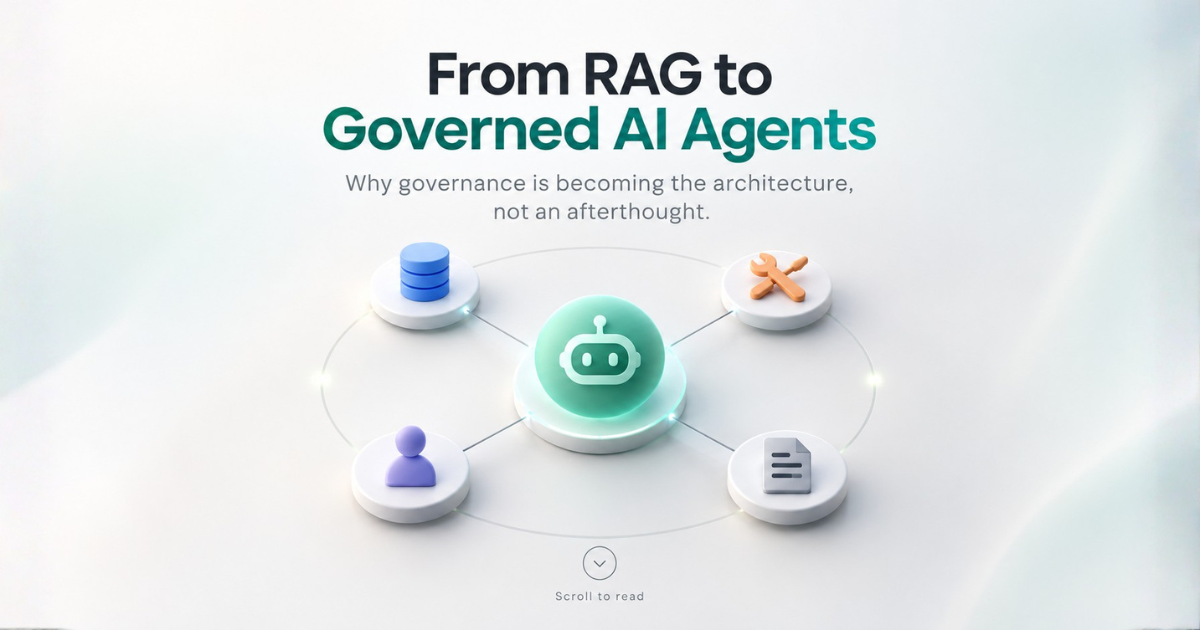
TL;DR: RAG addressed one of the first big enterprise AI challenges: grounding LLMs in the right information. The next challenge is harder: controlled autonomy. As enterprises move AI systems from answering questions to taking actions, the architecture has to change with them. Gartner predicts that by 2027, 40% of enterprises will demote or decommission autonomous AI agents due to governance gaps identified only after production incidents occur. The organizations pulling ahead aren't the ones with the most capable agents - they're the ones that engineered governance into the stack from the start. This is the infrastructure shift Lektik builds for.
Why RAG Was Never the Finish Line
RAG earned its place in the enterprise stack by solving a specific, painful problem: language models confidently making things up. Ground the model in retrieved documents, and hallucination drops. That was the win, and for a narrow band of use cases - internal search, document Q&A, support deflection - it was enough.
Why are enterprises moving away from standalone RAG systems? Because standard RAG follows a fixed sequence: retrieve once, generate once, stop. There's no evaluation loop, no retry logic, and no mechanism to recognize when the first retrieval pass missed context sitting two hops deeper in the data. Forrester's research on RAG adoption identifies this gap between simple document retrieval and true multi-step reasoning as the recurring limitation enterprises hit once they move past basic Q&A use cases. The architecture wasn't broken - it was just answering a narrower question than the business actually needed answered.
That gap is what pushed the market toward agentic RAG: instead of a static pipeline, the system becomes a reasoning loop. The agent plans a retrieval strategy, selects tools, evaluates whether it has enough context, and iterates until it does. Retrieval stops being a predetermined step and becomes a tool the agent decides how to use.
From Retrieval to Action: What "Agentic" Actually Changes
What's the difference between RAG and an AI agent? RAG answers questions using retrieved context. An agent plans, decides, uses tools, and executes multi-step tasks toward an objective - often with minimal human input at each step. That distinction matters more than it sounds, because it changes what can go wrong. A RAG system that misses context gives a bad answer. An agent that misreads its scope can take a wrong action: submit a payment, close a ticket incorrectly, push a change to a live system. The failure mode moves from "wrong words" to "wrong actions," and enterprise risk tolerance for the second one is much lower.
Momentum toward agentic deployment is real and fast. Gartner forecasts that 40% of enterprise applications will be integrated with task-specific AI agents by the end of 2026, up from less than 5% in 2025 - one of the steepest adoption curves the firm has tracked. But adoption and value capture are not the same curve. McKinsey's research finds that while nearly two-thirds of enterprises worldwide have experimented with agents, fewer than 10% have scaled them to deliver tangible value, and eight in ten cite data limitations as the roadblock. The pattern is consistent: the technology moves fast, the foundation underneath it doesn't move at all, and the gap between the two is where pilots stall.
Why do most agentic AI pilots fail to scale? Not because the models aren't capable enough. It's almost always the same three gaps: fragmented data that agents can't reliably access, no clear scope or process definition for what the agent is actually allowed to do, and no governance layer to catch a failure before it becomes an incident. This is precisely the "process before tools" problem Lektik has argued from day one - an agent bolted onto an undefined process just automates the ambiguity faster.
Governance Isn't a Feature - It's the Architecture
Here's the finding that should reset how most enterprises are thinking about their agent roadmap: only 17% of organizations have deployed AI agents to date, according to the 2026 Gartner CIO and Technology Executive Survey, cited in Gartner's 2026 Hype Cycle for Agentic AI - yet more than 60% expect to do so within the next two years. That gap between ambition and execution is exactly where governance maturity needs to catch up before deployment outpaces it.
What does "governed AI agent" mean in practice? It means the system's ability to act and the scope of access it's granted are treated as two separate, deliberately engineered decisions - not a single on/off switch. Gartner has been explicit that this distinction is where most failures originate: applying uniform governance across every agent, regardless of its autonomy level or scope, is itself a failure mode. A customer-support agent answering FAQs and a finance agent approving invoices should never sit under the same governance policy. Undifferentiated control either strangles low-risk agents with unnecessary friction or leaves high-risk agents dangerously under-supervised.
The 2026 Gartner Hype Cycle for Agentic AI reflects this directly: governance, security, and cost-focused capabilities are now emerging as their own category alongside the core agent technologies - a signal that the market has stopped treating governance as a compliance afterthought and started treating it as core infrastructure.
How much autonomy should an enterprise AI agent have? As much as the task's risk profile and the organization's audit requirements can support - scoped explicitly, per agent, and re-evaluated as the agent's role expands. Autonomy isn't a maturity badge to maximize; it's a variable to engineer deliberately, task by task.
Why Human-in-the-Loop Is a Design Principle, Not a Limitation
As agent systems move from generating text to taking action, the risk calculus changes in a way many enterprise AI strategies haven't caught up to. Organizations can no longer worry only about a system saying the wrong thing - they now have to account for systems doing the wrong thing: taking an unintended action, misusing a tool, or operating past the boundary of its intended guardrail. McKinsey's "State of AI Trust in 2026" names this explicitly as the defining risk shift of the agentic era, finding that security and risk concerns are the top barrier organizations cite when trying to scale agentic AI.
This is exactly where Lektik's build philosophy already sits. Human-in-the-loop design isn't a hedge against AI capability - it's a deliberate architectural checkpoint that keeps high-consequence decisions inside human authority while letting the agent handle the surrounding execution at machine speed. Done well, it doesn't slow a system down; it's what makes an enterprise comfortable letting the system run in the first place.
What Does an Enterprise Need Before Deploying AI Agents in Production?
Four things, in order:
- Connected, real-time data architecture. Agents can't reason well over fragmented systems. Data readiness is consistently the number-one blocker cited across the research.
- Explicit, scoped process definitions. What is this agent allowed to decide versus escalate? That answer should exist before a single line of agent logic is written.
- Differentiated governance by risk tier. Low-risk, high-volume tasks get lighter controls; high-consequence actions get tighter scope, audit trails, and human checkpoints - not the same policy applied everywhere.
- Orchestration across agents and tools, not point deployments. A single well-governed agent bolted onto a messy stack still fails at the seams. The value comes from connected systems - automation, data, and communication working as one architecture, not scattered tools.
This is the layer Lektik builds. Not a model, not a chatbot skin - the specification-first, process-before-tools engineering underneath agentic systems, with governance and human-in-the-loop checkpoints designed in from the first architecture decision rather than added after a production incident forces the issue. The enterprises that treat governance as infrastructure now are the ones who won't be part of Gartner's 40% demotion-and-decommission statistic in 2027.
FAQ
1. What's the difference between RAG and an AI agent? RAG retrieves relevant documents and generates an answer grounded in them - a single, fixed pass. An AI agent plans, makes decisions, selects tools, and executes multi-step actions toward a goal, often continuing to reason and retrieve until it has sufficient context, not just once.
2. Why are enterprises moving away from standalone RAG toward agentic architectures? Standard RAG can't handle multi-step reasoning across fragmented, heterogeneous data sources - a limitation enterprises consistently hit once they move past basic Q&A use cases. Agentic architectures add an evaluation and retry loop that standard RAG lacks.
3. What does "governed AI agent" mean? An agent whose autonomy level and access scope are deliberately engineered and differentiated by task risk - not a single blanket governance policy applied uniformly across every agent in the enterprise.
4. Why do most agentic AI pilots fail to scale past a proof of concept? Fragmented data, undefined process scope, and missing governance infrastructure - not model capability - are the consistent root causes cited across Gartner and McKinsey research.
5. How much autonomy should an enterprise AI agent be given? As much as its specific task's risk profile and audit requirements support, set explicitly per agent - not maximized by default and not held constant as the agent's responsibilities grow.
6. What does an enterprise need in place before deploying AI agents in production? Connected real-time data architecture, explicit process definitions, risk-differentiated governance, and cross-agent orchestration - the foundation has to precede the deployment, not follow it.