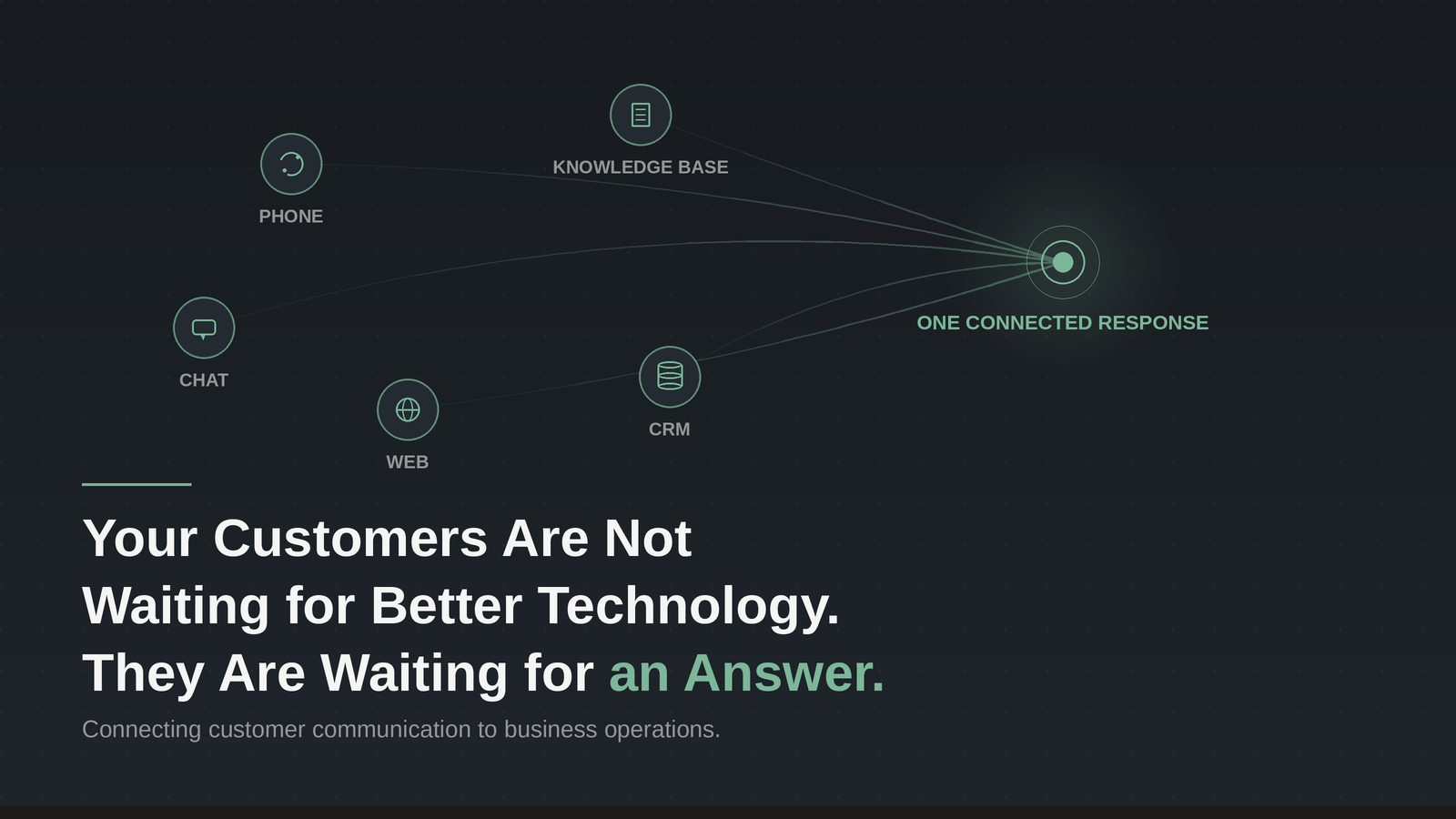
For the last few years, a lot of enterprise AI started with the same idea: build a chatbot.
A customer-support assistant. An internal Q&A tool. A copilot added to an existing application.
That made sense. Chat was familiar, relatively easy to demonstrate, and gave companies a quick way to experiment with generative AI.
But in 2026, the conversation has moved on.
The organizations getting real value from AI are no longer asking only:
“What can the AI tell us?”
They are asking:
“What work can the AI actually help us complete?”
That shift - from AI as a conversational feature to AI as part of the operating infrastructure of a business - is where enterprise AI is heading.
The Limitation Was Never Chat. It Was the Architecture.
Chat interfaces are not disappearing.
In fact, chat will continue to be one of the easiest ways for people to interact with AI.
But a chat window by itself is not an AI strategy.
Many early enterprise AI systems were primarily designed to retrieve information, summarize documents or generate responses. They were useful, but disconnected from the systems and workflows where the actual work happened.
Production AI requires more.
Persistent business context
A useful enterprise AI system needs more than the current conversation.
It may need to understand previous interactions, customer history, workflow state, business rules, decisions already made and what should happen next.
Simply sending a long conversation history back to an LLM is not the same as designing reliable memory and state.
Ability to act, not just answer
There is a major difference between:
“Your customer's order is delayed.”
and:
“The order is delayed. I updated the CRM, created the escalation, informed the account manager and prepared the customer notification for approval.”
The second requires tools, APIs, permissions, business logic and orchestration around the AI model.
Operational accountability
Once AI starts taking actions, companies need to know:
- What did the AI do?
- What information did it use?
- What was it allowed to access?
- Why was the action taken?
- Did it require human approval?
- Who owns the outcome if something goes wrong?
These are architecture questions, not prompting questions.
Measurable business value
The number of prompts submitted or conversations started is not a meaningful enterprise outcome.
Production AI should eventually connect to metrics the business already cares about:
Cycle time. Resolution time. Conversion. Cost per transaction. Accuracy. Revenue. Productivity.
The question is no longer whether employees are using AI.
The question is whether AI is improving how the business operates.
What Production Enterprise AI Looks Like
The more mature AI systems we see emerging today tend to share a few characteristics.
1. Agentic execution
AI is moving beyond generating answers toward coordinating multi-step work.
An agent might retrieve information, call an API, compare options, update a system, generate a document and ask a human for approval before completing the final action.
The model is only one component of that process.
2. Grounded business context
Enterprise AI cannot depend only on what an LLM already knows.
It needs access to trusted business information:
- operational databases
- documents
- APIs
- CRM and ERP data
- company policies
- historical decisions
- user permissions
- workflow state
Depending on the problem, that may involve RAG, structured databases, semantic search, knowledge graphs or direct API access.
The important part is not the technology label.
It is whether the AI is working from the right information.
3. Governance, identity and auditability
When AI can take action, permissions become critical.
An agent should not automatically inherit unlimited access simply because an employee can use it.
Production systems need clear boundaries around:
- what the AI can read
- what it can change
- which actions require approval
- what information is restricted
- how actions are logged
- when the system should escalate to a human
AI governance is becoming an operating requirement, not just a compliance exercise.
4. Integration-first design
The best AI system may not even look like an AI product.
It could appear inside a CRM.
A field application.
A procurement dashboard.
A healthcare workflow.
A finance platform.
Or it might operate quietly in the background and involve a human only when something needs review.
The interface matters less than whether the AI fits naturally into how the organization already works.
5. Measurable outcomes
A production system needs a business metric attached to it.
Did the AI reduce processing time?
Did it increase the number of cases handled?
Did it improve extraction accuracy?
Did it reduce manual work?
Did it improve conversion?
Did it catch errors before they reached customers?
That is ultimately what separates an interesting AI demo from useful infrastructure.
The Enterprise AI Stack Is Getting Bigger
One of the biggest changes in 2026 is that the LLM is becoming just one layer of the overall architecture.
A production enterprise AI stack increasingly looks something like this:
1. Data and knowledge
Clean, connected and permissioned structured and unstructured business information.
If this layer is unreliable, the AI built above it will also be unreliable.
2. Context and memory
The information required to understand the current user, task, workflow and relevant history.
This can include both structured state and semantic memory.
3. Intelligence
LLMs such as OpenAI, Claude or Gemini, along with specialist models for areas such as computer vision, classification or forecasting.
The right architecture may use multiple models rather than forcing every task through one provider.
4. Orchestration and tools
Agents, APIs, business rules, MCP connections, workflows and deterministic services that allow AI to perform real tasks.
This is where an AI answer starts becoming an AI action.
5. Experience
Chat is one interface.
But AI can also be embedded into mobile applications, dashboards, enterprise software, voice systems and background workflows.
6. Governance and evaluation
Permissions, audit logs, human approvals, testing, monitoring, tracing, model evaluation and cost controls.
This layer becomes increasingly important as the system is given more autonomy.
The important realization is simple:
The LLM is no longer the architecture. It is one component inside the architecture.
What This Looks Like at Lektik
We see the same shift in the systems we build.
IkyaData
IkyaData addresses one of the hardest parts of enterprise AI: giving AI access to trusted business context.
It connects fragmented enterprise information and creates a consistent intelligence layer so users can interact with operational data using natural language.
The value is not simply “chat with your data.”
The deeper problem is making sure the AI understands the right data, its meaning and the business context around it.
Seequince
Seequince approaches the problem from the workflow side.
It brings workforce and field operations - tasks, assignments, scheduling, progress and reporting - into a structured digital workflow.
This type of operating layer is important because useful AI needs somewhere to act.
AI creates considerably more value when it is embedded into the systems where work already happens rather than being added as a completely separate destination.
These are two different sides of the same production-AI equation:
trusted intelligence + operational workflow.
Six Questions Executives Should Ask Before Starting the Next AI Project
Before deciding on models, frameworks or agent platforms, there are more important questions to answer.
1. What business process are we actually trying to improve?
Start with the workflow, not the AI.
2. What data and systems does the AI need access to?
And equally important: what should it not have access to?
3. What actions should the AI be allowed to take?
Reading information and modifying a system are very different risk levels.
4. What requires human approval?
More autonomy is not automatically better architecture.
The right system knows when it can proceed and when it should stop.
5. What happens when the AI is wrong?
There should be a clear review, escalation and recovery process for important actions.
6. How will we measure whether it worked?
Define the operational metric before building the system.
If these questions cannot be answered, the project probably isn't ready for production yet.
The Bottom Line
The first phase of enterprise generative AI showed companies what AI could say.
The next phase is about what AI can do.
Inside real workflows.
Using trusted business information.
With the right permissions.
With humans involved where they matter.
And with results measured against actual business outcomes.
Chat isn't disappearing.
But the chatbot is becoming the interface rather than the architecture.
And that may be the most important shift happening in enterprise AI right now.
At Lektik, this is how we increasingly approach AI products: not as isolated AI features, but as complete systems spanning data, intelligence, workflow, integration and governance.
Because getting an LLM to generate a good answer is becoming easier.
Building an AI system you can trust to participate in running a business is the harder - and much more valuable - problem.
FAQ: Production Enterprise AI in 2026
What is production enterprise AI?
Production enterprise AI refers to AI systems integrated into real business processes, data and applications rather than being limited to isolated experiments. They may retrieve information, make recommendations, perform actions and coordinate workflows while operating within defined permissions and governance controls.
How is agentic AI different from a chatbot?
A traditional chatbot primarily responds to user requests. An agentic system can coordinate multiple steps, interact with tools and APIs, maintain workflow state and perform actions within defined boundaries. Chat may still be the interface used to control the agent.
Why do enterprise AI pilots struggle to reach production?
Common challenges include poor data quality, weak system integration, unclear business outcomes, insufficient governance and difficulty making probabilistic AI behave reliably inside deterministic business processes.
What should companies evaluate before deploying AI agents?
Companies should clearly define the business process, required data, system permissions, actions the AI can perform, human-approval boundaries, failure and escalation processes, security requirements and how business impact will be measured.