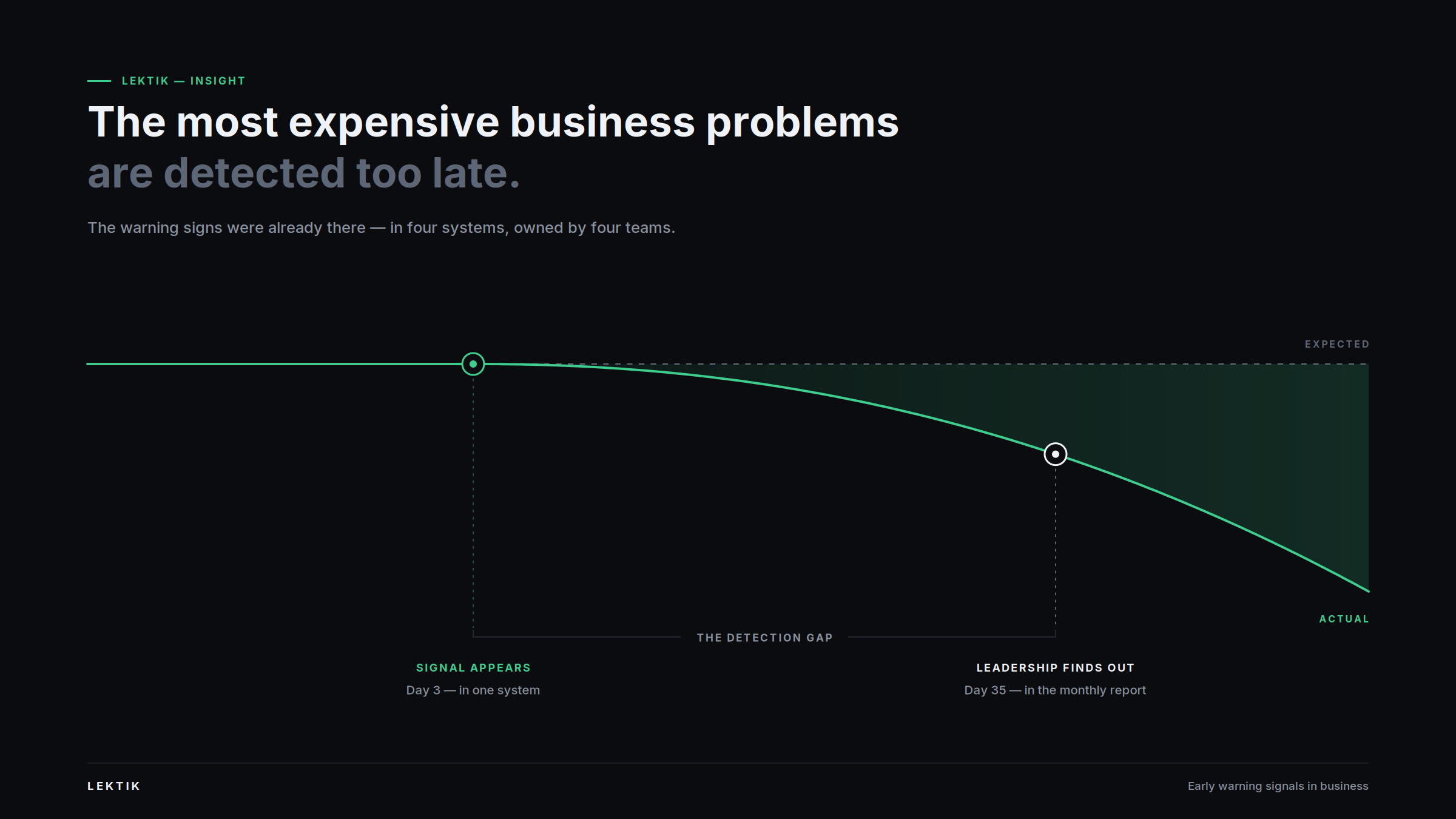
If automation creates more exceptions, more checking and more confusion, it has failed.
Automation is supposed to make work easier.
But in many businesses, it simply makes an existing process run faster — even when that process is already broken.
The better question is not “What can we automate?”
It is:
“How should this process work, and where can automation actually improve it?”
The Problem Isn't Automation. It's What We Automate.
A process can be technically automated and still create more work.
You might have:
- More tools, each handling one small step
- Data duplicated across systems
- Handoffs that fail between teams
- Employees fixing automation errors manually
- Exceptions sitting in shared inboxes
- No clear owner when something goes wrong
Every automation may be working exactly as designed.
The business can still become harder to run.
This is what happens when automation is added on top of a fragmented process instead of fixing the process itself.
A person might catch a duplicate record before it causes a problem. A system can create that same duplicate hundreds of times before anyone notices.
Automation doesn't remove the underlying problem.
It can simply make the problem happen faster.
Task Automation ≠ Business Improvement
This distinction matters more than most automation discussions suggest.
Task automation makes a step faster.
Business improvement changes the process itself — removing unnecessary steps, reducing handoffs, connecting systems and making ownership clear.
That difference shows up in the research too. McKinsey found that workflow redesign had the strongest relationship with EBIT impact among 25 organisational attributes it studied, while only around one in five AI adopters had fundamentally redesigned a workflow.
The goal isn't to automate more tasks. It's to improve how work moves through the business.
Start With the Process, Not the Platform
One of the easiest ways to get automation wrong is to start with technology.
The better starting point is a simple statement:
This process should take X hours, cost Y per transaction, and [named person] owns the outcome.
That immediately gives the programme something to work toward.
Without it, scope expands, exceptions pile up and responsibility gets passed between the business, IT and vendors.
The business should own the outcome.
IT should own the reliability of the technology.
Those are not the same thing.
Not Everything Should Be Automated
Automation maturity isn't about removing humans from every process.
It's about knowing where human judgement still matters.
Keep a human involved when a decision:
- Is difficult to reverse
- Affects someone's rights, credit, care or employment
- Requires context the system cannot see
- Could need to be explained to a regulator or auditor
- Falls below an agreed confidence threshold
Payments, terminations, credit decisions and other high-impact decisions are obvious examples.
For lower-risk, repetitive processes, straight-through automation may make sense.
The key is to make the boundary explicit.
A mature automation strategy knows where the machine should stop.
Measure the Business Result
Automation dashboards often focus on activity:
Tasks completed. Hours saved. Tickets processed.
Those numbers don't tell you whether the business actually improved.
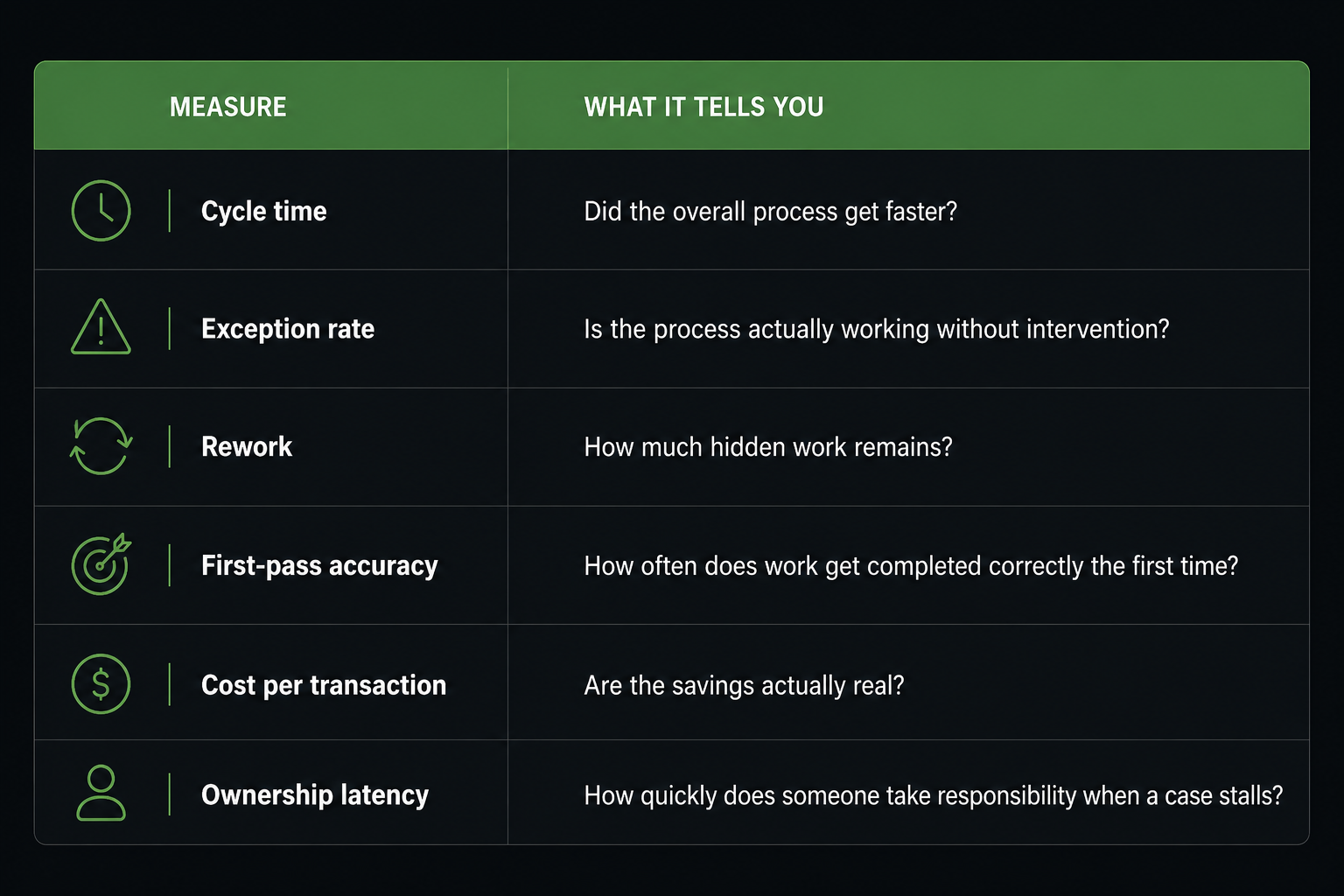
Instead, look at:
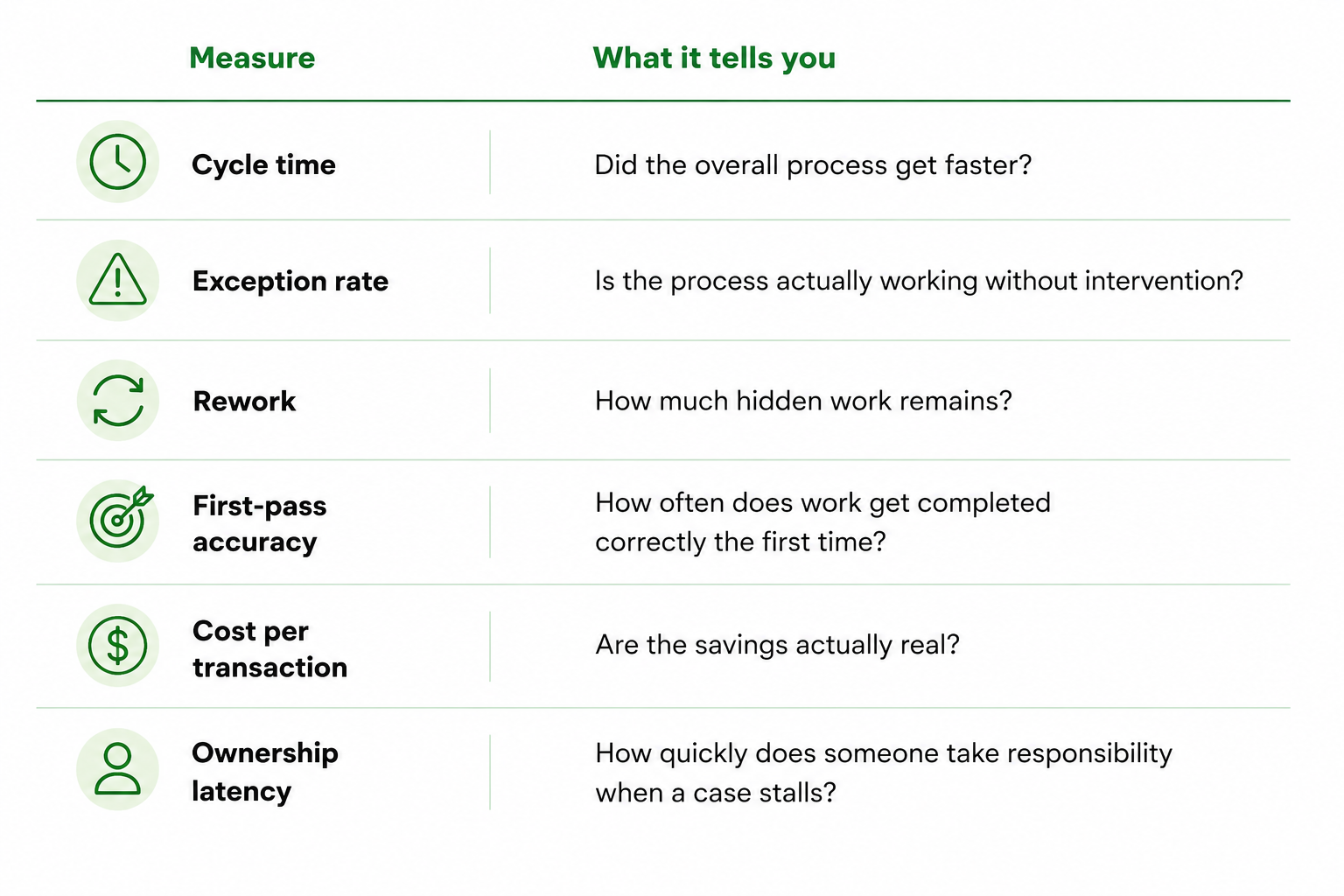
One signal deserves particular attention:
If step time falls while exception rates rise, automation may be creating more work — not less.
And without a baseline from before implementation, it becomes difficult to prove whether anything improved at all.
How Lektik Approaches Automation
At Lektik, we start with the business process, not the tool.
Our approach is straightforward:
1. Map the workflow
Understand how the process actually works, including the workarounds people use every day.
2. Find the friction
Identify delays, duplicate data, broken handoffs and recurring exceptions.
3. Define the outcome
Set measurable targets and assign a clear owner.
4. Connect the systems
Make sure information flows consistently across the systems involved.
5. Keep humans where they matter
Build explicit approval points for sensitive decisions.
6. Measure what changed
Track cycle time, exceptions, rework, accuracy and cost after deployment.
The result should not simply be a process with fewer clicks.
It should be a process with less friction and clearer accountability.
The Bottom Line
Automation is not a technology programme with a business benefit attached.
It is a decision about how work should flow through the business, supported by technology.
The real measure of success is simple:
Is the business easier to run than it was before?
If the answer is no, the problem may not be the automation.
It may be the process that came before it.
FAQ
What is business process automation?
Business process automation uses technology to execute an end-to-end business process with minimal manual intervention. It considers the entire flow — including handoffs, approvals and exceptions — rather than automating a single task.
Why do automation projects fail?
Often because companies automate an existing process without redesigning it or defining who owns the outcome. Gartner also points to unclear business value and inadequate risk controls as major reasons agentic AI projects are expected to be cancelled.
What should a company automate first?
Start with a high-volume, rules-based process that has a clear owner, a measurable baseline and a visible operational problem.
Good candidates might include invoice processing, enquiry intake, onboarding or order entry.
Should AI decisions always have human oversight?
No. Oversight should depend on the level of risk. Low-risk and reversible decisions can often be automated, while decisions that are legally consequential, difficult to reverse or dependent on human context should retain human involvement.
How do you know if automation is working?
Measure the process before and after implementation. Look at end-to-end cycle time, exception rate, rework, first-pass accuracy and fully loaded cost.
If those aren't improving, the automation isn't delivering enough business value.