Enterprise AI is moving beyond pilots. The question is no longer simply which model you use. It is how easily you can change it.
AI models are evolving faster than most enterprise technology stacks.
Capabilities improve. Pricing changes. Models are deprecated. New providers emerge. Regulatory requirements shift. A model that looks like the obvious choice today may not be the right choice twelve months from now.
Yet many enterprise AI applications are still designed around a single provider, API, model family, or orchestration framework.
That creates a new form of technology dependency.
The goal of model-agnostic architecture is not to avoid choosing a model.
It is to ensure that choosing one does not become a permanent architectural decision.
AI Vendor Lock-In Is Becoming an Architecture Problem
Vendor lock-in is not new.
Enterprises have dealt with it across cloud infrastructure, databases, ERP platforms, development frameworks and SaaS products for decades.
AI introduces a different problem: the dependencies can appear across multiple layers at the same time.
An application may depend on a provider's:
- API and SDK
- Model identifiers
- Prompt behavior
- Structured-output format
- Tool-calling conventions
- Embedding model
- Agent framework
- Memory implementation
- Evaluation tooling
- Safety and governance controls
Initially, those dependencies may appear harmless.
A team integrates one model, gets a prototype running and moves into production.
But as the application grows, model-specific assumptions begin spreading across the system.
Eventually, changing the model is no longer a configuration change.
It becomes a migration project.
The real question for enterprise AI is therefore not:
Which model should we standardize on?
It is:
How much of our architecture should depend on that model?
Where AI Lock-In Enters the Stack
AI dependency typically appears across three major layers.
1. Model Layer
This is the most visible form of dependency.
Application code may directly depend on a provider's:
- SDK
- API
- Model IDs
- Prompt structure
- Response format
- Tool-calling behavior
- Multimodal conventions
- Provider-specific features
This is usually the easiest type of dependency to address early.
But once model-specific logic becomes distributed across dozens of workflows and services, replacing the provider becomes significantly harder.
A simple rule helps:
Provider-specific behavior should be isolated rather than embedded throughout business logic.
2. Data and Retrieval Layer
The dependency can go deeper than APIs.
Production AI systems frequently rely on:
- Embedding models
- Vector databases
- Chunking strategies
- Retrieval pipelines
- Conversation history
- Agent memory
- Fine-tuning datasets
- Evaluation datasets
- Proprietary data formats
This creates an important distinction.
Portable storage does not automatically mean portable intelligence.
For example, embeddings generated by one model generally cannot simply be reused with a different embedding model. Changing the embedding strategy may require the underlying content to be embedded again.
That is why enterprises should retain control of the source documents, metadata, chunks, evaluation datasets and retrieval configuration, rather than treating generated vectors as the only usable representation of their knowledge.
The objective should be simple:
The enterprise knowledge layer should survive a model change.
3. Orchestration and Agent Layer
Agentic AI introduces an even deeper dependency.
A traditional AI workflow may look like:
User → Application → Model → Response
An enterprise agent may look more like:
User → Agent → Reasoning → Tools → Enterprise Data → Other Agents → Model → Action
Now the architecture includes:
- Agent frameworks
- Tool schemas
- Planning logic
- Memory
- State management
- Workflow orchestration
- Model-specific reasoning behavior
- Observability
- Guardrails
- Human approval mechanisms
At this level, switching the underlying model can affect far more than the model call itself.
It may impact reasoning behavior, tool execution, validation rules and business workflows.
This is why model abstraction alone is not enough for enterprise agents.
Enterprises also need:
Governance + Routing + Observability + Evaluation + Control
The deeper AI becomes embedded in business operations, the more important these layers become.
What Model-Agnostic Architecture Actually Means
Model-agnostic does not mean every model is interchangeable.
They are not.
Different models behave differently across:
- reasoning
- latency
- structured outputs
- multimodal processing
- tool use
- context windows
- coding
- document analysis
- safety behavior
- cost
A model-agnostic architecture accepts those differences.
It simply prevents them from spreading throughout the entire application.
Instead of:
Application → Model Provider
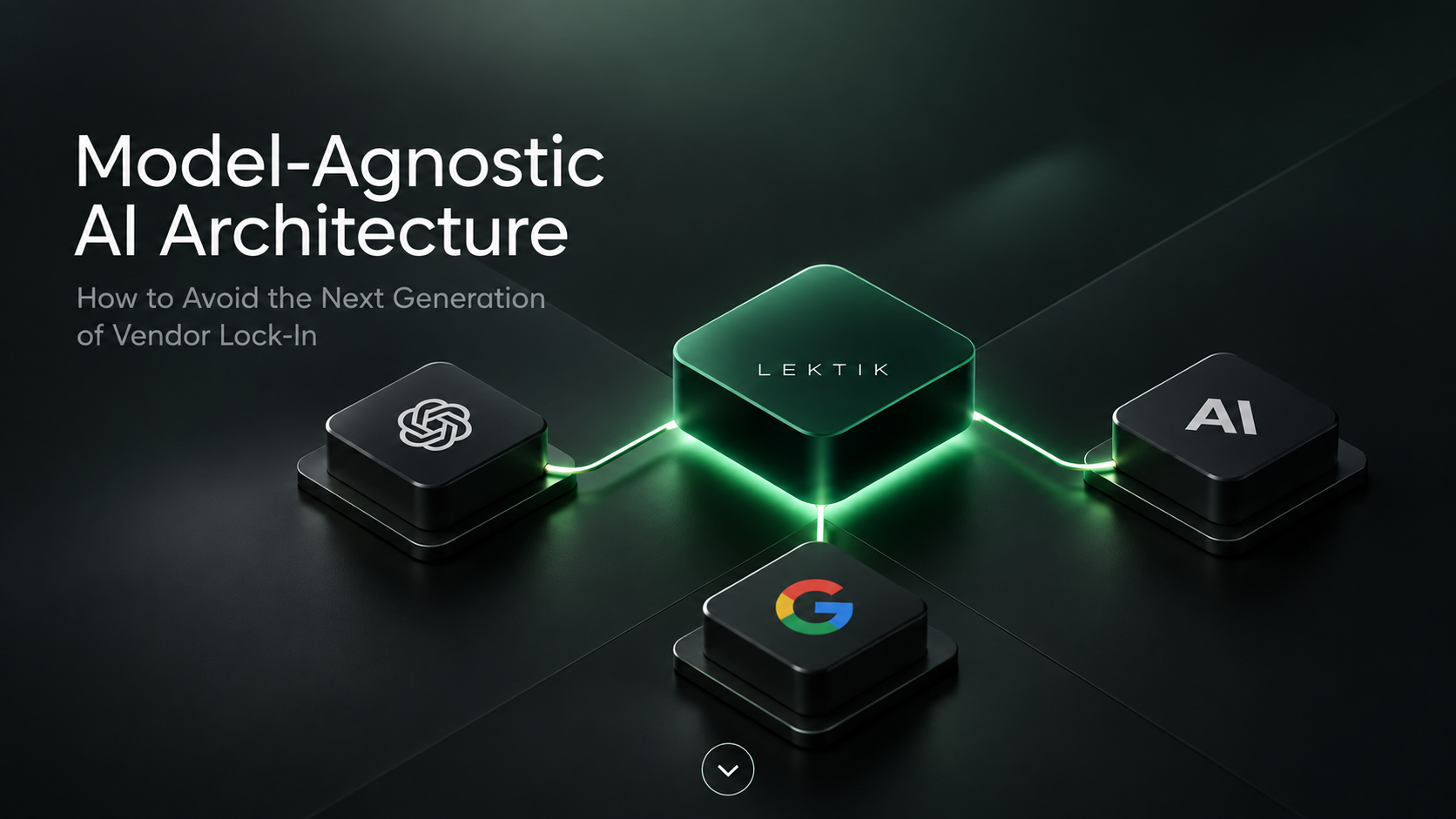
a stronger enterprise architecture looks more like:
Business Applications ↓ AI Control Layer Gateway · Policies · Routing · Evaluation · Observability ↓ Provider Adapters ↓ Models / Providers
Alongside that sits a provider-neutral enterprise layer containing:
Data · Knowledge · Memory · Logs · Evaluation Sets · Business Rules
The important architectural principle is:
Models do not have to be interchangeable. Model-specific differences have to be isolated.
Five Foundations of a Model-Agnostic AI Architecture
1. AI Gateway and Control Layer
An AI gateway provides a controlled interface between applications and model providers.
Depending on the architecture, it can centralize:
- authentication
- model access
- routing
- rate limits
- cost controls
- logging
- observability
- fallback policies
- security controls
- audit trails
Instead of every application integrating directly with multiple providers, applications communicate through a governed AI layer.
That dramatically reduces how much provider-specific logic enters the business application.
But there is an important warning:
The gateway should not become the next source of lock-in.
Critical business logic, evaluation data and model policies should not become inseparable from a proprietary gateway implementation.
The abstraction layer itself should remain replaceable where practical.
2. Intelligent Model Routing
Not every workload requires the same model.
A simple classification workflow may not need the same capability as:
- contract analysis
- complex reasoning
- software engineering
- image understanding
- financial document extraction
- autonomous agents
A routing layer can select models according to factors such as:
Capability | Quality | Cost | Latency | Compliance | Availability
That changes multi-model architecture from a disaster-recovery strategy into an operating model.
For example, an enterprise might use:
- one model for high-volume classification
- another for complex reasoning
- a specialized model for document processing
- a private model for sensitive workloads
The business application does not need to know how that decision is made.
The AI infrastructure layer does.
3. Portable Evaluation
One of the biggest obstacles to changing models is uncertainty.
Teams ask:
Will another model actually perform well enough for our workloads?
That question should not be answered by benchmarks alone.
Enterprise teams should maintain evaluation datasets based on their own use cases.
Candidate models can then be tested for:
- accuracy
- output quality
- latency
- cost
- reliability
- hallucination rate
- structured-output adherence
- tool-calling performance
- policy compliance
This makes model selection measurable.
Instead of:
"We think the new model is better."
the organization can determine:
"For these workloads, this model delivers equivalent quality at 35% lower cost."
Portable evaluation is therefore one of the most important foundations of model portability.
4. Provider-Neutral Data, Knowledge and Memory
Enterprise knowledge should remain under enterprise control.
Where practical, keep the following independent from the model provider:
- source documents
- structured business data
- retrieval metadata
- conversation history
- agent state
- evaluation datasets
- prompts and policies
- audit logs
- business knowledge
- application memory
Generated artifacts such as embeddings may still depend on specific models.
That is acceptable.
What matters is retaining the underlying information required to recreate them.
The architecture should allow the intelligence layer to change without forcing the enterprise knowledge layer to move with it.
5. Provider Adapters and Standardized Interfaces
A practical model-agnostic architecture requires controlled provider-specific adapters.
These adapters translate a common enterprise interface into provider-specific implementations.
For example:
Enterprise Tool Schema
can be translated into:
Provider A Tool Format
or
Provider B Tool Format
without changing the business workflow.
The same principle can apply to:
- structured outputs
- multimodal requests
- streaming
- safety controls
- model parameters
- tool calling
This does not eliminate provider differences.
It contains them.
Model-Agnostic Architecture Matters Even More for AI Agents
The move from AI assistants toward autonomous or semi-autonomous agents makes architectural independence more important.
An enterprise agent may:
- Interpret a request.
- Retrieve enterprise knowledge.
- Decide which tools to use.
- Execute an API call.
- Query another system.
- Evaluate the result.
- Request human approval.
- Trigger a business action.
The model is only one component of that system.
If the entire workflow becomes tightly coupled to the model provider's agent framework, memory layer and orchestration logic, changing providers becomes extremely difficult.
Enterprises therefore need to separate:
Business workflow
from:
Agent orchestration
from:
Model execution
wherever practical.
This is also why governance becomes critical.
You cannot effectively govern an AI system if you cannot observe, evaluate, route and control its actions.
Model-Agnostic Does Not Mean Multi-Model Everything
There is another mistake enterprises should avoid.
Model portability has a cost.
Introducing gateways, abstraction layers, evaluation systems and routing increases engineering and operational complexity.
For a small internal prototype, integrating directly with one provider may be completely reasonable.
For a production system supporting critical business processes, the calculation changes.
The architectural investment becomes increasingly justified when the system has:
- significant transaction volume
- sensitive enterprise data
- regulatory requirements
- long expected lifetime
- customer-facing AI
- autonomous agents
- multiple business units
- high AI expenditure
- mission-critical workflows
The correct goal is therefore not maximum abstraction.
It is the appropriate level of independence for the business risk involved.
The Real Value Appears When Something Changes
During normal operations, model-agnostic architecture may look like additional engineering work.
Its value becomes visible when:
- a model is deprecated
- pricing changes materially
- capacity becomes constrained
- business requirements change
- regulatory restrictions emerge
- a better model becomes available
- the organization's AI strategy changes
- a provider changes its roadmap
At that moment, the difference becomes:
Change the configuration and validate the workload.
versus:
Redesign the application and migrate the system.
That is the real economic argument for model portability.
The Strategic Question for Enterprise AI
Enterprises will still standardize.
They may prefer a particular provider because of:
- security
- enterprise agreements
- performance
- infrastructure alignment
- governance
- cost
- compliance
There is nothing wrong with that.
The mistake is allowing commercial preference to become unnecessary architectural dependency.
Model selection should increasingly behave like an infrastructure policy.
Not a permanent application design decision.
How Lektik Approaches Model-Agnostic Enterprise AI
At Lektik, we approach enterprise AI architecture around three principles:
The model should be replaceable.
The intelligence layer should be governed.
The business logic and enterprise knowledge should remain yours.
For organizations already deploying AI into production, the starting point is usually not changing the model.
It is understanding where dependency already exists.
Lektik AI Architecture Audit
We assess areas including:
Model Dependencies APIs, SDKs, prompts, model-specific behavior and capabilities.
↓
Data & Retrieval Dependencies Embeddings, vector stores, retrieval pipelines, memory and proprietary formats.
↓
Agent & Orchestration Dependencies Agent frameworks, tool schemas, workflow logic and model-specific reasoning.
↓
Governance & Observability Logging, evaluation, access control, safety, cost and auditability.
↓
Migration Risk What would actually need to change if the model or provider changed tomorrow?
The outcome can include:
AI Dependency Map + Lock-In Risk Assessment + Target Architecture + Migration Roadmap
The objective is not to redesign systems simply for the sake of architectural purity.
It is to identify where flexibility has meaningful business value and design for it before migration becomes urgent.
Final Thought
AI models will change.
Their capabilities will improve.
Their economics will change.
New providers will emerge.
Enterprise requirements will evolve.
Your business architecture should not need to be rebuilt every time the intelligence layer changes.
Build the intelligence layer to evolve.
Keep the business layer yours.