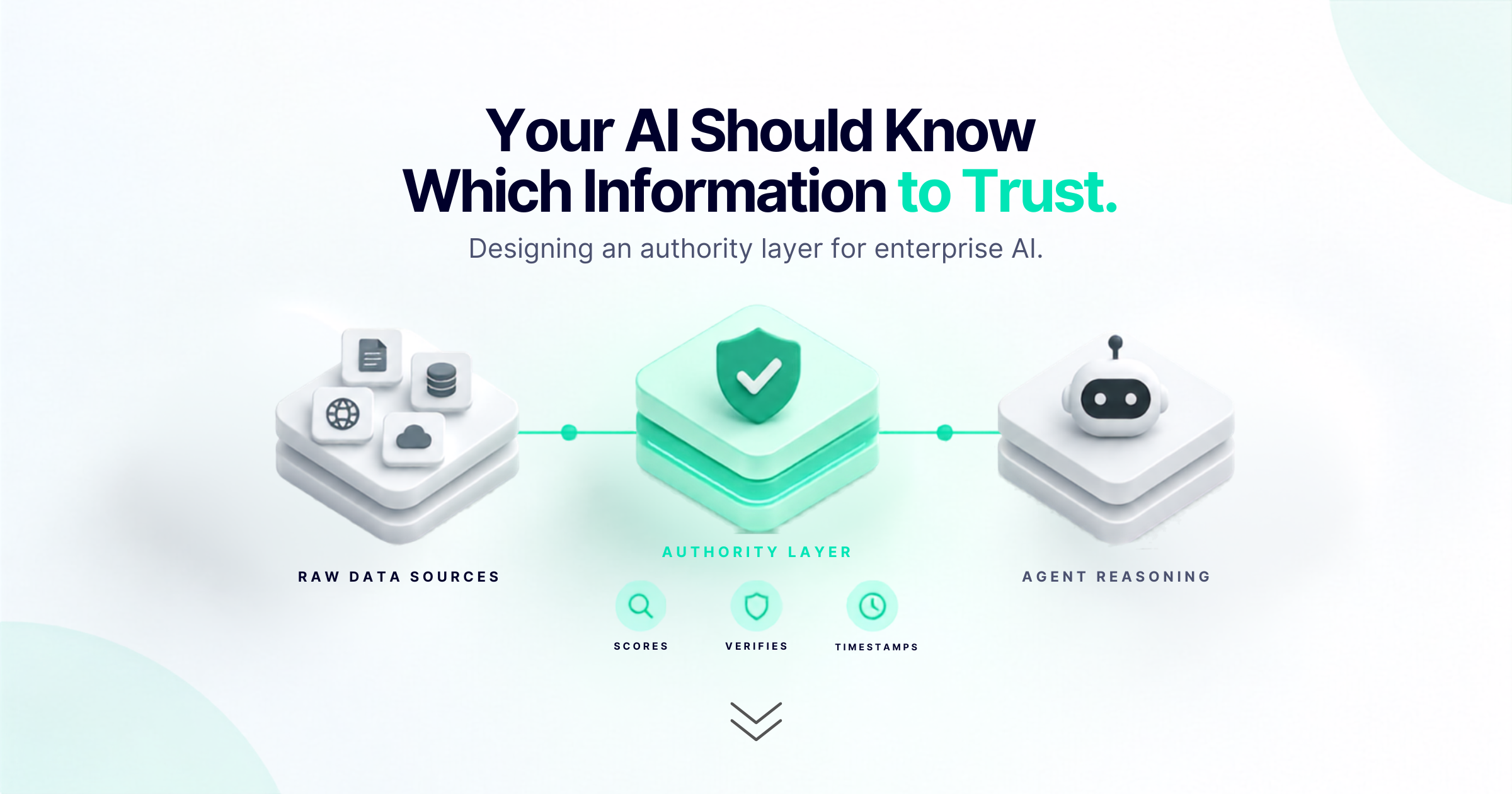
TL;DR: Enterprise AI's trust problem is now structural. Gartner projects that by 2028, half of organizations will adopt zero-trust data governance as unverified AI-generated content spreads through enterprise systems and separately expects more than 40% of agentic AI projects to be canceled by the end of 2027 over cost, value, and risk-control failures. McKinsey's 2026 AI Trust Maturity Survey backs this up from the inside: responsible-AI maturity is improving, but strategy, governance, and agentic AI controls still lag, with only about 30% of organizations reaching a strong maturity level in those areas. The fix isn't a bigger model - it's a dedicated authority layer: infrastructure that scores, verifies, and timestamps every source before an AI agent is allowed to reason over it or act on it.
The Trust Problem Enterprise AI Didn't See Coming
For most of the last two years, enterprise AI programs have been optimized around one question: is the model good enough? That question is increasingly the wrong one. AI systems are now flooded with inputs - internal documents, third-party feeds, AI-generated summaries of other AI-generated content - and most have no built-in way to tell a verified source from an unverified one.
Why can't enterprises trust their data by default anymore? Because the volume of AI-generated content inside enterprise systems is growing faster than the ability to label where it came from. Gartner predicts that by 2028, half of organizations will implement a zero-trust posture for data governance specifically because unverified AI-generated data is proliferating, and a Gartner Managing VP has warned that organizations can no longer assume the data flowing through their systems was created or checked by a human. That assumption - that ingested data is basically reliable - is exactly what most enterprise AI programs were quietly built on.
This shows up directly in what practitioners report back. In McKinsey's 2026 AI Trust Maturity Survey, 74% of respondents named inaccuracy and 72% named cybersecurity as highly relevant AI risks as adoption expands - the two most frequently cited risk categories in the entire survey. Security and risk concerns were also the single most common barrier organizations cited when asked what's stopping them from fully scaling agentic AI, ahead of regulatory uncertainty or technical limitations.
This matters most for agentic AI. A chatbot that gives a wrong answer is embarrassing. An agent that acts on a wrong answer - approving a transaction, updating a customer record, triggering a workflow - is a liability. The authority layer exists to catch the difference before it becomes an incident.
What Broken Trust Actually Costs
This isn't an abstract governance concern. It shows up directly in AI program economics.
What does bad source data actually cost an enterprise AI program? Gartner has predicted that at least 30% of generative AI projects would be abandoned after proof of concept by the end of 2025, citing poor data quality, inadequate risk controls, escalating costs, and unclear business value as the drivers - not model performance. More recently, Gartner has gone further for agentic AI specifically, predicting that over 40% of agentic AI projects will be canceled by the end of 2027 for the same combination of reasons. As Gartner analyst Anushree Verma put it, most agentic AI projects today are early-stage experiments driven by hype, which blinds organizations to the real cost and complexity of deploying agents at scale.
McKinsey's 2026 State of AI survey shows where that gap lands. Nearly nine in ten respondents report regular AI use in at least one business function - adoption is close to universal. But only about 6% qualify as AI "high performers," meaning they attribute at least 5% of EBIT to AI and describe its impact as significant, and only 37% of organizations report any positive EBIT contribution from AI at all, a figure McKinsey says is essentially unchanged year over year. Widespread use and reliable, governed, value-generating deployment are two very different things - and the distance between them is where the trust problem lives.
Where Governance Is Falling Short
McKinsey's AI Trust Maturity Model tracks five dimensions of responsible AI: strategy, risk management, data and technology, governance, and - new for 2026 - agentic AI governance and controls. The average maturity score across respondents rose from 2.0 in 2025 to 2.3 in 2026, real but modest progress. The problem is where that progress is concentrated: only about one-third of organizations report a strong maturity level in strategy, governance, and agentic AI controls specifically, while data and risk-management capabilities move faster. McKinsey also finds this governance gap is consistent across every region surveyed and that active mitigation of known AI risks lags behind organizations' own awareness of those risks across nearly every category.
What's the difference between data governance and an AI authority layer? Governance decides who is allowed to access data and sets the policies an organization intends to follow. An authority layer is closer to the "data and technology" and "agentic AI controls" dimensions McKinsey tracks - it operationalizes those policies into something an AI agent can act on in real time, scoring a source for credibility, freshness, and consistency before the agent is allowed to reason over it or act on it. Governance without that operational layer is exactly the pattern McKinsey's survey is describing: stated intent that isn't yet built into the system.
Why RAG Alone Can't Fix This
Retrieval-augmented generation solved a real problem: it grounded AI answers in enterprise data instead of the model's static training. But retrieval is not the same as trust. A RAG pipeline will happily retrieve a stale document, a conflicting internal report, or an unverified external feed with the same confidence it retrieves an authoritative, current source - because retrieval systems are built to find relevant content, not to rank how trustworthy that content is.
This is the layer enterprise AI architecture has been missing: something that sits between retrieval and reasoning, and asks a question RAG was never designed to answer - should the agent actually believe this source? Gartner has predicted that 40% of enterprise applications will be integrated with task-specific AI agents by the end of 2026, up from less than 5% in 2025. As that shift plays out, the gap between "retrieved" and "trustworthy" stops being theoretical, because agents don't just answer questions with unverified sources - they act on them.
Designing the Authority Layer: What It Actually Consists Of
What does an authority layer actually consist of, technically? In practice, four components:
- Source credibility scoring - distinguishing internal, human-verified sources from external, AI-generated, or unverified ones, and weighting agent reasoning accordingly.
- Freshness and staleness detection - flagging data that has aged out of reliability in real time, rather than discovering it only after an agent has already acted on it.
- Conflict resolution logic - a defined process for what an agent does when two trusted sources disagree, rather than silently picking one.
- Full audit trails - every answer or action an agent produces should trace back to the specific sources and authority scores that informed it, so decisions are explainable after the fact, not just accurate in the moment.
None of this replaces existing data governance or RAG infrastructure. It sits on top of both, translating governance policy and retrieved content into a trust signal the AI system can actually reason with in real time - which is precisely the connective layer McKinsey's maturity data suggests most organizations haven't built yet.
Where Lektik Fits
This is the layer Lektik builds as part of its AI infrastructure engineering practice: the connective tissue between enterprise data and agentic reasoning, engineered to score, verify, and timestamp sources before an agent acts on them. The positioning isn't "trustworthy AI" as a marketing line - it's a measurable, auditable layer that enterprises can inspect, test, and hold accountable, built alongside the governed-agent architecture enterprise AI systems increasingly require. For CTOs evaluating how to move agentic AI from pilot to production, this is the layer that determines whether that move is safe to make.
What CTOs Should Ask Before They Buy or Build
A short diagnostic worth running against any current or prospective AI system:
- Can every AI-generated answer be traced back to a specific, scored source?
- Does the system flag stale or unverified data automatically, or does staleness go unnoticed until something breaks?
- Is there a defined process for what happens when two trusted sources disagree?
- Is there a full audit trail connecting agent actions back to the sources and authority scores behind them?
- Who owns accountability for this internally? McKinsey's survey found organizations with explicit ownership for responsible AI score meaningfully higher on maturity than those without it.
If the honest answer to any of these is "not yet," that's the starting point - not a reason to slow down AI adoption, but a reason to build the authority layer before scaling agents further.
FAQ
What is an AI authority layer? An authority layer is infrastructure that scores, verifies, and timestamps data sources before an AI agent reasons over them or acts on them, so the system can distinguish trustworthy input from unverified or stale input in real time.
How is an authority layer different from data governance? Data governance controls who can access data and under what policies. An authority layer operationalizes that governance for AI agents, judging how much an agent should trust a given source once it has access, based on credibility, freshness, and consistency.
Why do enterprise AI projects fail even when the underlying data pipeline looks solid? Because a working pipeline moves data but doesn't necessarily verify it. Gartner has attributed both large-scale generative AI project abandonment and, more recently, agentic AI project cancellations to poor data quality, inadequate risk controls, escalating costs, and unclear business value - not model performance.
Can an authority layer be added to an existing RAG architecture? Yes. It's designed to sit between retrieval and reasoning rather than replace either - scoring and verifying what a RAG pipeline retrieves before an agent is allowed to act on it.
Is this the same as AI observability or explainability? It's related but distinct. Observability and explainability focus on understanding what a model did after the fact. An authority layer operates earlier, at the point of source evaluation, shaping what the agent is allowed to trust before it reasons or acts.
Why is agentic AI governance harder than governance for traditional AI? Because agents act, not just answer. McKinsey's 2026 AI Trust Maturity Survey found agentic AI governance and controls to be one of the weakest-scoring dimensions of responsible AI maturity, and security and risk concerns are now the top-cited barrier to scaling agentic AI further.