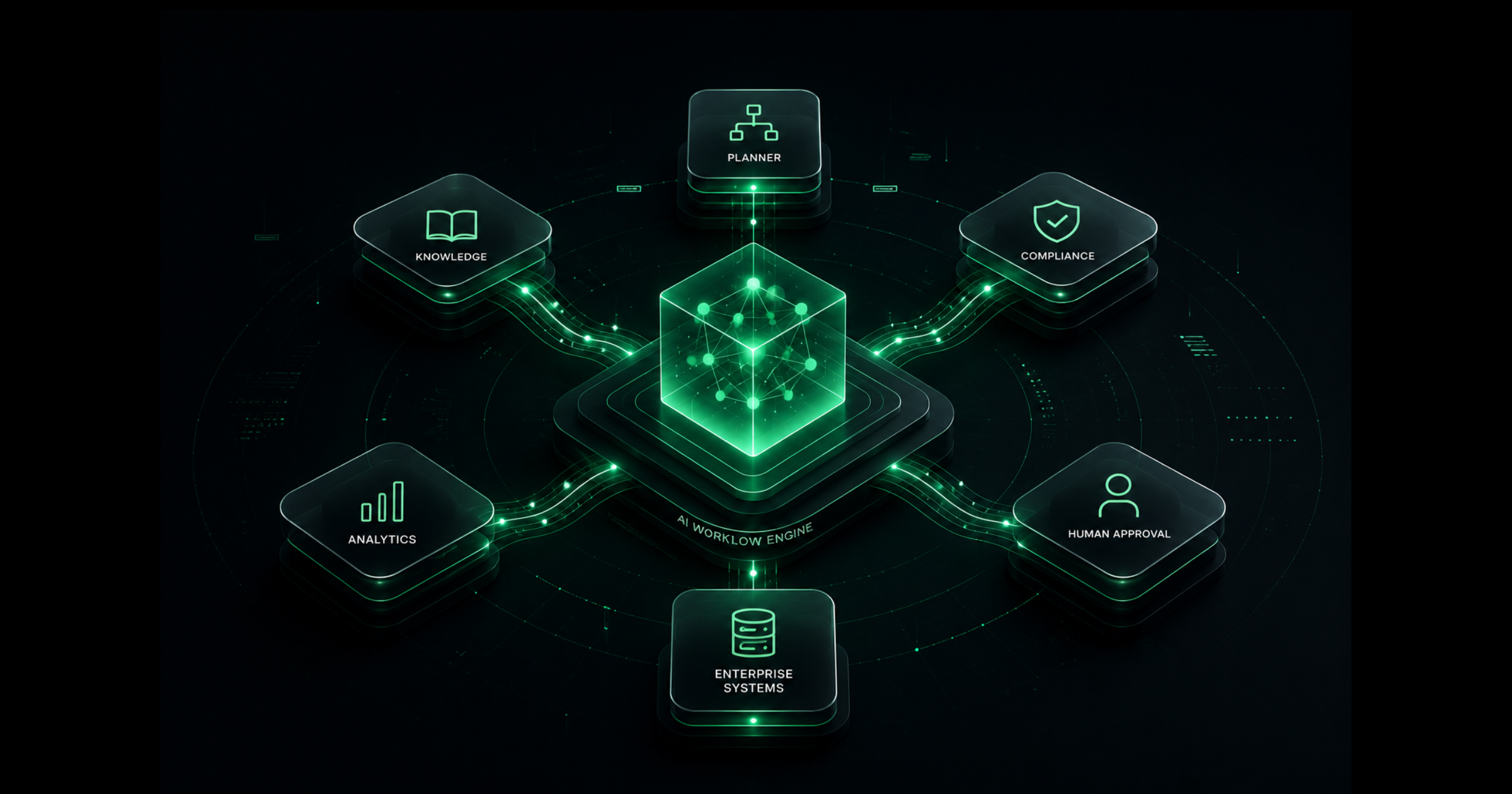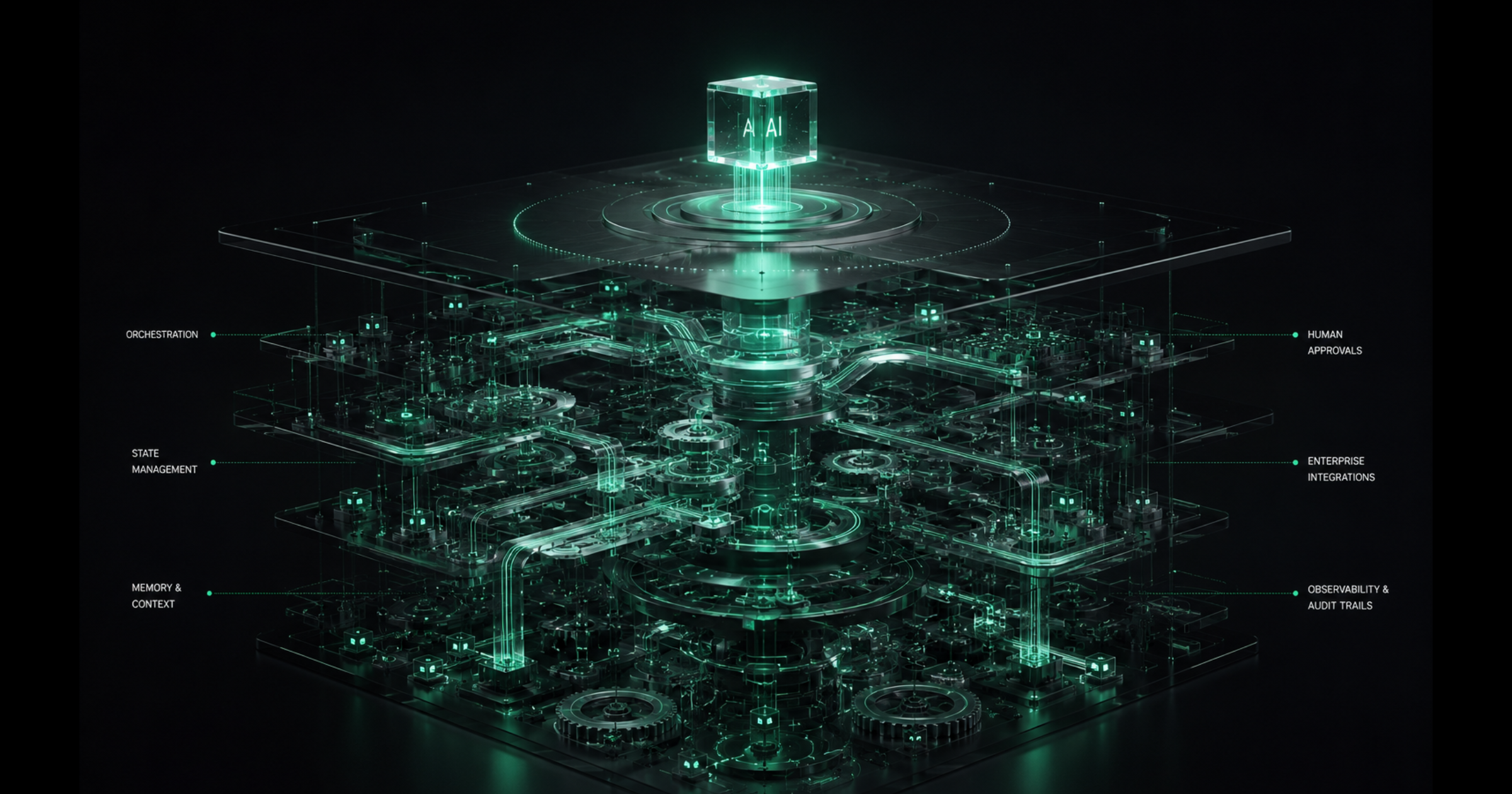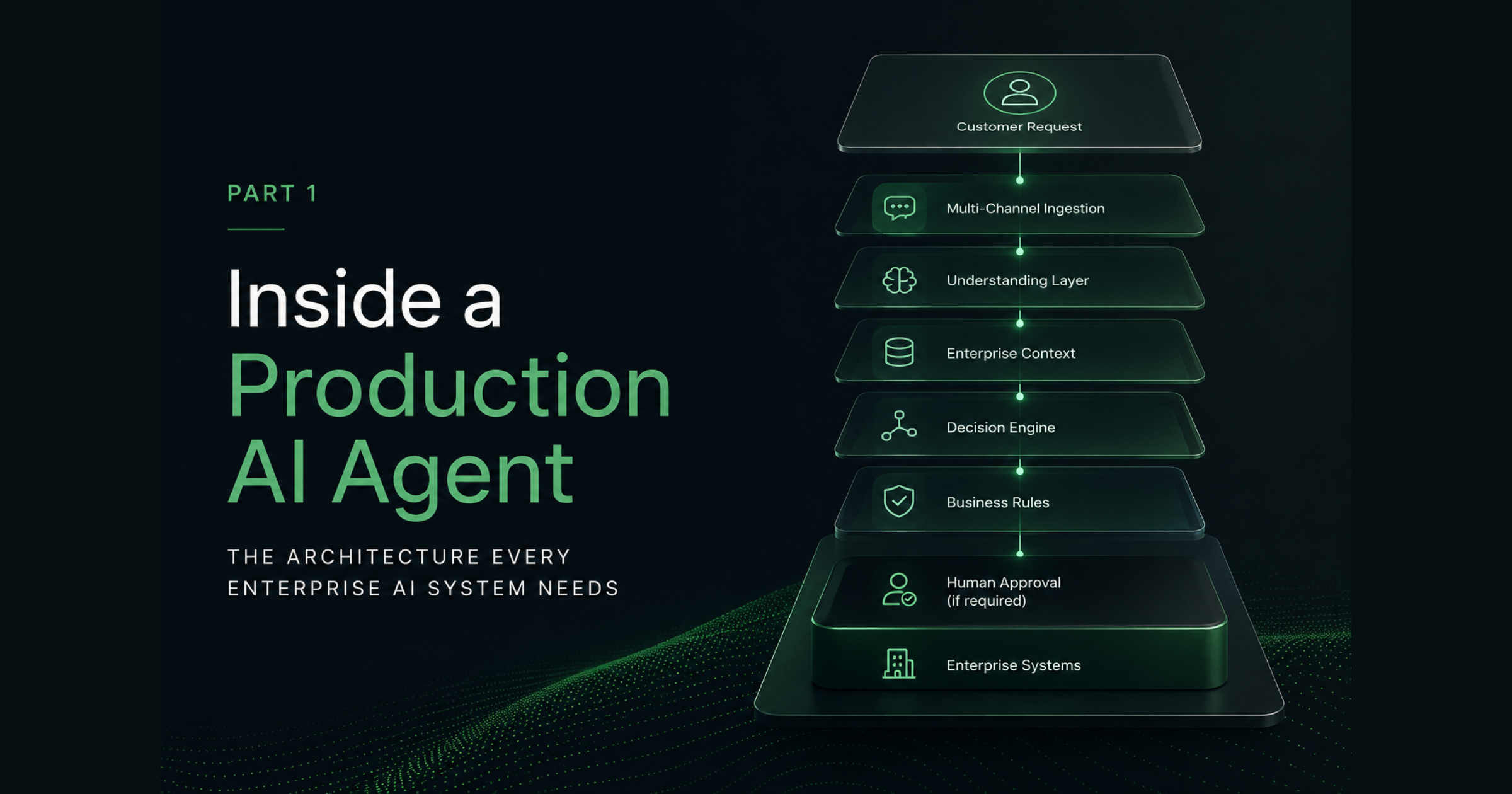
What most AI demos never show, and why architecture matters more than the model.
Executive Summary
Most AI conversations focus on models.
Enterprise AI succeeds because of architecture.
Behind every production AI agent is an orchestration layer responsible for understanding requests, retrieving enterprise context, applying business rules, and deciding when automation should stop and a human should take over. The language model is only one component in that workflow.
This article explores the foundational architecture behind production AI systems and explains why enterprises should evaluate the workflow-not just the model-when investing in AI.
AI Demos Show Intelligence. Production AI Delivers Reliability.
The AI demos circulating online are impressive.
A customer asks a question. The AI responds in seconds. The interaction looks effortless.
But production environments are fundamentally different.
Enterprise AI doesn't answer one carefully crafted prompt. It processes thousands of requests arriving through different channels, works with incomplete information, interacts with multiple enterprise systems, and operates under business rules, security policies, and regulatory requirements.
That's why the most important part of an enterprise AI platform is rarely the model itself.
It's everything surrounding it.
Production Reality
Enterprise AI must operate continuously while handling:
- Multiple communication channels
- Voice calls and documents
- Customer history
- Internal knowledge
- Business policies
- Human approvals
- API failures
- Compliance requirements
Production begins where demonstrations end.
The Enterprise AI Workflow
Every production AI system follows a structured workflow before generating a response.
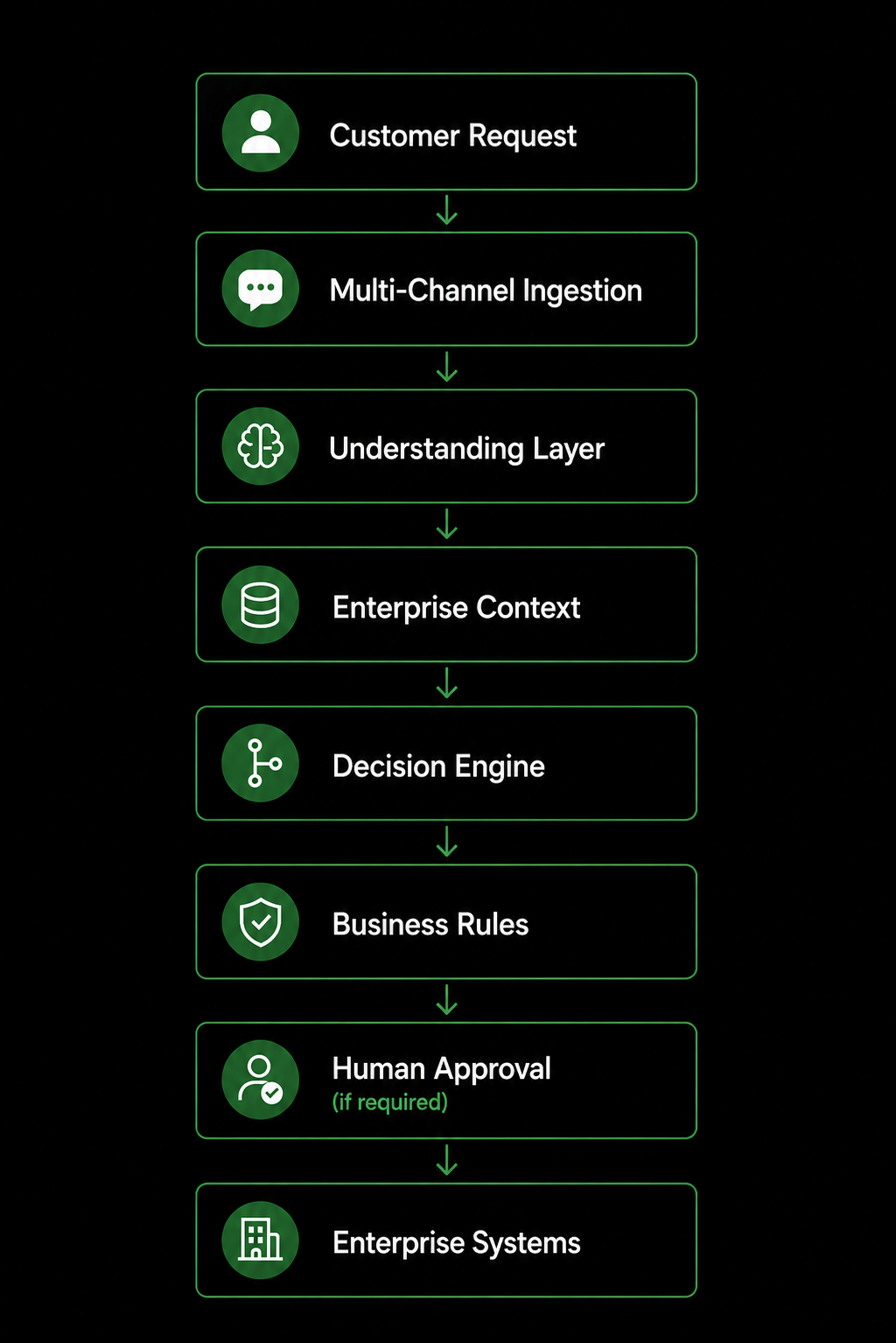
While every implementation differs, the architectural principles remain remarkably consistent.
The Four Foundational Layers of Production AI
Before an AI system can automate work, it must successfully complete four foundational stages.
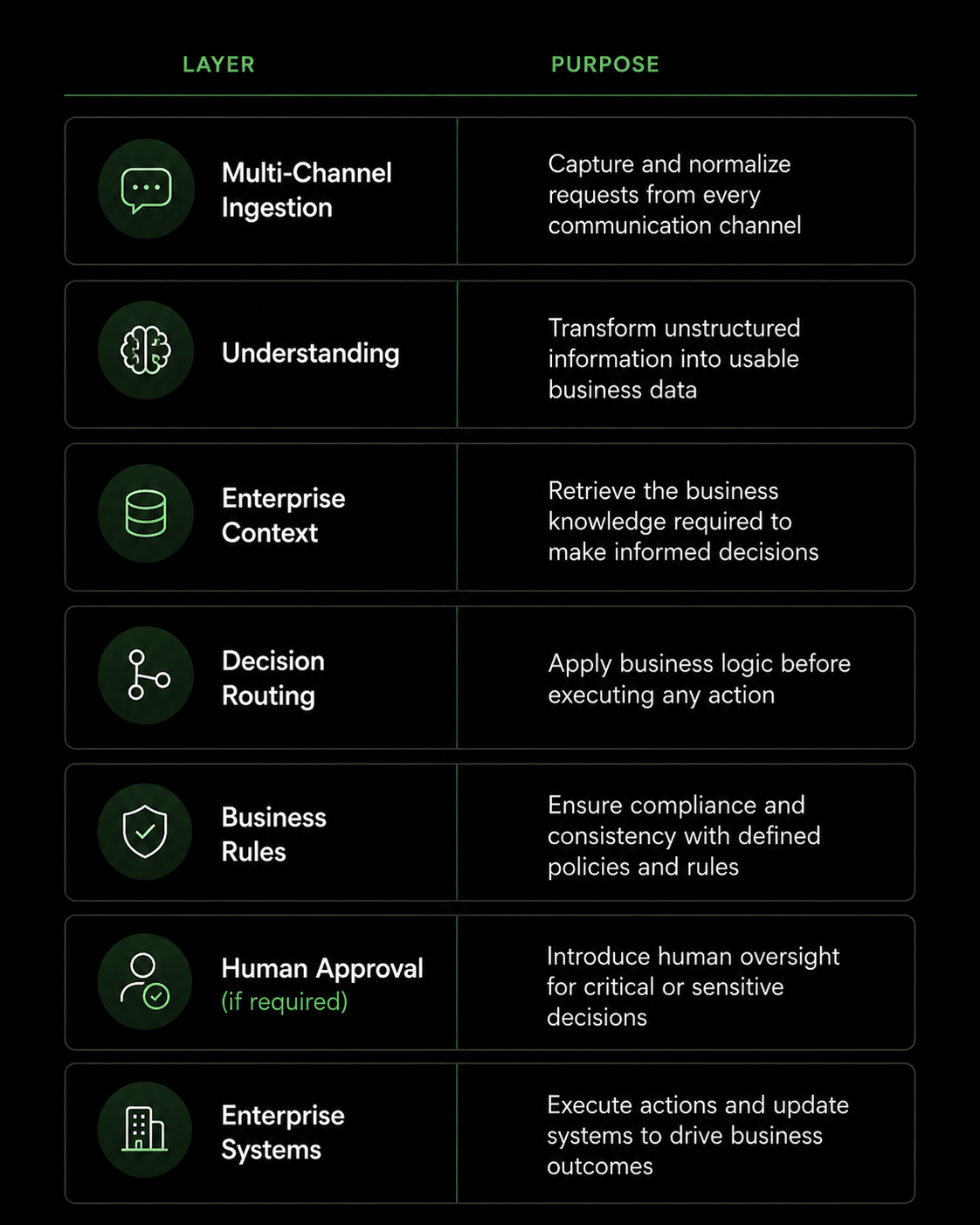
These layers determine whether an AI system behaves like a chatbot-or like an enterprise platform.
Layer 1: Multi-Channel Ingestion
Enterprise users don't interact through a single chat window.
Customer requests arrive through:
- Voice calls
- Slack
- Microsoft Teams
- Contact forms
- APIs
- PDFs
- Shared documents
Every source speaks a different language.
Before an AI model can reason about a request, the platform must normalize every input into a common structure. This creates a consistent foundation regardless of where the request originated.
Without this ingestion layer, organizations end up building separate AI workflows for every communication channel-creating unnecessary complexity and long-term maintenance challenges.
Why it matters
A unified ingestion layer allows one AI workflow to support every customer touchpoint instead of maintaining multiple disconnected automations.
Layer 2: Understanding the Request
Most enterprise information isn't neatly structured.
Invoices arrive as PDFs.
Contracts are scanned documents.
Support conversations happen over phone calls.
Customer emails contain incomplete information.
Before reasoning begins, production AI systems transform this raw input into structured business information using technologies such as:
- Speech transcription
- Optical Character Recognition (OCR)
- Document understanding
- Entity extraction
- Metadata classification
This stage significantly improves the quality of downstream decisions.
When organizations believe "the AI misunderstood," the root cause often lies in poor input processing-not poor reasoning.
Executive Insight
Production AI doesn't reason over raw documents.
It reasons over structured business information extracted from those documents.
Layer 3: Enterprise Context Retrieval
This is where production AI separates itself from consumer AI.
A chatbot answers using general knowledge.
An enterprise AI agent answers using your business knowledge.
Before making a recommendation or executing a task, the platform retrieves relevant information from enterprise systems, including:
- CRM records
- ERP platforms
- Previous customer interactions
- Internal documentation
- Company policies
- Contracts
- Knowledge bases
Instead of responding in isolation, the AI builds its understanding using the same context that an experienced employee would reference before making a decision.
Without this enrichment layer, even the most advanced language model is operating with limited visibility into the business.
Key Principle
Intelligence without context produces confident guesses.
Intelligence with enterprise context produces informed decisions.
Layer 4: Decision Routing and Business Logic
Not every decision should be delegated to a language model.
Production AI systems separate reasoning from policy.
The model identifies the situation.
Business rules determine what actions are permitted.
For example:
- Pricing limits
- Eligibility requirements
- Approval thresholds
- Regulatory restrictions
- Company policies
These deterministic rules exist outside the AI model, ensuring that critical business decisions remain transparent, predictable, and easy to audit.
Keeping business logic separate also makes systems easier to update as policies evolve over time.
Executive Insight
AI determines what is happening.
Business rules determine what is allowed to happen.
What This Means for Enterprise Leaders
Many AI evaluations focus on model performance.
In production, however, the questions become much broader.
Ask whether the platform can:
✓ Process requests from multiple channels
✓ Understand documents and voice interactions
✓ Retrieve enterprise knowledge before responding
✓ Separate AI reasoning from business rules
These architectural capabilities often have a greater impact on long-term success than incremental improvements in model accuracy.
Architecture Readiness Checklist
Before deploying an enterprise AI agent, ask these questions:
- □ Can requests be captured from every customer channel?
- □ Is unstructured information converted into structured business data?
- □ Does the system retrieve enterprise context before making decisions?
- □ Are business rules managed separately from the language model?
- □ Can workflows be updated without retraining the AI?
If the answer to any of these questions is No, the organization is still building a prototype rather than a production-ready AI platform.
Key Takeaways
Production AI is not defined by the language model.
It is defined by the architecture surrounding it.
Multi-channel ingestion, structured understanding, enterprise context, and deterministic business rules form the foundation of every reliable AI deployment.
These layers are what transform an impressive demonstration into a system capable of operating continuously inside a real enterprise.
In Part 2, we'll explore the operational layers that keep production AI running—including memory architecture, human approval workflows, enterprise integrations, resilience, and governance.