Most enterprise AI projects don't fail because the models are bad.
They fail because nobody engineered the workflow around them.
A large language model can summarize a document, answer a question, or generate code. But real business processes aren't completed in a single prompt. They span multiple systems, involve several decisions, require approvals, and often continue over hours or even days.
That's why enterprise AI is moving beyond prompt engineering. The challenge is no longer what the model can generate—it's how AI, people, business rules, and enterprise systems work together to reliably achieve an outcome.
This emerging discipline is AI Workflow Engineering.
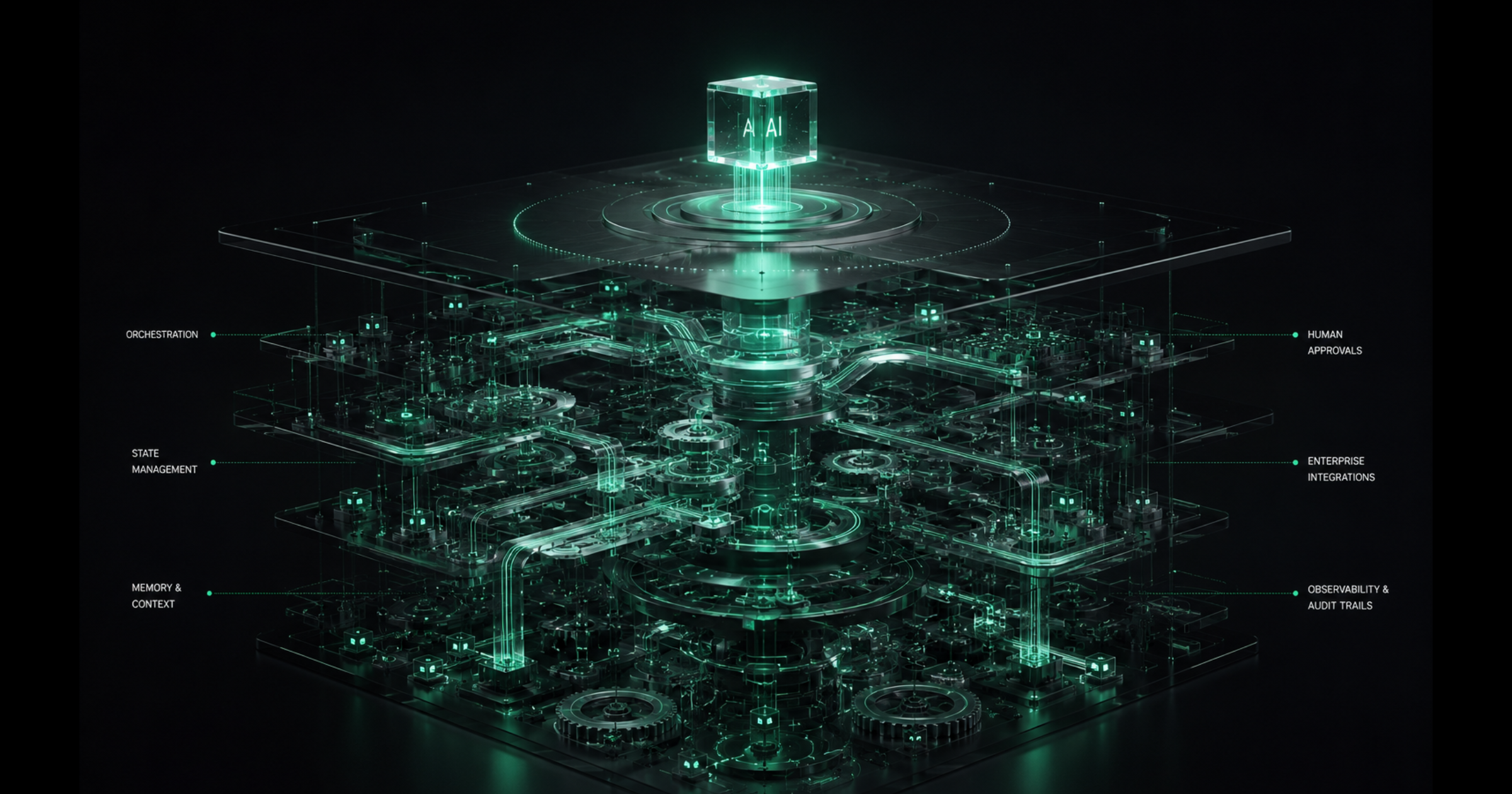
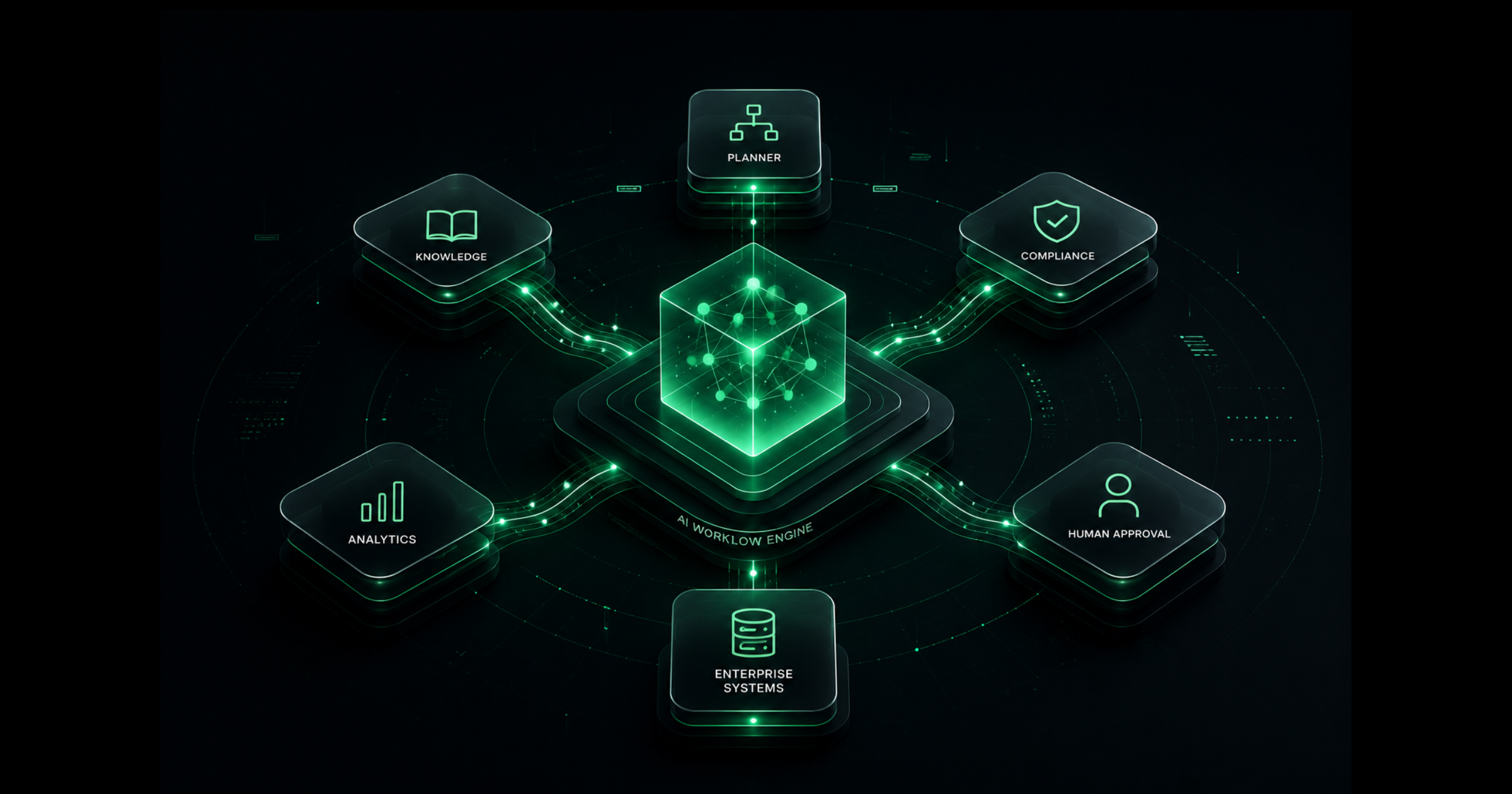
Rather than designing individual AI interactions, AI Workflow Engineering focuses on architecting end-to-end workflows where agents collaborate, humans intervene when needed, business rules enforce governance, and systems maintain memory across long-running processes.
For enterprises moving from AI experimentation to production, this distinction is becoming increasingly important.
What Is AI Workflow Engineering?
AI Workflow Engineering is the practice of designing systems where AI agents, humans, business rules, and enterprise applications coordinate to complete complex business processes.
Unlike prompt engineering, which optimizes a single interaction with a model, workflow engineering considers the entire lifecycle of execution.
It answers questions like:
- Which agent performs which task?
- When should a human review the output?
- What information should be remembered across sessions?
- Which decisions must always follow deterministic business rules?
- How does the workflow recover if something fails?
These become architectural decisions rather than implementation details.
Traditional Software Architecture Wasn't Designed for This
Traditional enterprise software assumes predictable behavior.
The same request produces the same result every time.
AI systems don't.
Reasoning is probabilistic. Tool calls can fail. Information may be interpreted differently between executions. Without proper safeguards, a small mistake early in the workflow can cascade into expensive downstream errors.
Many organizations discover this only after successful AI pilots struggle to reach production. The issue isn't model quality—it's the lack of architecture around the model.
Building reliable AI workflows requires designing for uncertainty rather than assuming perfect execution.
Enterprise AI Workflows Need State, Not Conversations
Business processes aren't chat sessions.
A customer onboarding process might span three days.
An insurance claim may require several approvals.
A procurement request could involve multiple departments before completion.
These workflows need to pause, resume, delegate tasks, and maintain progress throughout their lifecycle.
Instead of treating AI as a conversation, successful enterprise systems treat workflows as stateful, resumable processes with clear ownership, checkpoints, and recovery mechanisms.
Memory Matters More Than Bigger Context Windows
One of the biggest misconceptions in enterprise AI is that larger context windows solve memory problems.
They don't.
The context window is temporary working memory. Enterprise workflows require durable memory.
Consider a support agent helping a customer over several weeks. The system shouldn't reload every previous conversation into the prompt. Instead, it should store important facts separately and inject only what's relevant for the current task.
The most effective architectures separate:
- Working context for immediate reasoning
- Persistent memory for long-term facts
- Business data stored in enterprise systems
This reduces cost, improves accuracy, and prevents context drift during long-running workflows.
AI Agents Work Better as Teams
Enterprise work rarely depends on one person doing everything.
AI shouldn't either.
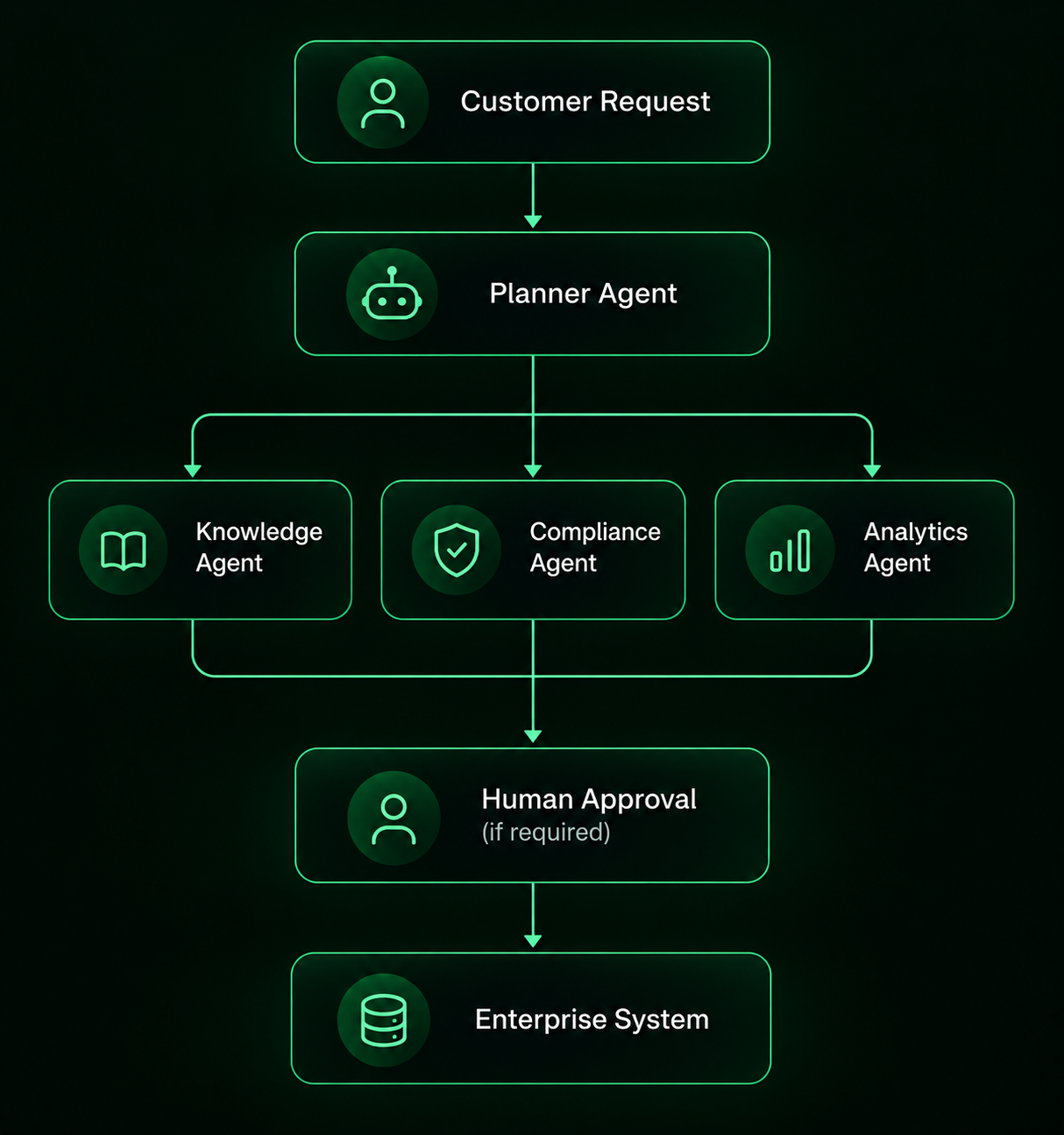
Instead of one large agent handling an entire process, organizations are increasingly deploying specialized agents that collaborate.
For example:
- One agent extracts information from documents.
- Another validates compliance requirements.
- A third updates enterprise systems.
- A planner coordinates the workflow.
- A human reviews only high-risk exceptions.
This modular approach improves reliability, simplifies debugging, and allows organizations to evolve individual agents without redesigning the entire system.
As interoperability standards such as MCP and A2A mature, coordinating multiple agents is becoming significantly easier than building isolated AI solutions.
Workflow Example
Human Oversight Should Match the Risk
One of the biggest mistakes organizations make is treating every AI workflow the same.
Not every agent needs the same level of oversight.
A document summarization agent doesn't require the same governance as one approving payments or updating financial systems.
A better approach is to scale oversight based on risk:
- Low-risk agents operate with minimal supervision.
- Recommendation agents require human review.
- Action-taking agents include approval workflows, audit logs, and rollback mechanisms.
This balance allows organizations to benefit from automation without sacrificing governance.
Let Rules Handle Rules
AI doesn't need to make every decision.
Some business logic should never depend on probabilistic reasoning.
Pricing thresholds.
Regulatory compliance.
Eligibility criteria.
Approval limits.
These belong inside deterministic rule engines where every decision is explainable and repeatable.
AI is most valuable where ambiguity exists—interpreting documents, understanding intent, summarizing information, or making recommendations.
The strongest enterprise architectures combine both approaches:
- AI interprets.
- Business rules enforce.
- Humans approve when necessary.
Each component does what it does best.
Event-Driven Architecture Makes AI Scalable
Modern AI workflows increasingly resemble distributed software systems rather than chatbot applications.
Instead of waiting for a single request to complete, agents respond to events:
- A document is uploaded.
- An approval is granted.
- A customer responds.
- A payment clears.
Each event triggers the next step automatically.
This event-driven approach allows workflows to continue asynchronously across hours or days without keeping a conversation permanently active.
It's also significantly easier to monitor, retry, and scale.
Cost Is an Architectural Decision
Running one AI request is inexpensive.
Running thousands of workflows every day is not.
Production AI systems must be designed with cost in mind.
Successful teams optimize by:
- using smaller models for routine tasks,
- reserving advanced models for complex reasoning,
- compressing context before passing it between agents,
- storing durable knowledge outside expensive prompts.
These architectural decisions often determine whether an AI initiative remains financially sustainable.
Production AI Requires Observability
When an AI workflow fails, organizations need more than an error message.
They need to understand:
- Which agent made the decision?
- What information was available?
- Which tool failed?
- Why was a business rule triggered?
- Where should the workflow resume?
Comprehensive logging, audit trails, exception handling, and measurable success metrics are essential for operating AI systems at enterprise scale.
Without observability, debugging long-running AI workflows becomes nearly impossible.
AI Workflow Engineering Is Becoming a Core Enterprise Capability
Prompt engineering helped organizations discover what AI could do.
Workflow engineering determines whether AI creates lasting business value.
As enterprises deploy autonomous workflows across operations, customer service, finance, healthcare, procurement, and software delivery, competitive advantage will increasingly come from designing reliable systems—not simply choosing better models.
The organizations succeeding with AI won't necessarily have the smartest agents.
They'll have the best-engineered workflows.
At Lektik, we see AI Workflow Engineering as the foundation for enterprise AI adoption. Building production-ready AI isn't about connecting a model to an API—it's about designing workflows where orchestration, governance, memory, business rules, and human oversight work together from day one.
Key Takeaways
- AI Workflow Engineering focuses on designing complete business workflows rather than individual prompts.
- Enterprise AI requires orchestration between agents, humans, business rules, and enterprise systems.
- Persistent memory is more valuable than simply increasing context windows.
- Specialized AI agents outperform monolithic agents in complex workflows.
- Governance should scale according to an agent's level of autonomy.
- Deterministic decisions belong in rule engines, while AI handles ambiguity.
- Event-driven architectures improve scalability, resilience, and observability.
- Cost optimization and monitoring should be designed into every production workflow.
Frequently Asked Questions
What is AI Workflow Engineering?
AI Workflow Engineering is the discipline of designing enterprise workflows where AI agents, humans, business rules, and enterprise systems work together to complete multi-step business processes reliably.
How is it different from prompt engineering?
Prompt engineering optimizes a single interaction with an AI model. Workflow engineering designs the entire execution process, including orchestration, memory, governance, approvals, and recovery.
Why do enterprise AI projects struggle in production?
Most production failures stem from poor workflow architecture, weak governance, missing observability, and inadequate memory management—not from the AI model itself.
What is agent orchestration?
Agent orchestration is the coordination layer that enables multiple specialized AI agents to divide work, share context, and complete complex workflows under a central controller.
Why is human-in-the-loop important?
Human oversight provides governance for high-risk decisions while allowing low-risk tasks to remain fully automated, creating a balance between efficiency and accountability.