AI autonomy is not the goal. Reliable autonomy is.
As enterprise AI moves from copilots and chatbots toward agents that can reason, access data, call tools, and take action, one question keeps coming up:
How much of the human should we remove from the loop?
That may be the wrong question.
For production AI, the better question is:
Where should AI act independently, where should it ask for help, and where must a human remain in control?
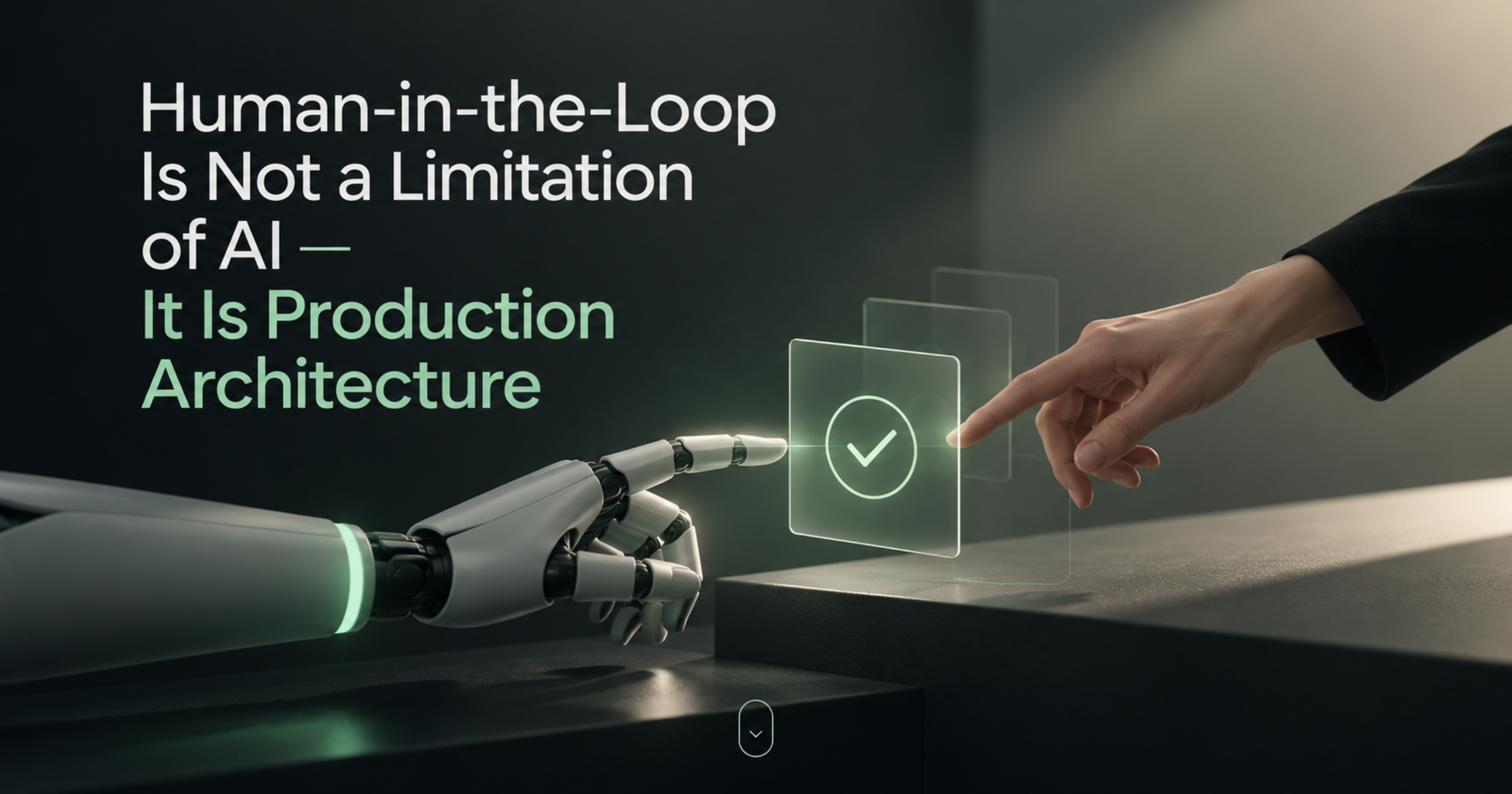
Human-in-the-loop (HITL) is often treated as evidence that an AI system is not autonomous enough. In reality, deliberate human oversight can be part of the architecture that makes enterprise AI deployable in the first place.
NIST's AI Risk Management Framework explicitly recognizes that AI systems can operate across a spectrum from fully manual to fully autonomous, with human roles and responsibilities defined according to the context and risk of the system.
The future of enterprise AI is therefore not necessarily human-free AI.
It is controlled autonomy.
The Problem With Maximum Autonomy
AI demonstrations tend to reward autonomy.
Give an agent a goal. Let it reason. Connect it to tools. Watch it complete the workflow without human intervention.
It makes for an impressive demo.
Production environments are different.
Enterprise systems encounter:
- Incomplete or conflicting information
- Ambiguous requests
- Sensitive customer or employee data
- Financial consequences
- Regulatory requirements
- Irreversible actions
- Exceptions that were never represented in the original workflow
An AI agent may be capable of taking an action without being authorized to take that action.
That distinction matters.
Capability answers: "Can the AI do this?"
Governance answers: "Should the AI do this?"
Production architecture has to answer both.
Human-in-the-Loop Does Not Mean Human Approval for Everything
A common misconception is that adding humans to an AI workflow simply recreates the manual process.
That happens when HITL is designed poorly.
A mature human-in-the-loop system does not ask a person to review every AI decision.
Instead, it defines when human intervention is necessary.
For example:
Low-risk + high-confidence
→ AI completes the task.
Ambiguous or low-confidence
→ AI escalates to a human.
High-impact or irreversible
→ AI prepares the action, but a human approves it.
Outside defined policy
→ AI stops and escalates.
The human therefore becomes part of the exception architecture, rather than a permanent bottleneck.
Microsoft's current guidance for responsible agent deployment similarly recommends human approval for consequential actions and clear escalation paths for sensitive or ambiguous cases.
The Production Architecture of Human + AI
A useful way to think about an enterprise AI workflow is:
Data → Reasoning → Policy Check → Decision → Action
But there should be another layer running across the workflow:
Human Oversight
That oversight can intervene at specific points.
1. Before reasoning
Is the request permitted?
2. During tool selection
Is the agent allowed to access this system or data?
3. Before execution
Does this action cross a defined risk threshold?
4. During exceptions
Does the situation fall outside the agent's confidence or authority?
5. After execution
Can the decision and resulting action be traced and reviewed?
Recent IBM Research work on enterprise agents describes a similar governance-by-construction approach, with policy controls and human approval gates integrated into the agent's execution pipeline rather than added after the fact.
This is the important shift:
Human oversight is not necessarily a separate process around the AI. It can be a component inside the AI architecture.
Not Every Decision Deserves the Same Level of Autonomy
There is no universal setting for AI autonomy.
Different decisions require different levels of control.
A useful enterprise spectrum is:
Assist → Recommend → Approve → Execute → Escalate
Consider a procurement workflow.
An AI system might:
- Summarize supplier proposals autonomously.
- Recommend a supplier based on defined criteria.
- Flag unusual pricing for review.
- Prepare a purchase order.
- Require human approval before a high-value commitment.
- Escalate exceptions that fall outside procurement policy.
The model itself may remain the same.
The authority surrounding the model changes.
That is an architectural decision.
NIST guidance emphasizes defining and documenting human roles, responsibilities, and oversight mechanisms according to the AI system and its context.
The Real Enterprise Question: Where Should AI Stop?
This is where AI strategy becomes architecture.
Instead of asking:
"How autonomous can we make this agent?"
Enterprise teams should ask:
"What decisions can this agent safely make without human intervention?"
That requires defining:
- Decision boundaries
- Confidence thresholds
- Permissions
- Escalation rules
- Human approval points
- Audit requirements
- Override mechanisms
- Data access policies
These controls should be designed before an agent is allowed to operate at scale.
Because once an AI system can take action across enterprise systems, the architecture around the model becomes as important as the model itself.
Human Feedback Is Also Operational Intelligence
There is another reason to design HITL properly.
Human intervention generates valuable information.
Suppose an agent repeatedly recommends an action that experienced operators override.
That is not simply a human correcting an AI.
It is a signal.
It may indicate:
- Missing business context
- Poor data quality
- An incomplete policy
- An incorrect confidence threshold
- A recurring exception
- A workflow that needs redesign
NIST specifically recommends measuring human oversight, including downstream actions such as overrides, reported errors, response types, and escalation activity.
This creates a feedback loop:
AI decision → Human intervention → Reason for intervention → System improvement
Over time, the organization can understand where the AI performs reliably and where additional controls or context are required.
The goal is not necessarily to eliminate every human intervention.
The goal is to make every intervention informative.
From Copilots to Controlled Agents
Enterprise AI is moving through an important transition.
Copilot
The human initiates the work.
AI assists.
Agent
The AI can initiate steps and execute actions toward a goal.
Production Agent
The AI can act within defined authority, policies, permissions, and escalation paths.
That third stage is where enterprise architecture becomes critical.
An agent that can send an email is one thing.
An agent that can modify customer records, approve transactions, change pricing, access sensitive information, or trigger downstream workflows is another.
The question is no longer simply whether the model can perform the task.
The question is whether the organization has designed the system so that the task can be performed safely, traceably, and within defined authority.
What This Means for Enterprise AI Leaders
For CIOs, CTOs, product leaders, and business owners, the shift is significant.
AI implementation should not begin with:
"Where can we remove a person?"
It should begin with:
"Where does AI create leverage, and where does human judgment create control?"
That changes how teams design AI systems.
Instead of treating governance as a compliance checkpoint at the end, it becomes part of the workflow itself.
Instead of measuring only automation percentage, teams can also examine:
- Decision accuracy
- Exception rates
- Override frequency
- Escalation quality
- Time to resolution
- Cost per decision
- Auditability
- Business outcomes
The result is a more useful definition of AI maturity:
Not how little human involvement remains, but how intelligently human involvement is designed.
The Lektik Perspective: Build for Controlled Autonomy
At Lektik, we see enterprise AI as more than deploying a model or adding an agent to an existing workflow.
The real work is designing the system around the intelligence.
That means determining:
What should the AI know?
What should it be allowed to do?
What should require approval?
What happens when the AI is uncertain?
How is every important decision traced?
For us, human-in-the-loop is therefore not a fallback mechanism.
It is one component of a production architecture for controlled autonomy.
We build AI systems around defined decision boundaries, enterprise context, governance, escalation paths, and measurable outcomes-so organizations can increase autonomy where the system has earned it, without treating autonomy as an objective in itself.
Because production AI should not simply be capable of acting.
It should know the boundaries of its authority.
The Bottom Line
The most mature AI system is not necessarily the one that removes humans from every decision.
It is the one that understands which decisions it can own, which decisions it should escalate, and which decisions should remain human-controlled.
Human-in-the-loop is not proof that AI has failed to become autonomous.
It is proof that someone designed the autonomy.
And in enterprise AI, that distinction matters.
Frequently Asked Questions
What is human-in-the-loop AI?
Human-in-the-loop AI is an AI system designed with defined points where humans can review, approve, override, or resolve AI decisions. The level of human involvement can range from occasional intervention to continuous oversight depending on the use case and risk.
Why is human-in-the-loop important for AI agents?
Human-in-the-loop is important when AI agents can take consequential actions. It provides a mechanism for handling ambiguity, high-impact decisions, policy exceptions, and actions that require human judgment or authorization. NIST recommends defining and documenting human roles and oversight according to the AI system's context.
Does human-in-the-loop reduce AI automation?
Not necessarily. Well-designed HITL can increase automation by allowing AI to handle routine, low-risk decisions while routing only exceptions and high-impact actions to humans.
What is the difference between human-in-the-loop and human-on-the-loop?
Human-in-the-loop generally means a human participates directly in a decision or action before it proceeds. Human-on-the-loop generally describes oversight where the AI can operate autonomously while humans monitor performance and intervene when necessary. The exact terminology can vary across organizations and system designs.
When should AI agents require human approval?
Human approval is particularly relevant for consequential, sensitive, difficult-to-reverse, or policy-controlled actions. The appropriate threshold depends on the business process, risk tolerance, permissions, and regulatory requirements.
How does human-in-the-loop improve AI governance?
HITL can provide defined escalation, approval, and override mechanisms. When combined with policies, logging, monitoring, and clear accountability, it becomes part of a broader AI governance architecture. NIST recommends documenting oversight and tracking measures such as overrides and escalations.
What is controlled autonomy in AI?
Controlled autonomy is an approach in which AI systems are allowed to make decisions and take actions within explicitly defined boundaries. Those boundaries can include permissions, policies, confidence thresholds, approval requirements, and escalation paths.
Is human-in-the-loop necessary for every AI system?
No. The appropriate level of human oversight depends on the system's purpose, risk, context, and potential impact. NIST notes that some AI systems may not require human oversight, while others may specifically require it.
How should enterprises measure human-in-the-loop AI?
Enterprises can measure decision accuracy, exception rates, human overrides, escalation frequency, time to resolution, error rates, auditability, and business outcomes. These measures help determine whether the human-AI workflow is improving over time.
What is the role of human oversight in enterprise AI?
Human oversight provides a mechanism for organizations to retain meaningful control over AI systems where judgment, authorization, accountability, or risk management matters. It should be designed into the system rather than treated as a manual workaround.