AI adoption is entering a new phase.
The first wave was about giving employees AI assistants.
The next wave is about giving AI agents the ability to act.
An agent can retrieve information, call enterprise systems, update records, trigger workflows, interact with APIs, and coordinate with other agents. As organizations deploy more of these systems, a new question becomes unavoidable:
Who governs all of them?
Managing five AI agents may be a team-level problem.
Managing hundreds becomes an enterprise architecture problem.
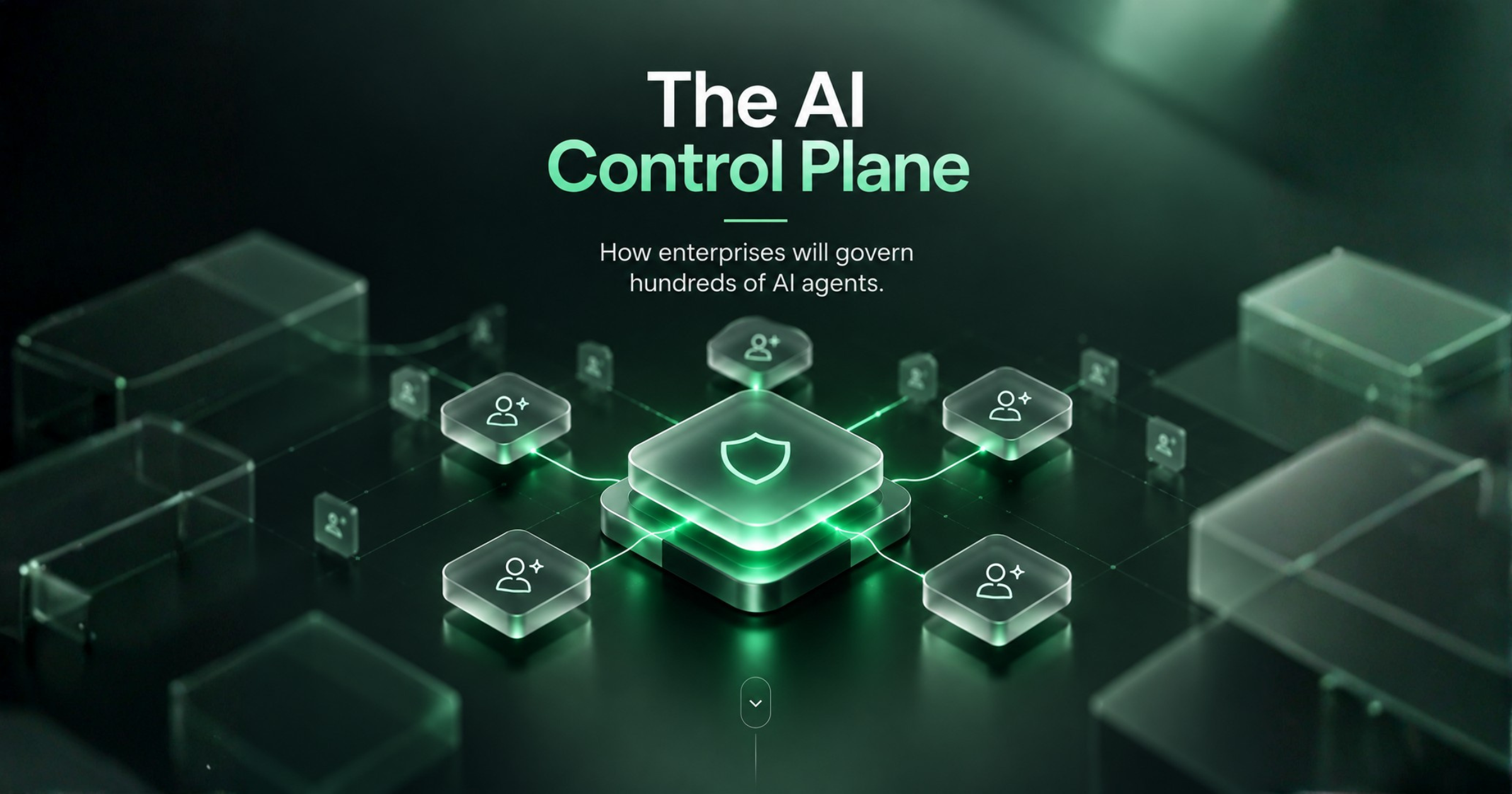
That is where the idea of an AI Control Plane becomes important: a centralized governance and coordination layer that gives enterprises visibility and control over AI agents, their identities, permissions, context, actions, and lifecycle.
From AI assistants to AI ecosystems
Traditional enterprise AI has largely been application-centric.
A business deploys a chatbot for customer service, a model for document processing, or a copilot for employees.
Agentic AI changes the operating model.
An agent doesn't simply produce an answer. It can take a sequence of actions to accomplish a goal.
A procurement agent might retrieve supplier information, compare contracts, communicate with internal systems, and initiate a workflow.
A customer service agent might access account information, check policies, update a CRM record, and escalate an issue.
A software engineering agent might inspect a repository, create code, run tests, and open a pull request.
Now multiply that across departments.
The enterprise no longer has an AI application problem.
It has an AI workforce governance problem.
Recent enterprise guidance from Microsoft and BCG similarly emphasizes centralized governance across agent identity, ownership, access, lifecycle management, visibility, and policy enforcement as agent adoption expands.
Why traditional governance starts to break
Most enterprise governance frameworks were designed around humans, applications, and relatively predictable workflows.
Agents introduce another type of actor: autonomous or semi-autonomous software operating with delegated authority.
That creates questions that existing systems may not answer cleanly:
- Which agent performed this action?
- On whose behalf was it acting?
- What data did it access?
- Which tools could it use?
- What policy authorized the action?
- Did another agent trigger it?
- When should a human have intervened?
- Can the organization reconstruct the entire decision path?
These aren't theoretical questions.
Enterprise AI agents increasingly interact with data, APIs and business systems, making identity, scoped authority and auditability important parts of agent governance.
The challenge is therefore not simply monitoring AI.
It is governing AI at the point where intelligence becomes action.
What is an AI Control Plane?
An AI Control Plane is the governance layer that sits across an organization's AI agents and provides common mechanisms for managing how they operate.
The exact architecture will vary by enterprise, but the concept generally brings together:
Identity - Who is the agent?
Authority - What is the agent allowed to do?
Context - Which information can it use and trust?
Policy - Which rules govern its actions?
Execution - Which tools and systems can it access?
Observability - What happened during its operation?
Lifecycle - Who owns, updates, evaluates, and retires the agent?
This is consistent with current enterprise definitions of an agentic control plane. Snowflake, for example, describes it as a governance and coordination layer for managing how agents access context, use tools, follow policies, and take authorized action.
The important distinction is that this is not simply another dashboard.
The control plane is intended to become part of the operating architecture.
Five capabilities an enterprise AI Control Plane needs
1. Agent identity
Every agent should have a verifiable identity.
Not just the identity of the employee who initiated a request.
Not just the application hosting the model.
The enterprise needs to know which agent acted and under what authority.
This allows organizations to establish ownership, apply access policies, investigate incidents, and maintain an auditable record of actions.
The principle is similar to established identity and Zero Trust approaches: access should be explicit, scoped, and appropriate to the task rather than assumed. Enterprise guidance increasingly highlights distinct identities and scoped authority for AI agents.
2. Policy and runtime guardrails
An agent shouldn't have unlimited authority simply because it has access to an API.
A control plane can define boundaries around:
- What an agent can access
- What actions it can perform
- Which environments it can operate in
- Which actions require approval
- What information it can expose
- When the agent must stop or escalate
The key shift is from policy documents to enforceable policies.
Governance becomes part of runtime behavior rather than something reviewed after an incident.
3. Context and authority
An agent can only make a reliable enterprise decision if it knows which information it is permitted to use and which information it should trust.
Consider an organization with multiple versions of the same customer record across different systems.
Which one is authoritative?
Which policy applies?
Which data is current?
This is where an authority layer becomes critical.
The AI Control Plane should help establish the relationship between the agent, the information it can access, the authority of that information, and the action it is permitted to take.
For Lektik, this is a particularly important distinction:
Enterprise AI needs more than intelligence. It needs governed context and trusted authority.
4. Observability and auditability
An AI agent's final output is only part of the story.
Enterprise teams need visibility into the path that produced it.
That can include:
- Agent identity
- User or workflow initiating the task
- Data accessed
- Tools called
- Policies evaluated
- Approvals requested
- Actions executed
- Failures and retries
- Final outcome
Observability therefore becomes more than application monitoring.
It becomes part of the enterprise's ability to understand and govern autonomous activity.
Microsoft's current guidance explicitly includes observability alongside ownership, identity and lifecycle management within AI agent control-plane governance.
5. Lifecycle and intervention
Agents aren't static software components.
Models change.
Tools change.
Business policies change.
Data sources change.
An agent that was appropriately scoped six months ago may no longer be appropriately scoped today.
The control plane should therefore support the complete agent lifecycle:
Register → Evaluate → Deploy → Monitor → Update → Reauthorize → Retire
It should also provide intervention mechanisms when an agent behaves outside its expected boundaries.
Control plane vs. orchestration vs. observability
These concepts are related but not interchangeable.
Orchestration coordinates execution.
It determines which agents, tools, or workflows run and how they interact.
Observability records what happened.
It provides traces, metrics, evaluations, and operational visibility.
The control plane governs both.
It establishes the identity, authority, policy, access and lifecycle rules under which those activities take place.
That distinction matters because enterprises can have excellent orchestration and extensive logging while still lacking a consistent governance model.
Seeing what an agent did is not the same as controlling what it was allowed to do.
The harder problem: agent-to-agent governance
The governance challenge becomes significantly more complex when agents start interacting with other agents.
Imagine this sequence:
Customer Agent → Risk Agent → Pricing Agent → CRM Agent → Notification Agent
Who authorized the final action?
Which agent initiated it?
What permissions were inherited?
What information moved between agents?
Where should a human approval have occurred?
The enterprise therefore needs to govern not only individual agents, but agent chains.
The control plane becomes the common layer through which those interactions can be identified, authorized, monitored, and audited.
This is one reason enterprise AI governance cannot remain fragmented across individual applications.
Governance at machine speed
Traditional governance often assumes that humans have time to review decisions.
Agents can operate continuously and execute actions in seconds.
That creates a fundamental mismatch.
A quarterly governance review cannot control a decision that happened three months earlier.
A policy buried in documentation cannot stop an unauthorized API call happening now.
Governance therefore needs to move closer to execution.
The emerging direction is runtime governance: policies, access controls, monitoring, approvals, and intervention mechanisms operating as part of the AI workflow itself. Current industry discussions around agent governance increasingly emphasize this move from passive discovery toward active enforcement.
The goal isn't to put a human in front of every AI action.
It is to make the boundaries around autonomous action explicit and enforceable.
The role of humans is changing
Human oversight doesn't have to mean manually approving every agent decision.
At enterprise scale, that would defeat much of the value of automation.
Instead, humans define:
- What agents are allowed to decide
- What requires approval
- What risk thresholds trigger escalation
- What information is authoritative
- What actions are prohibited
- Who owns the outcome
The objective is controlled autonomy.
Agents should be able to move quickly inside clearly defined boundaries, while higher-risk actions can be routed back to people.
This approach also aligns with broader AI risk-management principles. NIST's AI Risk Management Framework emphasizes managing AI risks throughout the AI lifecycle rather than treating governance as a single point-in-time activity.
Why this becomes strategic infrastructure
The more agents an enterprise deploys, the less sustainable it becomes to govern every agent independently.
A sales agent has one permission model.
A finance agent has another.
A customer-service agent has another.
A development agent has another.
Without a common governance layer, enterprises can end up with fragmented policies, inconsistent logs, duplicated controls, and limited visibility across the agent estate.
That is why the AI Control Plane is becoming an important architectural concept.
It provides a common governance foundation across heterogeneous AI systems.
BCG describes the enterprise AI control plane as an opportunity to unify identity, policy enforcement, visibility and governance across AI agents operating across platforms and business units.
Deloitte similarly argues that enterprise infrastructure increasingly needs to coordinate models, agents, workloads, and decisions across the organization.
Lektik's perspective: Build the infrastructure for controlled intelligence
At Lektik, the conversation around enterprise AI goes beyond deploying individual agents.
The larger question is:
What infrastructure allows an enterprise to scale intelligent systems without losing control of its decisions, data, and operations?
That requires more than an AI model.
It requires:
Trusted data → Authority → Agent reasoning → Policy → Action → Observability
The AI Control Plane sits across this flow, connecting intelligence with enterprise execution.
For organizations moving toward multi-agent architectures, the strategic opportunity is not simply to deploy more agents.
It is to build the infrastructure that makes those agents governable, auditable, and scalable.
Because the future enterprise may not have dozens of AI systems.
It may have hundreds.
And at that scale, governance cannot remain a collection of individual controls.
It has to become infrastructure.
What enterprises should prepare for now
Organizations don't need hundreds of agents today to start designing for this future.
They can begin with a few foundational questions:
1. Do we know which AI agents exist across the organization?
Create an inventory of agents, owners, use cases, environments, permissions, and dependencies.
2. Does every agent have a clear identity and owner?
Know which agent acted, on whose behalf, and under what authority.
3. Are permissions scoped to the task?
Avoid treating agents as permanent, over-privileged service accounts.
4. Do we know which information is authoritative?
Agent governance is inseparable from data governance and context management.
5. Can we reconstruct an agent's actions?
Build auditability and observability into the architecture rather than adding them later.
6. Which actions require human intervention?
Define escalation thresholds before autonomous workflows reach production.
7. Can governance work across different models and frameworks?
Enterprise AI will likely remain heterogeneous. Governance should not depend entirely on one model or agent framework.
Frequently Asked Questions
What is an AI Control Plane?
An AI Control Plane is a governance and coordination layer used to manage AI agents across an enterprise. It can bring together agent identity, permissions, policies, context, observability, lifecycle management, and runtime controls.
Why do enterprises need an AI Control Plane?
As organizations deploy more AI agents across departments and systems, managing each agent independently can create fragmented governance. A centralized control layer can provide consistent visibility, policies, access controls, and auditability across the agent ecosystem.
How do you govern AI agents at scale?
AI agent governance at scale requires several capabilities: agent inventory and ownership, distinct identities, scoped permissions, policy enforcement, trusted context, observability, lifecycle management, and defined human escalation paths.
What is the difference between an AI Control Plane and AI orchestration?
AI orchestration manages how agents and tools execute a workflow. An AI Control Plane governs the agents operating within those workflows, including identity, permissions, policies, lifecycle, and auditability.
What is agentic AI governance?
Agentic AI governance is the set of technical, operational, and organizational controls used to ensure AI agents operate within defined boundaries. It includes areas such as identity, access, policy enforcement, monitoring, evaluation, accountability, and human oversight.
Why is AI agent identity important?
Agent identity helps enterprises determine which agent performed an action, what authority it had, who or what authorized its operation, and how that action should be audited.
What is runtime governance for AI agents?
Runtime governance means applying policies and controls while an AI agent is operating, rather than relying solely on pre-deployment reviews or post-incident analysis. This can include access checks, policy evaluation, approval requirements, monitoring, and intervention.
How does an AI Control Plane support multi-agent systems?
It can provide a common governance layer across multiple agents, helping enterprises manage agent identities, permissions, interactions, policies, observability, and lifecycle controls across multi-agent workflows.
What should enterprises consider before deploying AI agents?
Enterprises should consider agent ownership, identity, data access, permissions, authoritative information sources, auditability, human escalation, security, lifecycle management, and how governance will work across multiple AI models and systems.
Is an AI Control Plane the same as AI governance?
Not exactly. AI governance is the broader organizational and risk-management discipline. An AI Control Plane is an architectural mechanism that can help operationalize governance across AI agents and workflows.
The executive takeaway
The next challenge in enterprise AI will not be creating another agent.
It will be managing the growing network of agents already operating across the business.
The organizations that scale agentic AI will need more than capable models and sophisticated workflows.
They will need a common way to answer:
Who is acting?
What can it access?
What can it do?
Why did it act?
Who authorized it?
And what happens when it crosses a boundary?
The AI Control Plane is emerging as one architectural answer to those questions.
As AI becomes more autonomous, governance has to become more architectural.