TL;DR
- Enterprise data is overwhelmingly unstructured. IDC found that 90% of the data organizations generated in 2022 was unstructured, and contracts, purchase orders, forms, and patient treatment notes are all part of that category.
- AI stalls when that content isn't ready. Gartner predicts that through 2026, organizations will abandon 60% of AI projects unsupported by AI-ready data.
- Document intelligence has moved far beyond OCR. It understands, validates, and structures content so systems and people can act on it.
- "Foundation" has a specific meaning here: for any AI use case that depends on documents, it is the layer that decides whether document data arrives complete, correct, and traceable.
- Lektik engineers this layer as infrastructure, connected to data platforms, workflows, and governed agents, and designed backwards from the decisions each document informs.
One Wrong Field, One Wrong Outcome
A fax comes into a hospital with a referral and a procedure code. The scan quality is poor, and one character in the code is difficult to read. The AI extracts the code incorrectly, but everything around it continues to work exactly as designed. The document is received, OCR runs, the fields are extracted, the workflow picks it up, and the prior authorization is submitted through the API. Then the payer rejects it. From a technical point of view, almost every component did its job. The problem is that the system started with one wrong piece of information, and everything after that simply carried the mistake forward.
This is one of the engineering problems we keep running into with enterprise AI:
The dangerous part is not always whether AI can read a document. It is whether the system knows when it should trust what it read.
That distinction becomes very important once AI stops answering questions and starts triggering actions.
Extraction is no longer the difficult part
Reading a PDF is relatively easy now. The harder part is deciding whether what was read is reliable enough to act on. Real enterprise documents are rarely clean, well-structured files. They may be scanned forms, email attachments, faxed referrals, contracts with amendments, invoices with complex tables, handwritten notes or policy schedules coming from systems that were never designed to work together. So the real question is not simply, “What does this document say?” It is whether this is the right document, whether the correct value was extracted, whether that value makes sense in the wider context, whether it conflicts with something elsewhere, and whether there is enough confidence to let a system take the next step. And months later, if someone asks why that decision was made, the answer still has to be traceable back to the original source. That is where the engineering problem becomes much more interesting.
Consider a simple invoice
Suppose an invoice says a supplier is owed $187,400. Pulling out the number itself is easy. The real work starts before the system decides whether that invoice should actually be paid. Does it match a valid purchase order? Is it the right supplier? Were the goods received? Do the quantities and prices line up? Was there an amendment somewhere that changes the amount? Has the invoice already been submitted? And does the person approving it even have authority for a payment of that size?
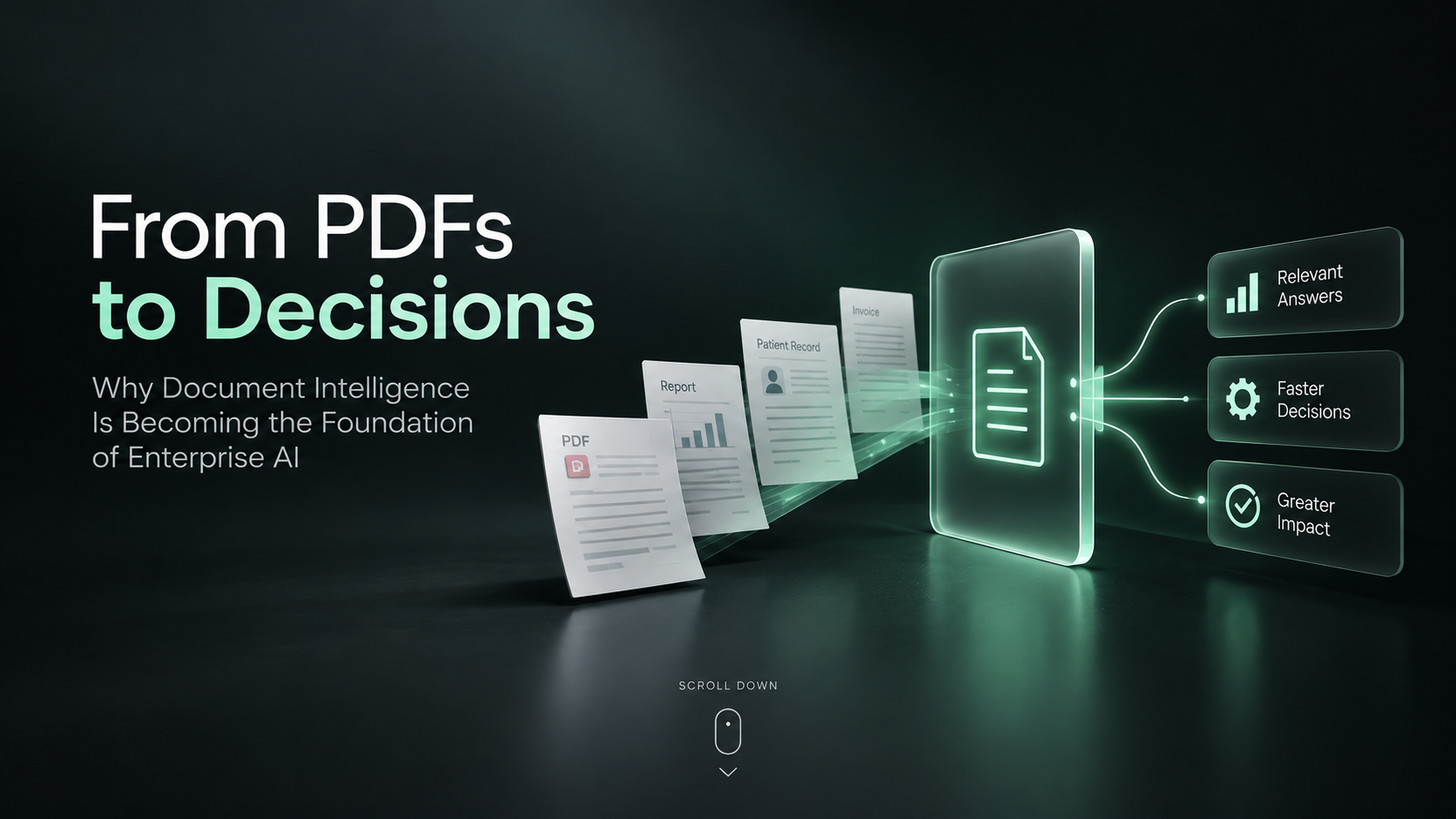
Only when those checks come together does the extracted number become useful. That is why we think about document intelligence as more than extraction. It is the layer that takes information from a document, validates it against the wider business context, handles exceptions, and turns it into something reliable enough to support a real decision.
Confidence changes the architecture
One thing becomes important very quickly in production: not every AI output should be treated the same. If a system extracts a procedure code with 99.7% confidence, you may be comfortable letting the workflow continue automatically. If the same code comes from a poor-quality fax and the confidence is only 71%, that should probably take a different path.
In practice, that means high-confidence results can move forward, medium-confidence results may need to be checked against other information, and low-confidence cases should go to a person. That sounds simple, but this is where a lot of the real engineering starts. You need thresholds, validation rules, exception queues, audit history, retry behaviour, source references, and a clean way for people to correct the system when it gets something wrong.
The model itself is only one part of that setup. The real production system is everything around it that decides when to trust the output, when to verify it, and when to stop and ask for human review.
This matters even more with AI agents
There is a big difference between AI giving someone the wrong answer and AI taking the wrong action. If a chatbot misreads a document, the result may simply be an incorrect response. But if an agent misreads the same document, it could submit something, approve or reject a request, update a system, send an email, or trigger another workflow.
At that point, a small extraction error is no longer just a bad answer. It has become an operational mistake. That is why putting agents on top of documents without a strong validation layer underneath is risky. The more autonomy you give the agent, the more important it becomes to make sure the information it is acting on is reliable in the first place.
Traceability is not an optional feature
Once these systems move into production, someone will eventually ask a very simple question: “Why did the system make this decision?” And that is where answers like “Claude extracted it” or “the vector database returned it” stop being useful. For important workflows, you need to be able to trace the decision all the way back to the source — the exact document, page, table or field, the value that was extracted, the confidence level, any validation that happened, whether a person corrected it, and what action followed.
That chain matters in areas like healthcare, insurance and finance, where decisions may later need to be reviewed, challenged or audited. The document itself becomes part of the evidence trail. If you cannot trace an output back to the source it came from, it becomes much harder to defend the decision that followed.
The architecture starts to look different
Once you think about the problem this way, the architecture changes completely. It is no longer just PDF → LLM → answer. It starts to look more like document → classification → extraction → validation → entity matching → business rules → confidence check → exception handling → workflow → action → audit trail.
There may also be several different technologies involved. Sometimes OCR is enough. Sometimes layout understanding matters. Sometimes an LLM is useful for interpreting context, while in other cases a deterministic rule is safer. Some values may need to be checked against a database or another document. And sometimes the correct system behaviour is simply: “I am not confident enough to act on this. A person needs to review it.”
That ability to stop is underrated. Good enterprise AI is not just about knowing what to do. It also needs to know when it should not do anything.
This is where we are spending more engineering time
At Lektik, we increasingly start these document-heavy AI systems from the decision and work backwards. Instead of beginning with “Which model should we use?”, we first ask what decision is eventually going to be made, what information is needed to make it, where that information comes from, what can be missing or wrong, what needs to be validated, when a person should step in, and whether the whole decision can be reconstructed later. That is essentially the decision-first approach described in the original piece.
That naturally brings document processing, data engineering, business rules, workflows, human review and AI agents together. And for us, that is the more interesting engineering problem now. Making AI read a PDF is no longer the difficult part.
The harder question is:
When should software trust what it read enough to actually do something about it?
That is usually the difference between an impressive AI demo and a system you can safely run in production.
Frequently Asked Questions
What is document intelligence? Document intelligence is the use of AI to understand, extract, validate, and structure information from unstructured documents such as PDFs, scans, and faxes, so it can support decisions, analytics, and automation.
Why is document intelligence important for enterprise AI? Much of the information enterprise decisions depend on sits in unstructured documents. Without a reliable way to turn that content into trusted data, RAG systems, AI agents, and analytics work from incomplete or unverified inputs.
What is the difference between OCR, IDP, and document intelligence? OCR reads characters. IDP typically automates extraction within workflows. As Lektik frames it, document intelligence adds contextual understanding, validation, data integration, and governance.
How does document intelligence improve RAG performance? It improves parsing, chunking, and metadata at ingestion, so retrieval returns complete context and answers stay grounded in source documents.
Can document intelligence handle regulated data in healthcare and financial services? Yes, when governance is built in from the start: PII and PHI handling, role-based access, lineage, audit trails, and human review for low-confidence outputs.
What are the best first use cases for intelligent document processing? High-volume, rules-driven processes with measurable cycle times, such as claims intake, loan onboarding, invoice processing, and prior authorizations.