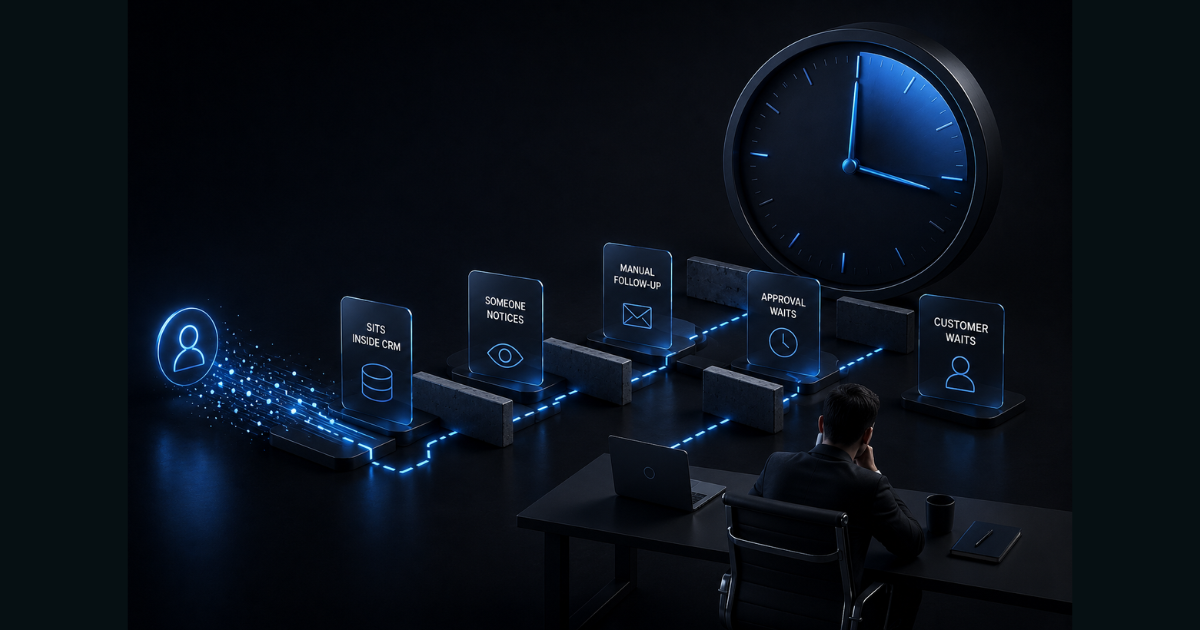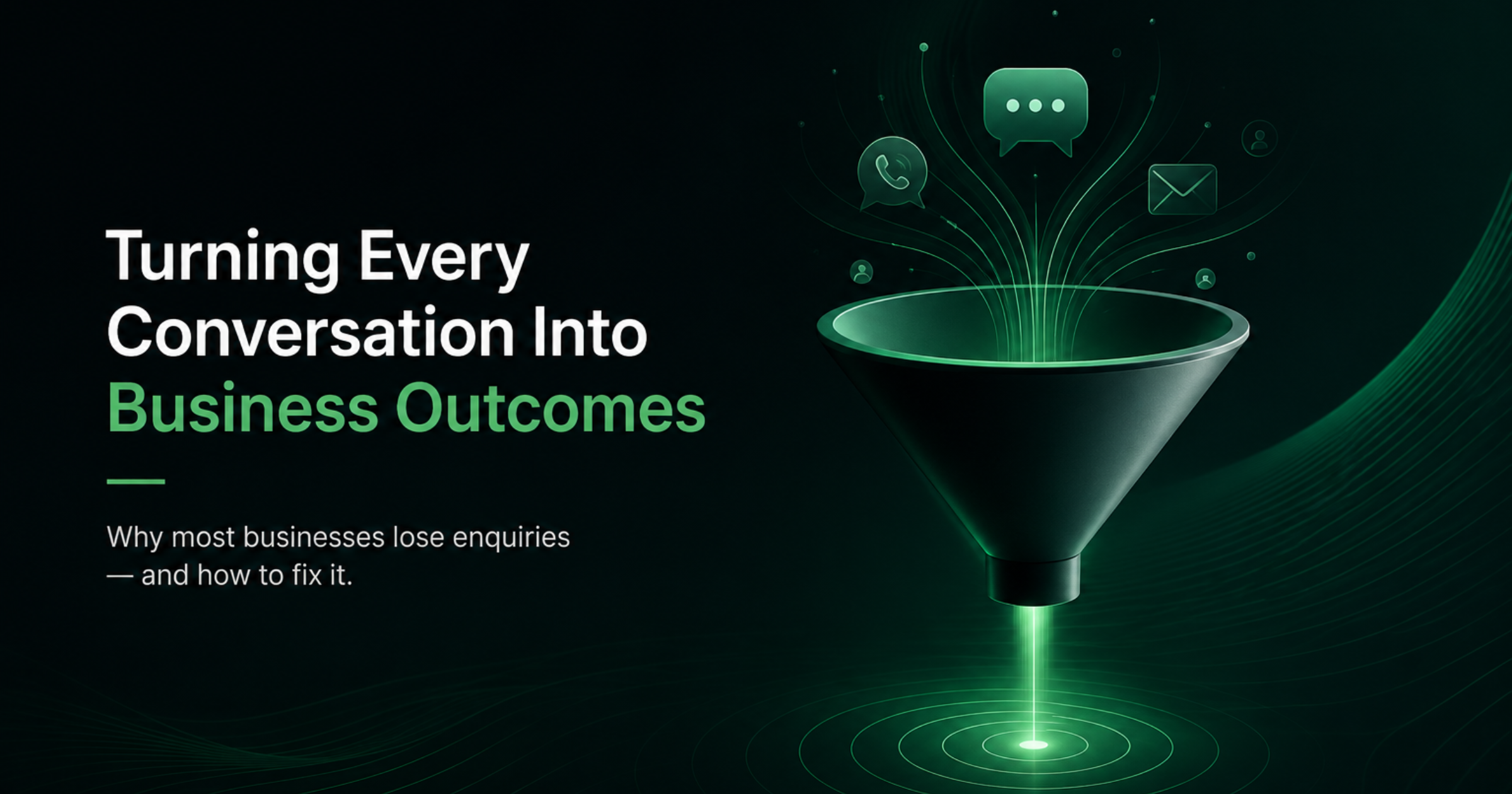
Most businesses don't have a lead generation problem. They have an enquiry-to-action problem.
Executive Summary
Businesses spend millions generating customer enquiries, yet very few can answer one simple question:
What happened after the customer reached out?
Most organisations measure lead generation, pipeline and revenue. Almost none measure the operational gap between a customer starting a conversation and that conversation becoming meaningful business action.
That gap is where revenue quietly disappears.
The organisations outperforming today are not simply generating more leads. They are ensuring every customer conversation automatically becomes a CRM record, a qualified opportunity, a booked appointment, a support ticket or an assigned task.
The competitive advantage is no longer attracting attention.
It is converting attention into action.
The Hidden Revenue Leak
Imagine this happens today.
A prospect calls your business.
Another submits a pricing enquiry.
Someone sends a WhatsApp asking if you serve their location.
An existing customer emails requesting urgent support.
Now ask one question.
What happened next?
Could your business answer that in under thirty seconds?
For most organisations, the answer is no.
Not because people don't care.
Because no one owns the complete journey between customer conversation and business action.
Marketing reports the enquiry.
Sales reports the opportunity.
Finance reports the acquisition cost.
But almost nobody measures what happens in between.
That invisible layer determines whether your marketing investment creates revenue or simply creates activity.
Every customer conversation should move the business forward. If it doesn't, your operating model is leaking revenue.
The Enquiry Completion Gap
Businesses lose enquiries in remarkably similar ways.
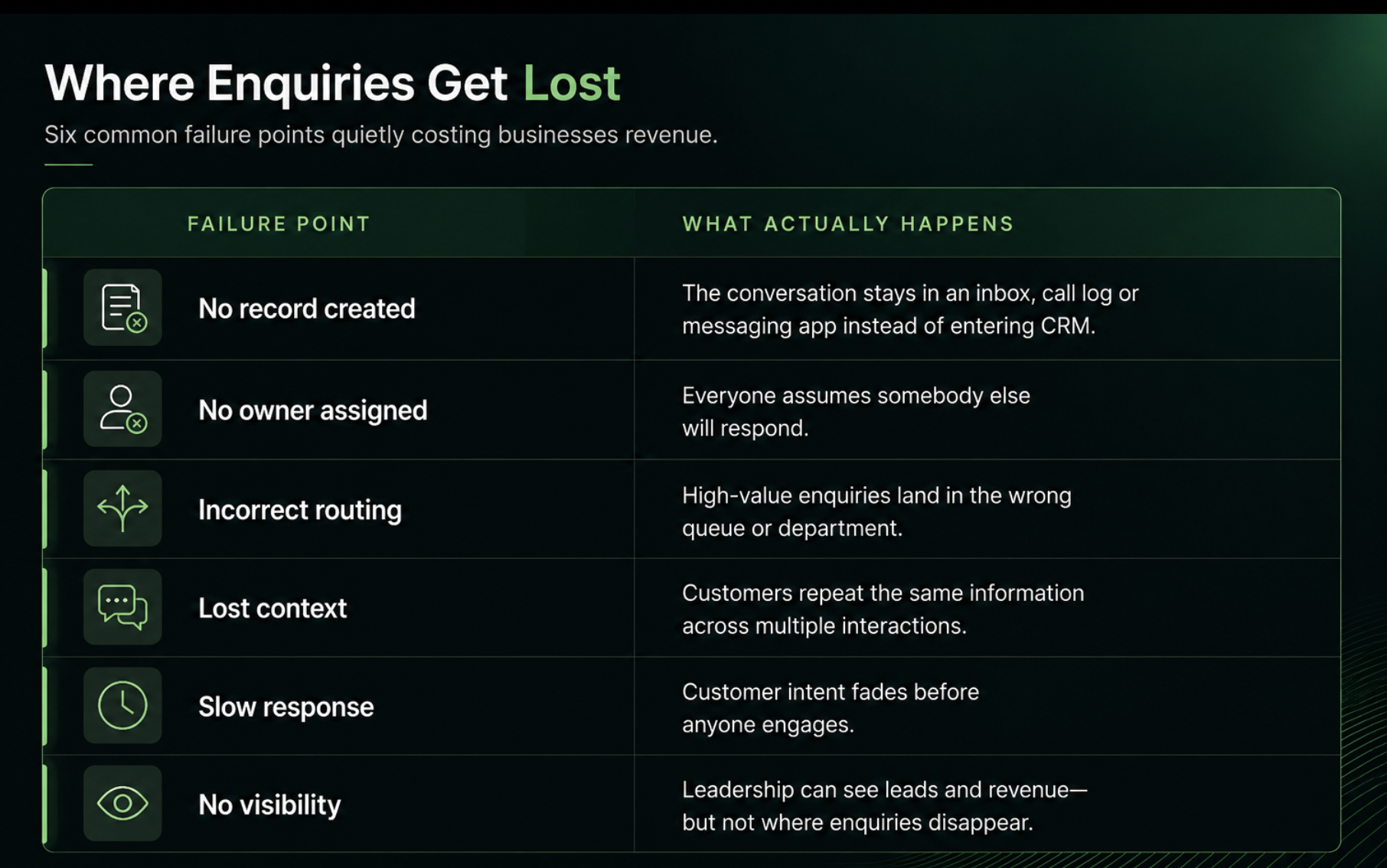
None of these failures seem significant on their own.
Together, they quietly determine whether marketing spend becomes pipeline or wasted opportunity.
Research over the past decade shows the problem has barely improved. Despite years of awareness, median B2B response times remain around 42 hours, while only a small percentage of organisations consistently respond within five minutes.
That tells us something important.
The problem isn't awareness.
It's architecture.
Why the First Five Minutes Matter
Speed isn't just good customer service.
It's one of the strongest conversion variables in modern sales.
Recent benchmark analysis shows a dramatic relationship between response time and conversion:
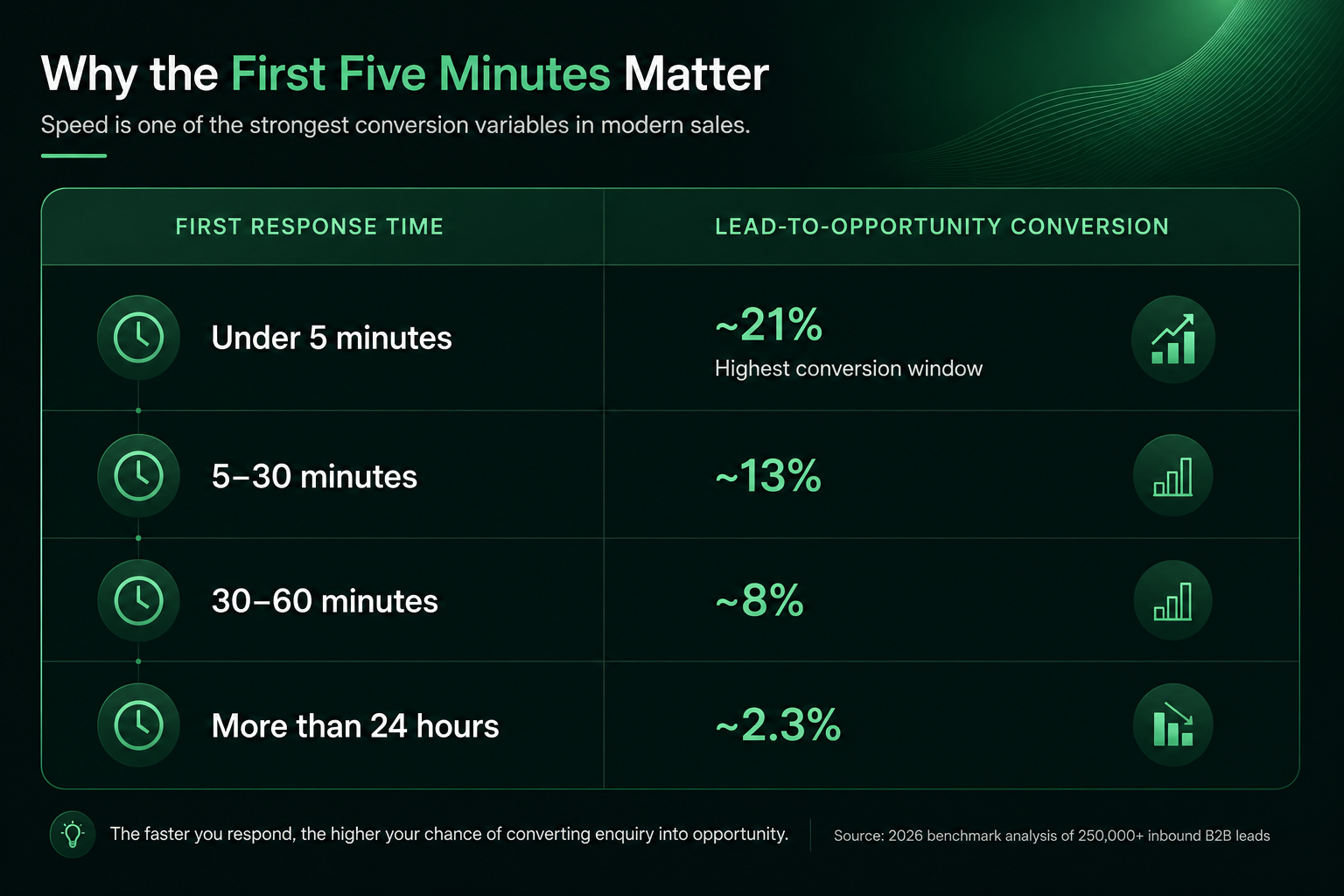
The reason is simple.
Customers rarely contact just one company.
They contact several.
The business that responds first often becomes the business that wins.
Meanwhile, customer expectations have changed.
People increasingly expect businesses to respond immediately—even outside normal business hours. Unfortunately, many of the highest-intent enquiries arrive precisely when teams are unavailable.
The result is uncomfortable.
Your best opportunities are often the ones you're least prepared to handle.
The Real Problem Isn't People
Slow follow-up is often treated as a performance issue.
The data suggests otherwise.
Sales professionals spend less than half of their working week actually selling. The majority of their time is consumed by CRM updates, administrative work, internal coordination and searching for information.
Adding more people rarely solves the problem.
It simply adds more manual handoffs.
Modern customer operations improve performance by removing unnecessary work between:
Conversation → System → Action
Instead of expecting teams to manually capture every interaction, leading organisations automate the operational layer that sits between customers and internal systems.
The Next Operating Model
This is why customer operations are rapidly changing.
The question is no longer whether AI can answer enquiries.
The real question is:
Can every conversation automatically trigger meaningful business action?
Analysts increasingly agree that this is where enterprise customer operations are heading.
AI is expected to resolve a growing share of routine customer interactions over the next few years—but only when connected directly to CRM, scheduling, ticketing and workflow systems.
The organisations seeing measurable value are not replacing people.
They're eliminating operational friction before people become involved.
The future operating model looks like this:
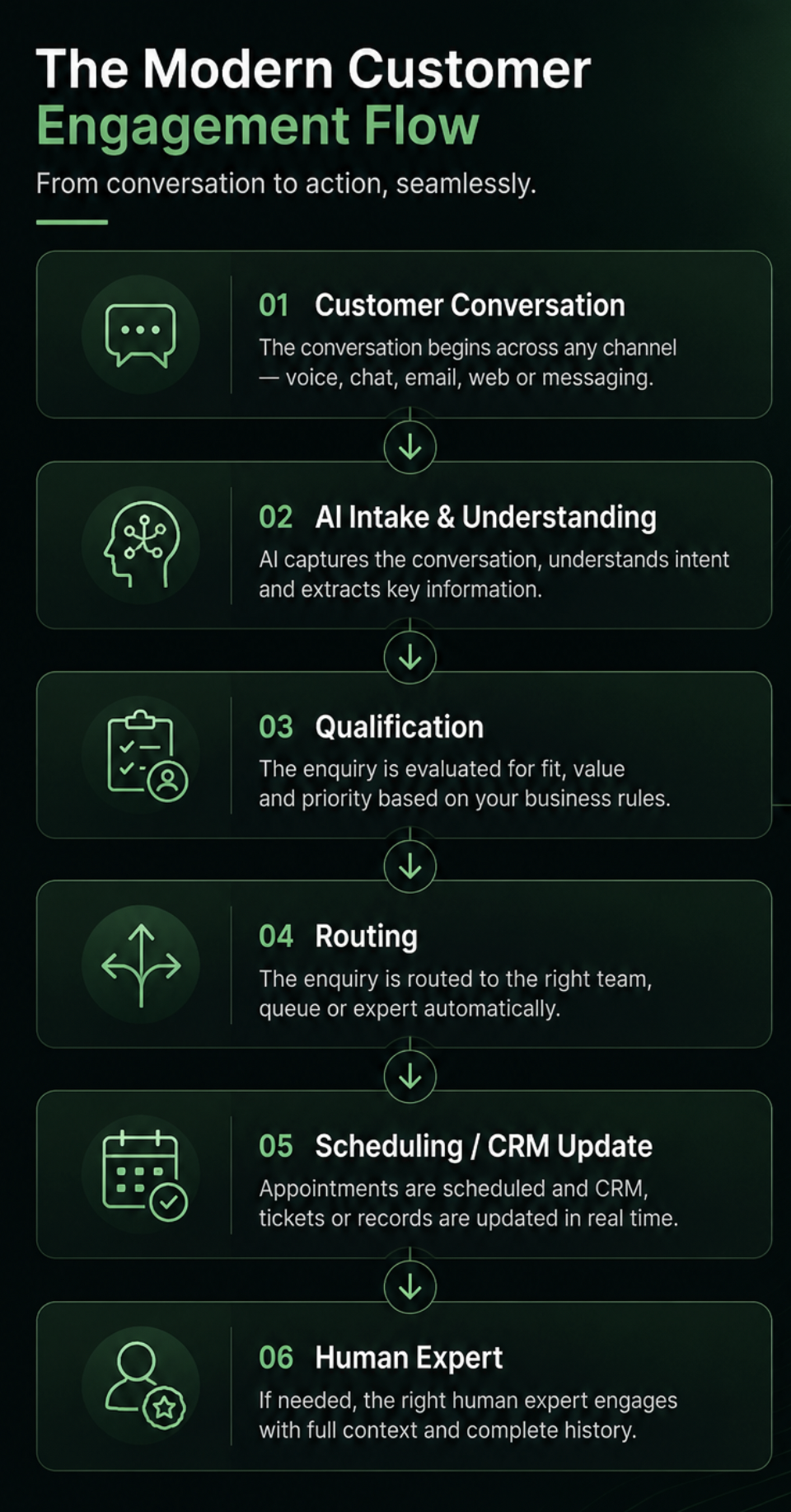
Automation owns the predictable work.
People own judgement, negotiation and relationships.
What Great Customer Operations Look Like
Every customer conversation should automatically create business momentum.
An effective enquiry workflow should:
Capture the conversation
Every interaction becomes structured business data.
Understand customer intent
Identify what the customer actually needs—not just keywords.
Qualify the opportunity
Assess fit based on your business criteria.
Schedule the next step
Book appointments using live availability.
Assign ownership
Route enquiries to the right person immediately.
Trigger follow-up
Ensure every conversation progresses until resolved.
Escalate when needed
Transfer complex or urgent situations to a human—with complete context attached.
The objective isn't to automate selling.
It's to guarantee that every customer reaches the right human with the right context at the right time.
The Metric Most Businesses Never Measure
Most dashboards stop at leads and revenue.
The real operational insight lives in the middle.
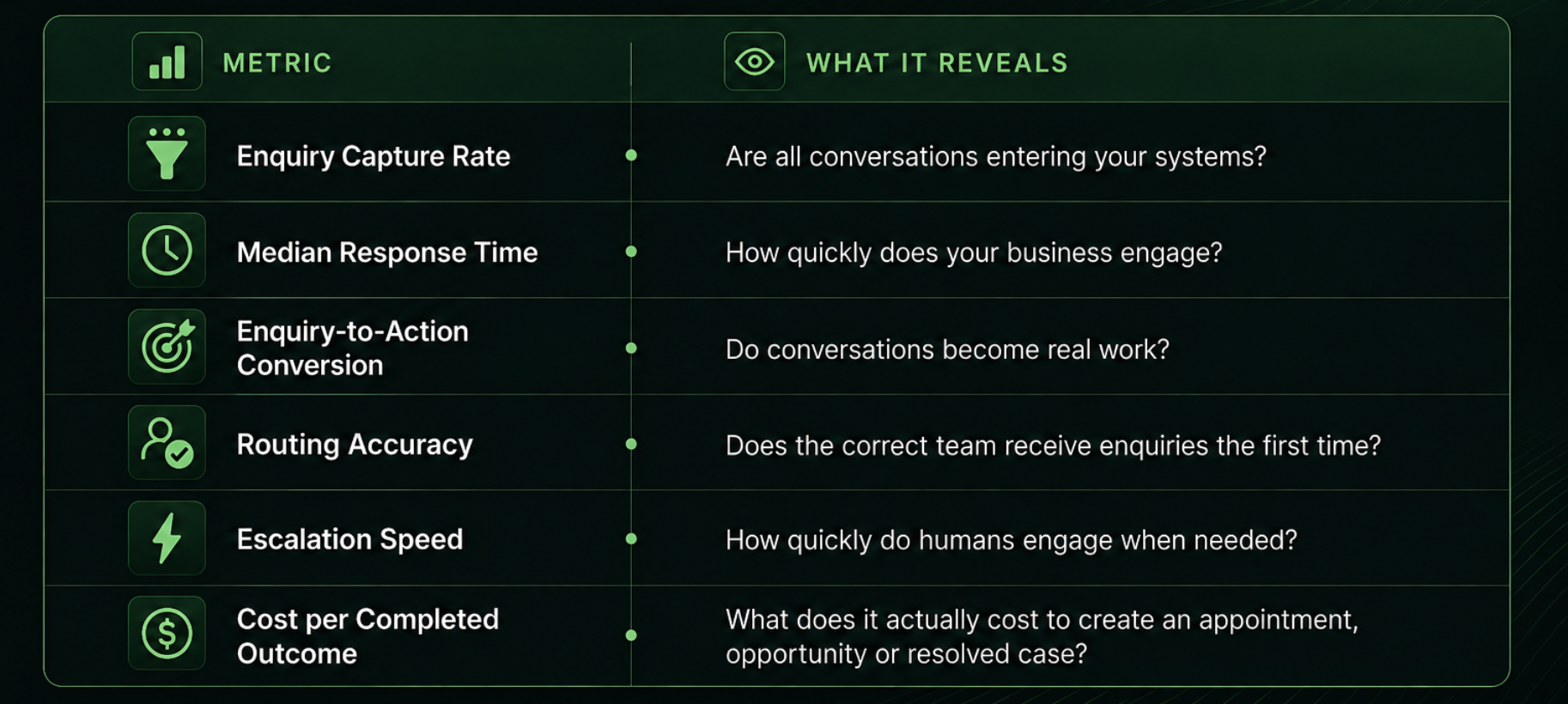
When measured by channel and time of day, these metrics almost always reveal concentrated operational bottlenecks that can be fixed without redesigning the entire business.
The Bigger Shift
For years, businesses have competed to generate more leads.
Increasingly, that is becoming the wrong objective.
The companies creating sustainable advantage are optimising for something different:
More completed conversations.
Lead generation creates demand.
Operational intelligence converts demand into measurable business progress.
The organisations that master this layer will consistently outperform those still focused only on acquiring more enquiries.
Where Lektik Fits
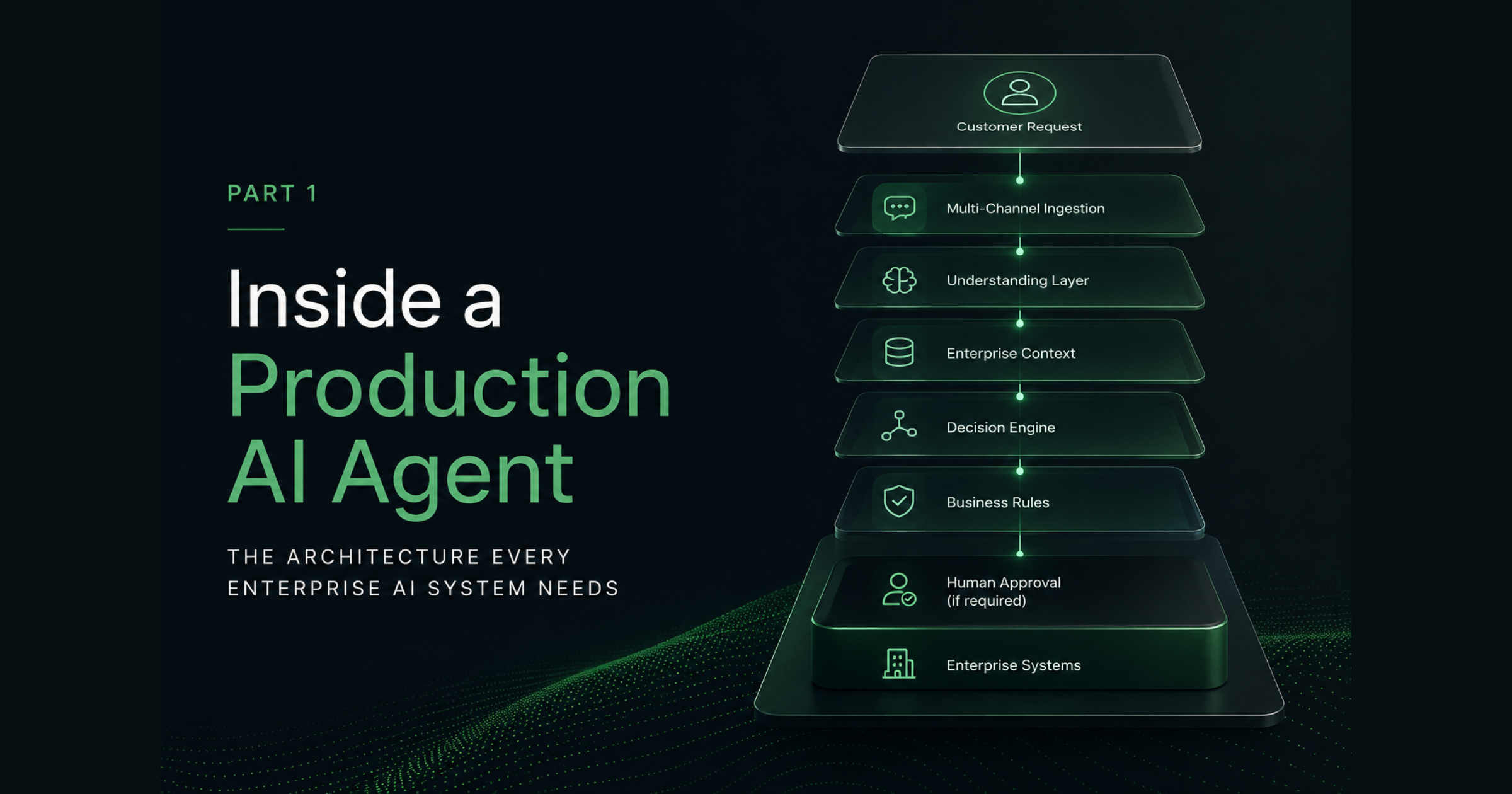
Lektik connects customer conversations directly to enterprise workflows.
Whether an enquiry begins through voice, chat, email or a website form, the platform ensures every interaction becomes structured, measurable business action.
Instead of creating disconnected conversations, Lektik automatically connects enquiries to:
- CRM systems
- Scheduling platforms
- Ticketing systems
- Internal task management
- Business workflows
For voice-led customer engagement, Calrb enables organisations to answer calls around the clock, qualify customer intent, book appointments, update enterprise systems and escalate high-priority conversations with complete context preserved.
The result is simple.
Every conversation moves the business forward.
Executive Takeaway
Every customer enquiry has already been paid for.
Through marketing investment.
Brand trust.
Or a customer's decision to contact your business instead of someone else's.
The real question isn't how many enquiries you generate.
It's how many become meaningful business action.
Businesses don't lose customers when conversations begin.
They lose them when conversations stop moving.
The future of customer operations won't be defined by faster marketing.
It will be defined by operational systems that ensure every conversation becomes progress.
Frequently Asked Questions
What is enquiry-to-action conversion?
Enquiry-to-action conversion measures the percentage of customer conversations that become a meaningful business action, such as a CRM lead, booked appointment, assigned task or support ticket. It focuses on operational follow-through rather than lead volume.
What is considered a good lead response time?
Responding within five minutes is increasingly becoming the benchmark for high-performing organisations. Faster response significantly improves qualification and conversion compared to delays of several hours or days.
How does AI improve customer enquiry management?
AI enables businesses to respond instantly, capture structured information, qualify enquiries, schedule appointments, assign ownership and update enterprise systems automatically—reducing delays while preserving complete customer context.
Should AI replace customer-facing teams?
No. AI should manage predictable operational work such as intake, qualification, routing and scheduling. Human teams remain essential for negotiation, relationship building, complex decisions and sensitive customer interactions.
Why do businesses lose enquiries?
Most enquiries are lost because they never become structured business actions. Missing CRM records, delayed responses, poor routing, fragmented customer context and lack of ownership create operational gaps that quietly reduce conversion.
How can businesses eliminate enquiry leakage?
The most effective approach is connecting every communication channel directly to operational systems so that each conversation automatically generates a record, assigns ownership, triggers follow-up and remains visible until completion.