Why conversation history and RAG aren't memory and what enterprise agent architectures need to remember
TL; DR
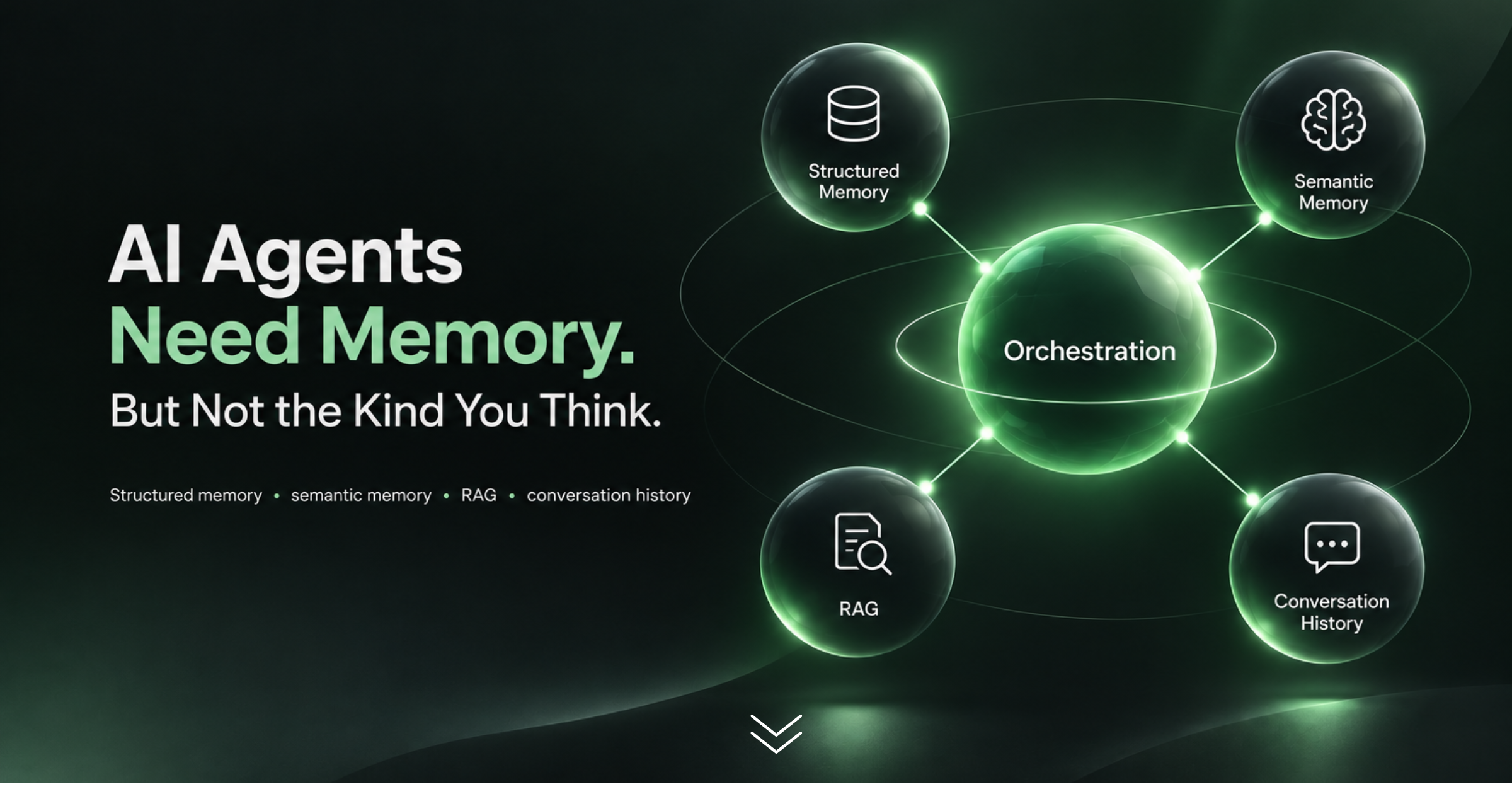
Most "AI agent memory" claims conflate four different things:
Raw conversation history • RAG retrieval • Semantic memory • Structured (episodic) memory
Each solves a different failure mode.
- Conversation history breaks under context-window limits.
- RAG retrieves from a static corpus, not from what a specific user or process actually did.
- Semantic memory holds durable facts but goes silently stale.
- Episodic memory preserves the "what happened, when, and why" that audit trails and governance depend on.
Gartner projects 40% of enterprise applications will embed task-specific AI agents by the end of 2026, up from under 5% in 2025, which means the memory architecture question is no longer theoretical.
It's the difference between an agent that's useful and one that's a liability.
Why "AI Memory" Is Doing Too Much Work
Ask three vendors what their AI agent's "memory" does, and you'll likely get three different answers - because the term is being stretched to cover retrieval, storage, and recall simultaneously.
That ambiguity has real consequences: enterprise buyers evaluate "memory" as a checkbox feature, then discover in production that their agent re-asks resolved questions, contradicts a decision made two weeks earlier, or can't explain why it took a given action.
Does RAG Give an AI Agent Memory?
No.
RAG (Retrieval-Augmented Generation) retrieves from a knowledge base - documents, policies, product data - that doesn't change based on what a particular user said or did.
Memory, by contrast, is a store that updates with every interaction and belongs to a specific user, task, or agent instance.
The key distinction: the two are complementary, not interchangeable, and treating them as the same thing is one of the most common architecture mistakes in production agent deployments today.
Gartner's February 2026 research on agentic infrastructure names this gap directly, framing it as AI's institutional memory problem.
The research projects that by 2028, more than half of AI agent systems will rely on context graphs - structured records of decisions, not just documents or embeddings - to solve it.
That's not a minor technical distinction.
It's the difference between an agent that knows facts and one that knows your facts.
Conversation History: The Illusion of Memory
The simplest - and most common - approach to "giving an agent memory" is appending the full prior conversation to each new prompt.
It feels like memory because the agent can reference what was just said.
It isn't memory. It's a growing prompt.
Why Does My AI Agent Forget Things Mid-Project?
Because conversation history hits a hard ceiling: the context window.
As threads grow, teams either truncate history (losing early context) or pay rising token costs to keep it all in play.
Recent academic testing makes the failure concrete: researchers at the University of Toronto and the Vector Institute found that a pure in-context memory approach failed to satisfy roughly half of user requests after just five interaction turns.
An agent that "remembers" only by re-reading the whole conversation every time isn't storing anything - it's re-deriving context from scratch, at increasing cost, with decreasing reliability.
For a task that spans a single session, this is tolerable.
For a multi-week project, a recurring workflow, or anything that needs to persist across sessions and users, it fails outright.
RAG: Knowledge, Not Memory
RAG earned its place in enterprise AI by solving a real problem: grounding a model's answers in an organization's actual documents instead of its training data.
That remains valuable - for policy lookup, product knowledge, and domain grounding, RAG is often the right tool.
What's the Difference Between RAG and Agent Memory?
RAG answers:
"What does the organization know?"
Memory answers:
"What happened with this user, task, or account?"
A RAG pipeline retrieving from a compliance manual will give the same answer to every user who asks the same question.
Memory is what lets an agent say, correctly, that this client already escalated this issue last Tuesday and this was the resolution.
RAG has no concept of that history unless it's been separately captured and indexed - which is a memory problem, not a retrieval problem.
Semantic Memory: What the Agent Knows About You
Semantic memory is the layer most people mean when they say an AI "remembers" them: durable facts and preferences extracted from interactions - a user's role, an account tier, a stated preference - stored so the agent doesn't have to be re-told every session.
What Happens When an AI Agent's Memory Goes Stale?
This is where enterprise risk concentrates.
Semantic memory is typically fast to retrieve and easy to build, but it's also where the worst production bugs hide: a fact written once and never invalidated.
A user promoted from "viewer" to "approver" whose permission fact was never updated isn't a UI glitch - it's an agent silently acting on outdated authority.
Structured facts belong in a system built for exact truth and controlled updates, not a similarity-search index where the closest match isn't necessarily the current one.
The practical distinction that matters here: semantic memory should be architected as a source of controlled, current truth - with clear write and invalidation rules - not just a growing pile of embeddings.
Episodic and Structured Memory: What Actually Happened
This is the layer most enterprise AI conversations skip entirely, and it's the one that matters most for governed, auditable systems.
Why Does an Enterprise AI Agent Need an Audit Trail, Not Just a Summary?
Episodic memory preserves specific events - with time, causality, and the participants involved - rather than a compressed fact.
The distinction matters concretely:
A semantic fact might say:
"Client declined Option A."
An episodic record preserves:
Why - the budget constraint, who raised it, what was approved instead, and when.
For regulated industries, customer-facing agents, or any workflow where a decision needs to be explained after the fact, that difference is the entire point.
A summarized fact can't reconstruct a decision trail.
An episodic record can.
This taxonomy - working, episodic, semantic, and procedural memory - comes from CoALA (Cognitive Architectures for Language Agents), a framework published by researchers at Princeton in 2023.
It's a useful anchor precisely because it forces a question enterprise buyers should be asking:
Which of these four does your vendor's "memory" feature actually provide?
How It Fits Together in a Real Architecture
How Should Enterprises Architect Memory for Production AI Agents?
The pattern that holds up in production isn't picking one memory type - it's composing all of them under a layer that tracks where every piece of context came from.
RAG retrieves from the corpus.
Semantic memory supplies current facts.
Episodic memory supplies history and rationale.
An orchestration layer merges these into the model's working context.
And critically, provenance is tracked in system logs, not buried in the prompt.
The model doesn't need to know which source answered which part of a query.
The system does, and it needs to be able to show its work.
This is the layer where most off-the-shelf agent tooling stops short, and it's the layer where Lektik works directly with enterprise clients: designing the orchestration between retrieval, semantic memory, and structured episodic memory so that agents don't just sound coherent, but are governed, auditable, and traceable end-to-end.
The architecture question isn't:
"Does this agent have memory"
It's:
"Which kind, stored where, invalidated how, and traceable to whom."
With Gartner projecting a steep jump in task-specific agent adoption through the remainder of 2026, and McKinsey's State of AI research finding that while 88% of organizations now use AI in at least one business function, only about 6% qualify as "AI high performers" attributing 5% or more of EBIT to AI, the gap between deploying an agent and deploying one that's trustworthy at scale increasingly comes down to exactly this:
Memory architecture, not model choice.
What to Ask Your AI Vendor
Before treating "memory" as a solved checkbox, enterprise buyers should get specific answers to:
01. Does "memory" here mean retrieval or recall?
If it's RAG alone, it isn't memory.
02. Where do facts live, and how are they invalidated?
A fact with no expiration or update path is a liability waiting to surface.
03. Is there an audit trail for agent decisions?
Or only a summary of outcomes?
04. Who owns provenance tracking?
Is it visible in logs, or does the model have to "remember" it was told something, with no external record?
FAQ
Is RAG a Type of Memory?
No.
RAG retrieves from a static or slowly-updated knowledge corpus.
Memory is a dynamic store tied to a specific user, task, or agent instance that updates with every interaction.
What's the Difference Between Semantic and Episodic Memory in AI Agents?
Semantic memory stores generalized facts (what is true now - a role, a preference, an account status).
Episodic memory stores specific past events with time, causality, and context intact (what happened, when, and why).
Why Do AI Agents Contradict Earlier Decisions?
Usually because the system relies on conversation history or summarized facts rather than a structured episodic record - so the reasoning behind a prior decision was never preserved in a retrievable, current form.
Do Enterprises Need All Four Memory Types, or Just Some?
It depends on the use case.
Simple assistants may need only conversation history and RAG.
Agents handling ongoing workflows, customer history, or regulated decisions typically need semantic and episodic memory as well, composed under a governed orchestration layer.
What's the Cost of Getting Agent Memory Architecture Wrong?
Stale facts acted on with silent confidence, decisions that can't be explained or audited, and rising token costs from re-deriving context that should have been stored.
In regulated or customer-facing contexts, these aren't just UX issues - they're governance and compliance exposure.