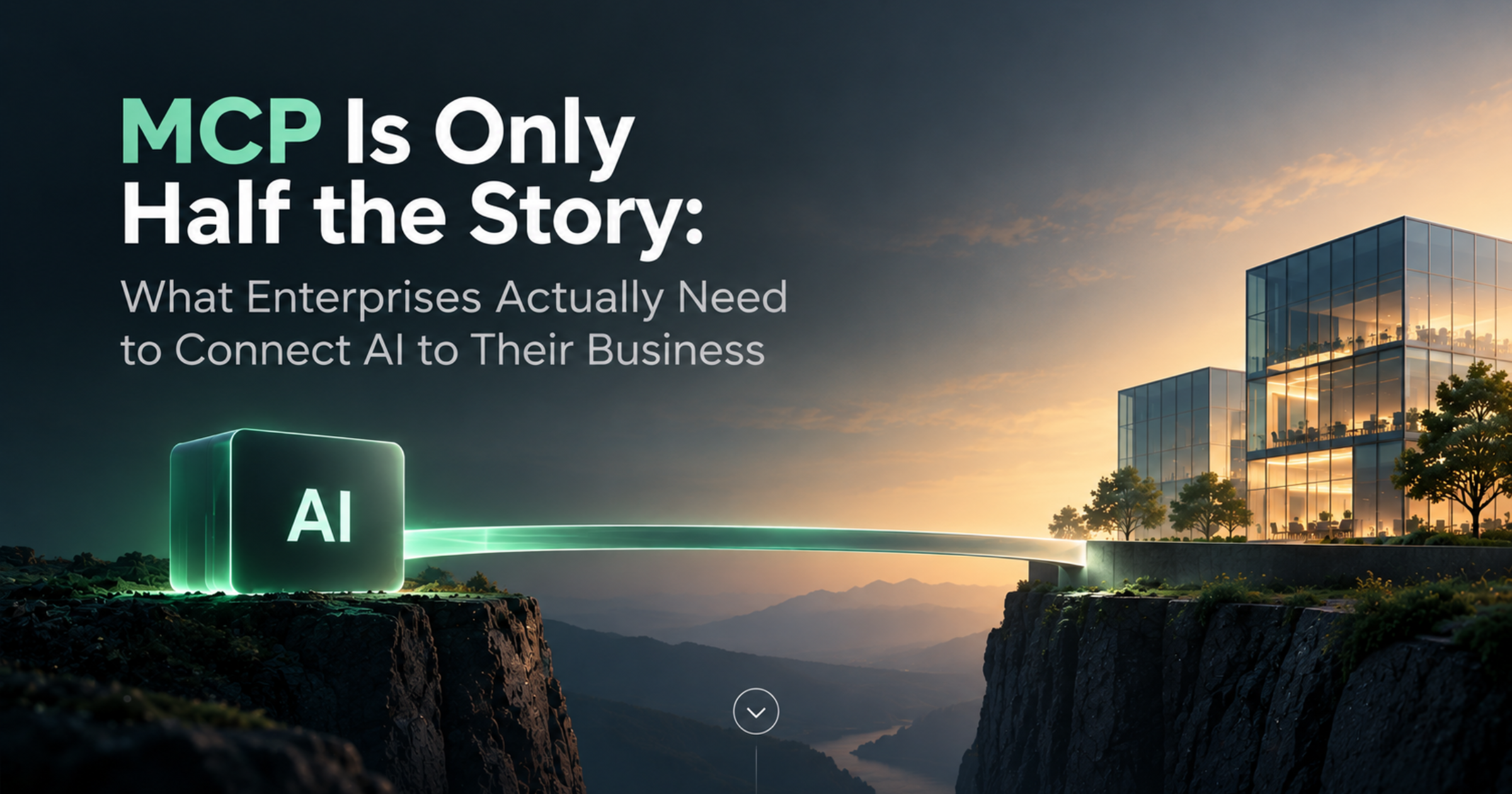
Model Context Protocol (MCP) is changing how AI applications connect with enterprise systems.
An AI agent can interact with CRMs, ERPs, databases, documents, APIs and business applications through standardized interfaces. Instead of building a completely different integration approach for every AI application, MCP provides a common way to expose tools, resources and context.
That is an important step forward.
But connecting AI to enterprise systems is only the beginning.
The harder question is:
What happens after the AI connects?
An agent having access to information does not automatically mean it knows which information to trust, how systems relate to one another, what business rules apply, what actions it is authorized to take, or when a human needs to intervene.
This is why MCP should be viewed as an important part of the enterprise AI architecture—not the architecture itself.
MCP Solves an Important Part of the Connectivity Problem
Enterprise AI faces a fundamental integration challenge.
Business information is distributed across:
- CRM platforms
- ERP systems
- Operational databases
- Data warehouses
- Documents
- SaaS applications
- Internal APIs
- Legacy systems
MCP standardizes how AI applications can interact with external tools and context.
That can significantly simplify how AI applications connect to the systems where enterprise work happens.
But enterprise AI still needs to answer several additional questions:
Which information should it trust?
What does that information mean within the business?
What is the agent allowed to access?
What happens when two systems disagree?
What actions can the agent take?
When does a human need to approve an action?
Can we reconstruct what happened if something goes wrong?
This is where enterprise AI architecture becomes much broader than connectivity.
Access to Data Is Not Access to Business Context
Imagine an executive asks an AI agent:
“Why did revenue from our largest account decline this quarter?”
The agent may have access to:
- CRM records
- ERP revenue data
- customer support tickets
- contracts
- pricing information
- product usage data
Technically, the agent is connected.
But the systems may tell different stories.
The CRM may classify the account one way.
The ERP may use another classification.
The contract may define a different billing period.
A recently approved document may contain an adjustment that has not yet propagated to every system.
The AI therefore faces a problem that connectivity alone cannot solve:
Which information represents the business truth for this particular question?
That is the difference between data access and business context.
For AI to reason reliably across enterprise information, it needs more than raw data. It needs metadata, ownership, lineage, relationships, business definitions, freshness and governance context.
MCP can help expose systems and capabilities.
The surrounding enterprise architecture must help the AI understand how that information should be interpreted.
Enterprises Need Context and Authority
Consider a simpler example.
Your CRM says a customer has 4,200 employees.
Your financial system says 3,900.
A recently approved account document says 4,100.
An AI agent should not simply retrieve all three numbers and choose whichever appears most probable.
It needs context.
Which system owns this information?
When was each value updated?
Is one source authoritative for account planning while another is authoritative for billing?
Has the latest value been formally approved?
Does a business rule determine which source takes precedence?
This requires what we think of as a Context and Authority Layer.
It helps an AI system understand:
- source authority
- data ownership
- freshness
- lineage
- business definitions
- relationships between systems
- organizational terminology
- policies governing the information
- approved versus provisional information
This is the difference between an AI system that can retrieve enterprise information and one that can reason within the enterprise.
A Five-Layer Architecture for Enterprise AI
When we think about enterprise AI systems at Lektik, we find it useful to look at the architecture across five layers.
1. Enterprise Systems
These are the systems where business information and operations already exist.
ERP → CRM → Databases → Documents → Data Platforms → SaaS → Internal APIs
AI should work with this existing business architecture rather than forcing the enterprise to rebuild everything around the AI.
2. Connectivity
This layer allows AI applications and agents to interact with enterprise systems.
MCP → APIs → Connectors → Events → Integration Services
MCP can play an important role here by providing a standardized mechanism for exposing tools, resources and context to AI applications.
But connectivity alone does not determine how information should be interpreted or what an agent should be allowed to do.
3. Context & Authority
This layer gives enterprise information meaning.
Business definitions → Metadata → Lineage → Source authority → Ownership → Relationships → Freshness
It helps agents understand not only what information exists, but what it means and which information should be trusted for a particular task.
4. Agents, Reasoning & Orchestration
This is where AI uses enterprise context to accomplish work.
Agents → Reasoning → Planning → Tool selection → Workflow orchestration
A production agent may need to gather information from several systems, apply business rules, reason across the information and coordinate multiple steps before reaching a conclusion or recommending an action.
5. Governance, Observability & Action
This layer determines what the AI can actually do—and provides visibility into what it did.
Identity → Permissions → Policies → Approvals → Audit → Observability → Execution
It should answer questions such as:
Who is the agent acting for?
Which systems can it access?
Which tools can it invoke?
Which decisions can it make independently?
Which actions require human approval?
What information influenced the decision?
What actions were executed?
Did any tools or workflows fail?
Can the entire process be reconstructed later?
This layer becomes increasingly important as AI moves from answering questions to performing real business operations.
Governance Must Travel With the Agent
There is a major difference between an AI system that generates information and one that changes the state of a business.
An agent that summarizes a sales report presents one level of risk.
An agent that can:
- change a customer record
- approve a purchase
- issue a refund
- modify a contract
- send an external communication
- update a financial workflow
operates at a very different level.
Enterprise AI therefore needs controls around identity, access, authority, execution, approvals and auditability.
The underlying principle should be straightforward:
Give an agent the minimum data, tools and authority required to complete its job.
And when greater authority is required, make the escalation and approval process explicit.
Observability Becomes a Production Requirement
As AI agents become part of operational workflows, traditional application monitoring is no longer enough.
Enterprises need visibility into the behavior of the agent itself.
That can include:
- tool calls
- workflow steps
- failures and retries
- latency
- model and infrastructure usage
- policy violations
- approval requests
- execution outcomes
- unusual agent behavior
If an AI-driven workflow fails, organizations need to understand more than whether an API returned an error.
They need to know:
What was the agent trying to accomplish?
Which information did it use?
Which tools did it call?
What decision did it make?
What action was ultimately executed?
Without this visibility, it becomes difficult to operate AI agents reliably in production.
From Connected Agents to Orchestrated Business Workflows
Enterprise processes rarely exist inside a single system.
Consider procurement.
An AI-driven procurement workflow may need to:
- Check current inventory.
- Review supplier contracts.
- Compare historical pricing.
- Verify approved vendors.
- Analyze demand forecasts.
- Apply procurement policies.
- Recommend an action.
- Request approval where required.
- Execute the purchasing workflow.
- Record and monitor the outcome.
MCP can help the agent interact with the systems involved.
But connectivity does not determine how those systems should be used together.
The architecture still needs to coordinate data, context, reasoning, policy, human approval and action across the workflow.
That distinction becomes increasingly important as enterprises move from isolated AI assistants toward multi-step agentic systems.
The Executive Question Is Bigger Than “Do We Need MCP?”
For technology leaders, the more useful question is:
“What needs to exist around MCP so AI can operate safely and intelligently across our enterprise?”
Before moving from AI experimentation into production, organizations should be able to answer several questions.
Can AI identify the authoritative source?
If multiple systems contain overlapping or conflicting information, is there a defined source of authority?
Can AI understand business context?
Does the agent understand business definitions, relationships, policies, workflows and organizational terminology?
Can access follow the user and the agent?
Can permissions and identity be enforced consistently as the agent moves across systems?
Can actions be controlled?
Can the architecture clearly distinguish between an agent that can read, recommend, request approval and execute?
Can decisions be traced?
Can the organization determine which information, tools, reasoning steps and approvals contributed to an action?
Can agent behavior be monitored?
Can teams detect failures, abnormal behavior, policy violations and degraded workflows before they become business problems?
Can the architecture scale?
Can new agents reuse enterprise context, integrations and governance controls—or does every new AI application require another collection of custom integrations?
These questions move the conversation from AI connectivity to enterprise AI infrastructure.
Where Lektik Fits
At Lektik, we see MCP as an important part of the emerging enterprise AI stack—not the destination.
The bigger opportunity is not simply connecting an AI model to another API.
It is creating the infrastructure that allows AI to understand the business before it acts on the business.
That means bringing together:
Connectivity
Connecting AI to existing enterprise systems through MCP, APIs, connectors and integration services.
Context
Giving agents the business definitions, relationships and information required to understand what they are working with.
Authority
Establishing which sources should be trusted for particular decisions and workflows.
Reasoning & Orchestration
Enabling agents to work across systems and multi-step business processes rather than answering from isolated sources.
Governance
Controlling what agents can access, recommend, approve and execute.
Observability
Providing visibility into agent decisions, tool usage, failures, approvals and outcomes.
Action
Connecting AI reasoning to real enterprise workflows with appropriate safeguards and human intervention.
The objective is not to replace the enterprise architecture with an AI layer.
It is to make AI work intelligently within the architecture the business already depends on.
At Lektik, that means helping enterprises build AI systems around their existing business architecture—not asking the business to rebuild itself around an AI model.
MCP Is Infrastructure. The Advantage Is What You Build Around It.
MCP matters because AI needs standardized ways to interact with the systems where enterprise work happens.
But interoperability alone does not create enterprise intelligence.
The next challenge is making those connections:
context-aware, authoritative, governed, observable and actionable.
Enterprises that solve this problem will have more than AI connected to their systems.
They will have AI capable of operating within the complexity, policies and workflows of the business itself.
MCP connects AI to the enterprise.
The architecture around it determines whether AI can actually work for the enterprise.
Frequently Asked Questions
What is Model Context Protocol (MCP)?
Model Context Protocol is an open standard that provides a standardized way for AI applications to interact with external systems that expose tools, resources and context.
Is MCP enough for enterprise AI?
MCP can provide an important part of the connectivity layer, but enterprise AI requires additional capabilities around trusted business context, source authority, identity, permissions, governance, orchestration, observability and controlled execution.
What does enterprise AI need beyond MCP?
Production enterprise AI typically requires business context, metadata, source authority, identity and access controls, policy enforcement, workflow orchestration, human approvals, auditability, observability and action management.
What is a Context and Authority Layer?
A Context and Authority Layer helps AI understand how enterprise information should be interpreted and which sources should be trusted for a particular task. It can incorporate source ownership, lineage, freshness, business definitions, relationships and governance rules.
How is MCP different from an AI agent control plane?
MCP standardizes interactions between AI applications and external tools and context. An agent control plane operates at a broader level, managing areas such as agent identity, permissions, policies, coordination, lifecycle, observability and execution across agents and enterprise services.