A SaaS founder in Austin closes a $4 million seed round and does what most venture-backed startups are expected to do: hire aggressively.
The engineering team grows from five developers to fourteen in under six months.
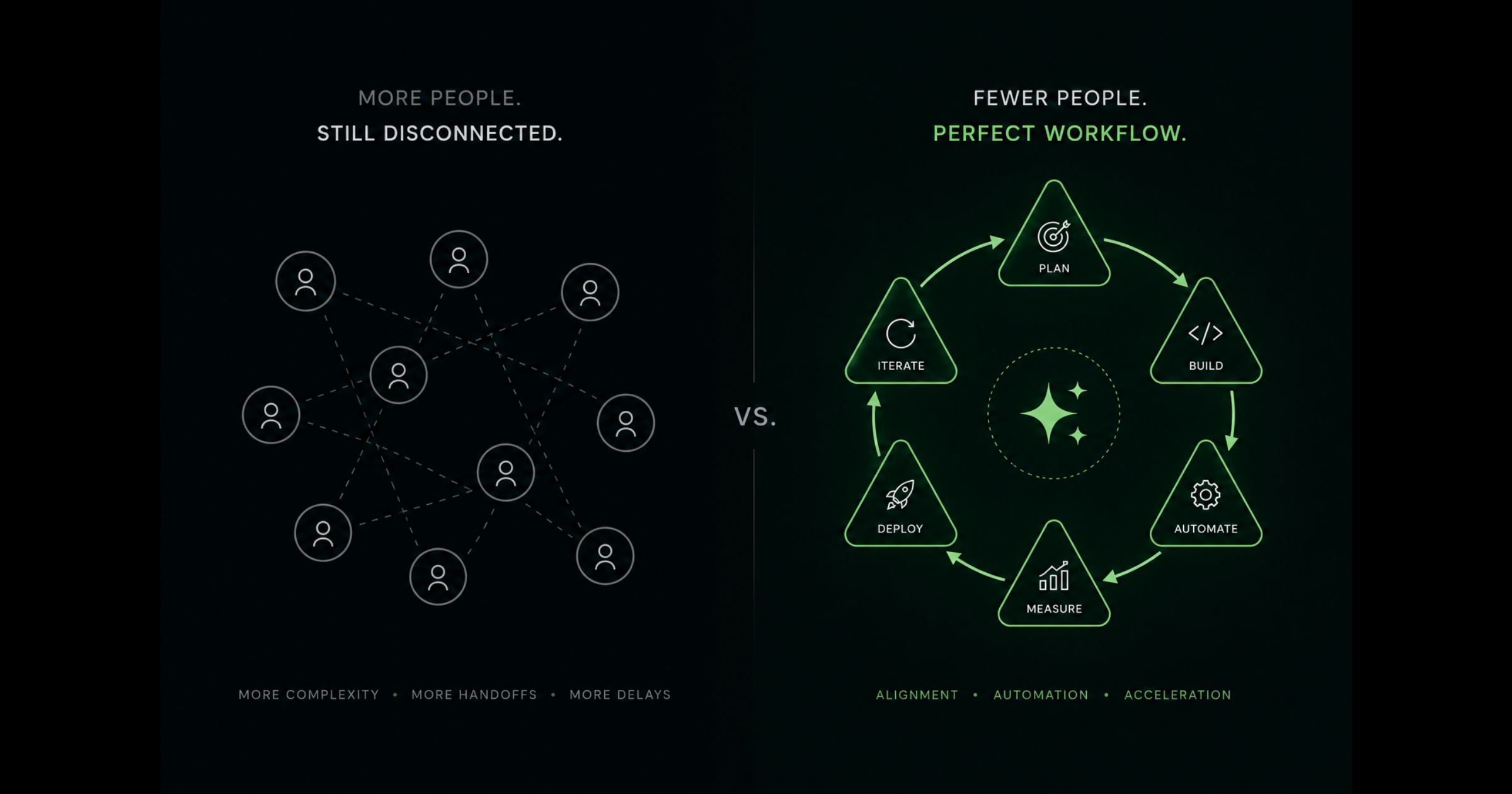
Headcount increases. Burn increases. Meetings increase.
Release velocity does not.
By the next quarter, the company is shipping fewer meaningful product updates than it did when the team was smaller. Product cycles slow down. Technical debt expands quietly beneath the surface. Senior engineers spend more time reviewing coordination artifacts than solving product problems.
This is becoming a common operating pattern across modern SaaS companies.
The issue is not developer quality. It is not a lack of tools. And increasingly, it is not even a lack of AI adoption.
The real issue is that many startups still operate with pre-AI organizational assumptions inside an AI-accelerated market.
That mismatch is now expensive.
For founders evaluating the best AI for SaaS development or exploring lean AI engineering consulting services, the important shift is not simply adding AI tools into workflows. It is redesigning product execution around leverage rather than labor volume.
The companies moving fastest today are not necessarily hiring the largest engineering organizations.
They are building AI-native delivery systems.
The Real Problem Is Coordination Overhead, Not Engineering Capacity
Most startup delivery slowdowns are incorrectly diagnosed as “lack of developer bandwidth.”
In reality, many teams are already operating with sufficient technical talent. The bottleneck emerges elsewhere:
- Excess coordination layers
- Fragmented ownership
- Bloated sprint structures
- Context-switching
- Review bottlenecks
- Inefficient handoffs
- Rising architectural inconsistency
As engineering teams scale, communication costs rise non-linearly.
A five-person engineering team can often operate through direct alignment. A fifteen-person team usually cannot. More planning rituals emerge. More documentation dependencies appear. More synchronization becomes necessary just to maintain operational coherence.
The result is subtle but measurable:
- More engineers
- More process
- Slower execution
This becomes especially visible in startup ecosystems like San Francisco and New York City, where venture-backed companies often equate operational maturity with organizational expansion.
But software delivery does not scale linearly with headcount.
In many cases, adding developers reduces execution efficiency unless the operating model itself changes.
AI is exposing this reality faster.
The Flawed Assumptions Most Startups Still Operate Under
Assumption 1: More Developers Automatically Increase Output
This assumption made partial sense in earlier software cycles where development execution was constrained primarily by manual coding throughput.
Today, implementation speed is increasingly commoditized.
Modern AI-assisted workflows can compress:
- Boilerplate generation
- Refactoring
- Documentation
- Testing support
- Internal tooling
- API integration scaffolding
- Repetitive engineering tasks
The bottleneck has shifted upward into:
- Decision quality
- System architecture
- Product clarity
- Workflow orchestration
- Prioritization discipline
A weak execution system with more developers simply produces larger operational drag.
Assumption 2: AI Replaces Developers
This framing misunderstands how high-performing AI-native teams actually operate.
AI is not replacing strong engineers.
It is increasing the leverage of focused engineering teams.
The highest-performing startups are using AI to:
- Reduce low-value execution overhead
- Shorten iteration cycles
- Increase experimentation capacity
- Improve developer focus
- Compress delivery timelines
The engineer remains central.
The operating model changes around them.
Assumption 3: Speed Requires Sacrificing Quality
Historically, startups accepted technical debt as the cost of rapid shipping.
AI-native product development changes this equation.
When implemented correctly, AI-assisted workflows can improve both:
- Delivery speed
- Engineering consistency
Automated testing support, faster refactoring, architecture-aware copilots, and workflow automation reduce the traditional tradeoff between velocity and maintainability.
The important distinction is operational discipline.
AI amplifies both strong systems and weak systems.
The AI-Native Execution Model
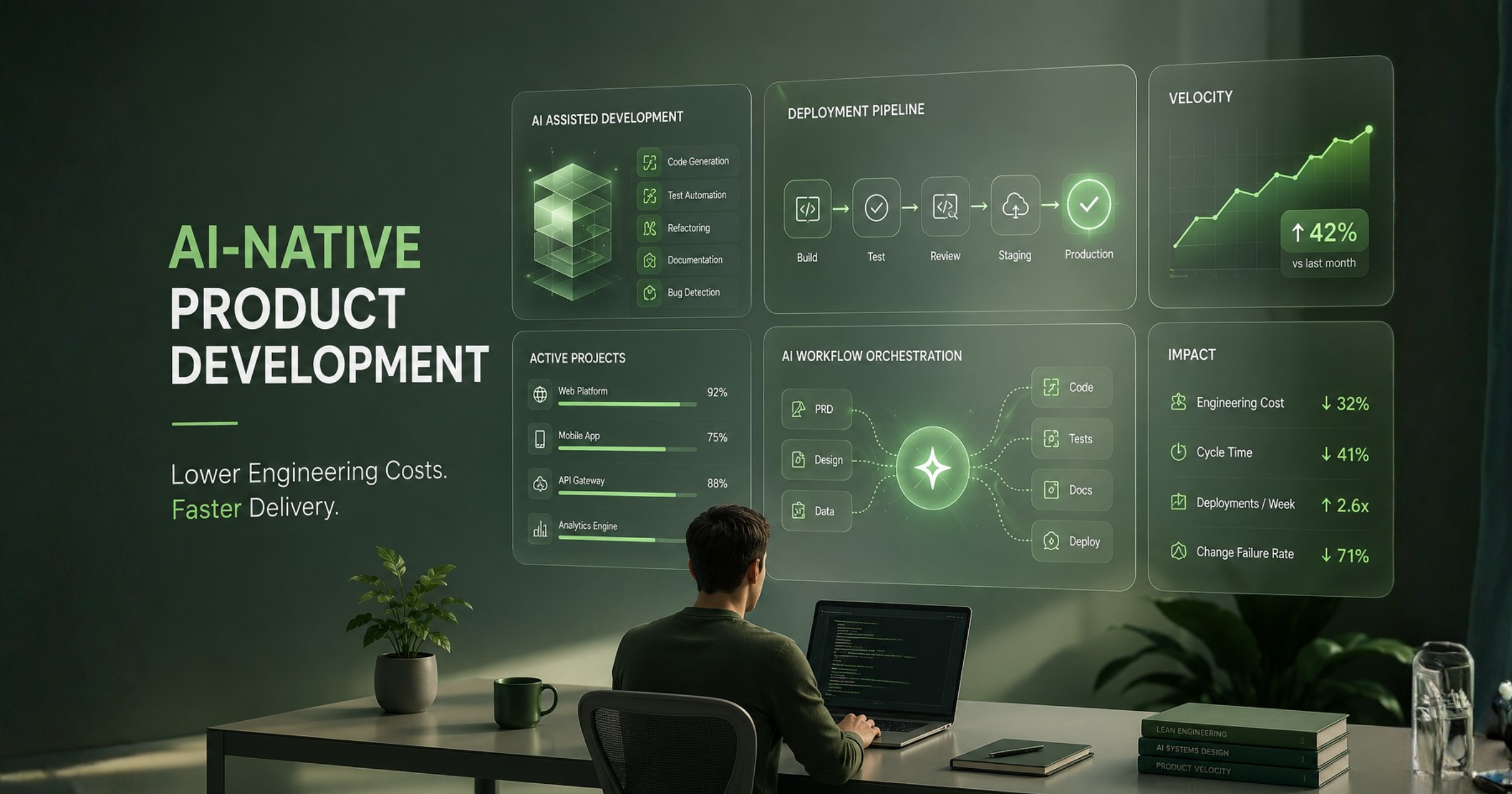
The startups achieving disproportionate product velocity are increasingly operating through what can be called the AI-Native Execution Model.
This model is not about replacing engineering teams with automation.
It is about maximizing execution-to-coordination ratio.
Core Principle 1: Keep Teams Structurally Lean
Smaller engineering teams tend to maintain:
- Faster communication loops
- Higher ownership density
- Cleaner accountability
- Lower synchronization cost
AI increases the effective output capacity of these smaller teams.
A six-person AI-native engineering organization can often outperform a traditional twelve-person team operating through heavier coordination structures.
This is becoming increasingly common among product startups in Seattle and Austin where lean operational models are prioritized earlier in company growth.
Core Principle 2: Automate Repetition, Not Judgment
AI performs best when handling operational repetition.
Examples include:
- Code scaffolding
- Test generation
- Internal documentation
- Workflow automation
- QA support
- Refactoring assistance
- Dependency analysis
Human engineers should remain focused on:
- Architecture decisions
- Product logic
- System reliability
- Strategic tradeoffs
- Customer-facing complexity
This separation matters.
Founders who attempt to fully automate engineering workflows usually create brittle systems. Founders who selectively automate execution layers create leverage.
Core Principle 3: Optimize for Iteration Speed
The highest-leverage startups are reducing cycle time between:
- Product idea
- Prototype
- User feedback
- Iteration
- Deployment
AI-native workflows compress this loop dramatically.
This has second-order business effects:
- Faster customer validation
- Lower wasted build cycles
- Reduced engineering burn
- Better product-market alignment
- More efficient capital deployment
In practical terms, this often matters more than raw feature volume.
Core Principle 4: Centralize Product Context
One hidden cost inside growing startups is fragmented institutional knowledge.
As teams scale, context disperses across:
- Slack threads
- Documentation systems
- Sprint boards
- Engineering tickets
- Individual contributors
AI-native organizations increasingly centralize operational context into structured systems that both humans and AI workflows can reference consistently.
This reduces:
- Rework
- Misalignment
- Onboarding drag
- Duplicate implementation effort
The operational impact compounds over time.
What Founders Should Actually Do
The practical implication is not “adopt more AI tools.”
Most startups already have access to tools.
The more important question is whether the company’s execution model still assumes pre-AI operational constraints.
What Founders Should Stop Doing
- Hiring reactively to solve process inefficiency
- Measuring engineering productivity through headcount
- Expanding management layers too early
- Separating product and engineering too aggressively
- Treating AI as a standalone experimentation initiative
These decisions often increase organizational drag faster than they improve delivery.
What Founders Should Prioritize Instead
1. Measure Coordination Cost
Track:
- PR review delays
- Sprint spillover
- Meeting load
- Deployment frequency
- Decision latency
- Time-to-iteration
These are often stronger indicators of execution health than team size.
2. Build AI Into Delivery Infrastructure
The best AI for SaaS development is rarely a single tool.
The advantage comes from integrated workflow systems:
- AI-assisted development environments
- Automated testing pipelines
- Context-aware documentation systems
- AI-supported QA workflows
- Internal developer tooling
The operational stack matters more than isolated tooling experiments.
3. Maintain High Ownership Density
Lean teams outperform bloated organizations when contributors own meaningful product surfaces end-to-end.
This reduces:
- Dependency chains
- Approval layers
- Coordination friction
- Delivery ambiguity
A small product team with strong ownership and AI leverage can move exceptionally fast.
4. Use External Expertise Selectively
Many founders are now exploring lean AI engineering consulting services not to outsource engineering entirely, but to redesign delivery systems more intelligently.
The most effective consulting relationships focus on:
- Workflow architecture
- AI integration strategy
- Delivery optimization
- Technical process redesign
- Product execution systems
The leverage comes from operational redesign, not contractor volume.
Why Lean AI-Native Teams Are Becoming Structurally Advantageous
Traditional startup scaling models were built around labor expansion.
AI-native companies increasingly scale through operational leverage instead.
This changes how founders should think about:
- Hiring
- Burn rate
- Team design
- Product velocity
- Capital efficiency
A lean engineering organization with strong AI-enabled workflows can now:
- Ship faster
- Maintain lower burn
- Reduce coordination drag
- Iterate more frequently
- Preserve architectural consistency
That is becoming strategically significant in slower funding environments where efficiency matters more than symbolic growth metrics.
The startups gaining advantage are not necessarily the ones with the largest engineering organizations.
They are the ones with the cleanest execution systems.
Conclusion The conversation around AI in software development is often framed incorrectly.
The real shift is not that AI replaces engineers.
It is that AI changes the economics of coordination.
For years, startups assumed scaling product velocity required scaling headcount proportionally. That assumption is weakening quickly.
AI-native product development introduces a different operating model:
- Smaller teams
- Higher leverage
- Faster iteration
- Lower coordination overhead
- More efficient execution systems
For founders, the strategic question is no longer whether to adopt AI.
It is whether the company’s operating structure is capable of translating AI leverage into measurable execution advantage.
The startups that solve this well will not simply build software faster.
They will operate with structurally different economics.