The AI conversation has changed.
For the past two years, organizations have focused heavily on AI adoption-deploying new tools, experimenting with use cases, and finding ways to improve productivity.
But a more important question is now emerging:
Who is governing AI inside the organization?
Across businesses today, employees are already using tools such as ChatGPT, Claude, Gemini, Copilot, AI coding assistants, and AI-powered workflow platforms. In many cases, these tools are being adopted faster than organizations can create policies to manage them.
The result is a growing governance gap.
AI adoption is accelerating. AI governance is struggling to keep pace.
According to Gallup data, approximately 50% of U.S. employees now use AI at work, marking a significant milestone in workplace adoption. Yet many organizations still lack comprehensive oversight into how these tools are being used across departments and business processes.
As AI becomes embedded into daily operations, governance is no longer optional-it is becoming a business requirement.
The Challenge Is Not AI Adoption
Most organizations can deploy AI tools.
The more difficult challenge is managing AI responsibly at scale.
Leadership teams increasingly find themselves asking critical questions:
- Which AI tools are employees using?
- Which business processes depend on AI?
- What company data is being shared with external models?
- Who is accountable for AI-generated decisions?
- How are AI risks being monitored and managed?
- What controls exist for compliance and auditability?
For many organizations, clear answers do not yet exist.
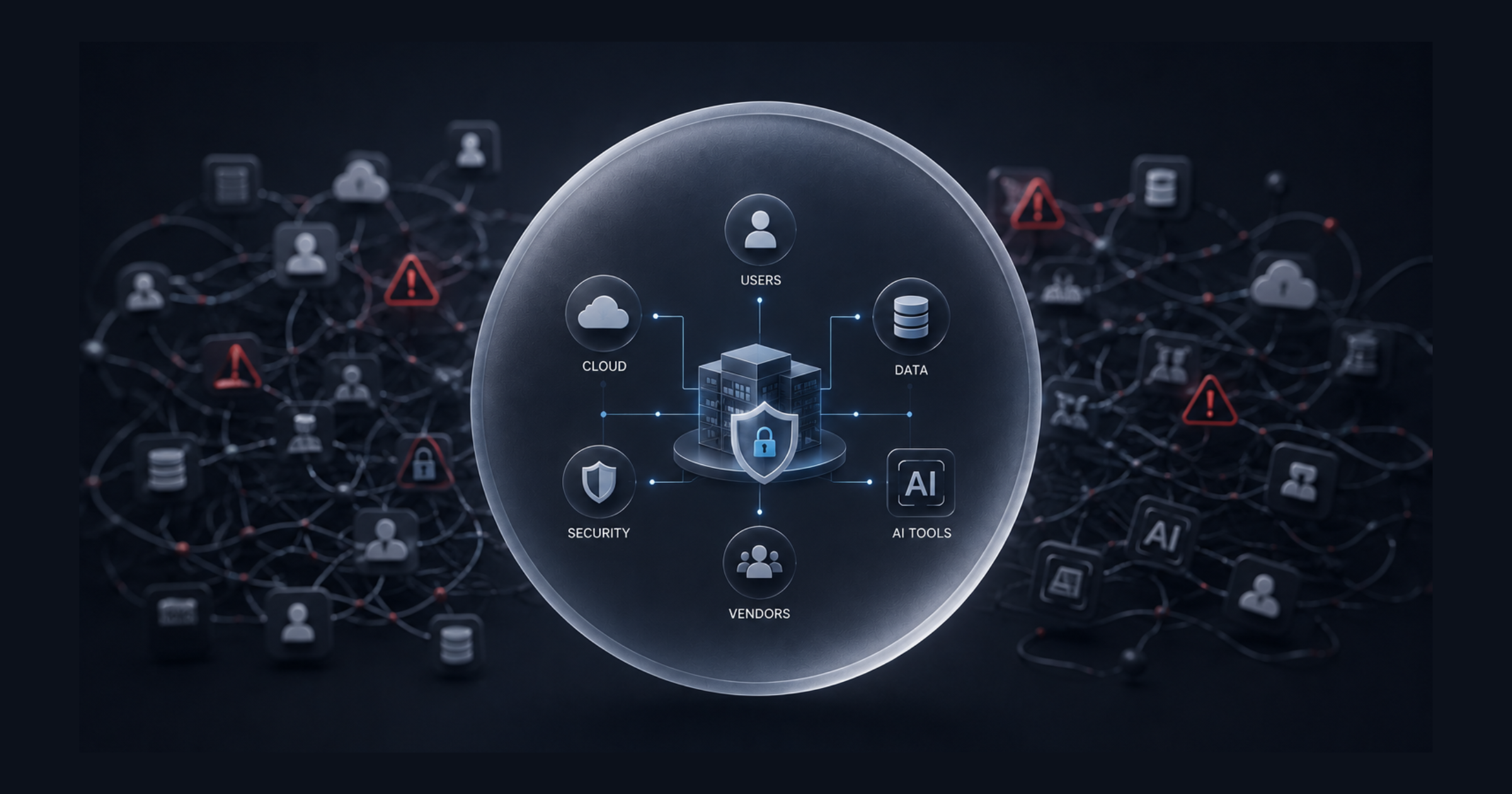
This challenge is often referred to as "Shadow AI"-the use of AI systems without formal visibility, governance, or approval from IT and security teams. As AI tools become easier to access, shadow AI is emerging as one of the biggest governance concerns facing modern enterprises.
AI Is Becoming Part of Daily Operations
AI is no longer confined to innovation labs and pilot projects.
Today, AI is increasingly involved in:
- Customer service interactions
- Sales and marketing workflows
- Software development
- Business operations
- Reporting and analytics
- Decision-support systems
- Knowledge management
- Process automation
As organizations integrate AI into core business functions, visibility becomes increasingly important.
Without governance, leaders may not know where AI is influencing decisions, what data it accesses, or how outcomes are being generated.
The challenge becomes even more significant as organizations begin deploying autonomous AI agents and agentic workflows that can perform actions with minimal human intervention.
Why Every Organization Needs a Digital Control Tower
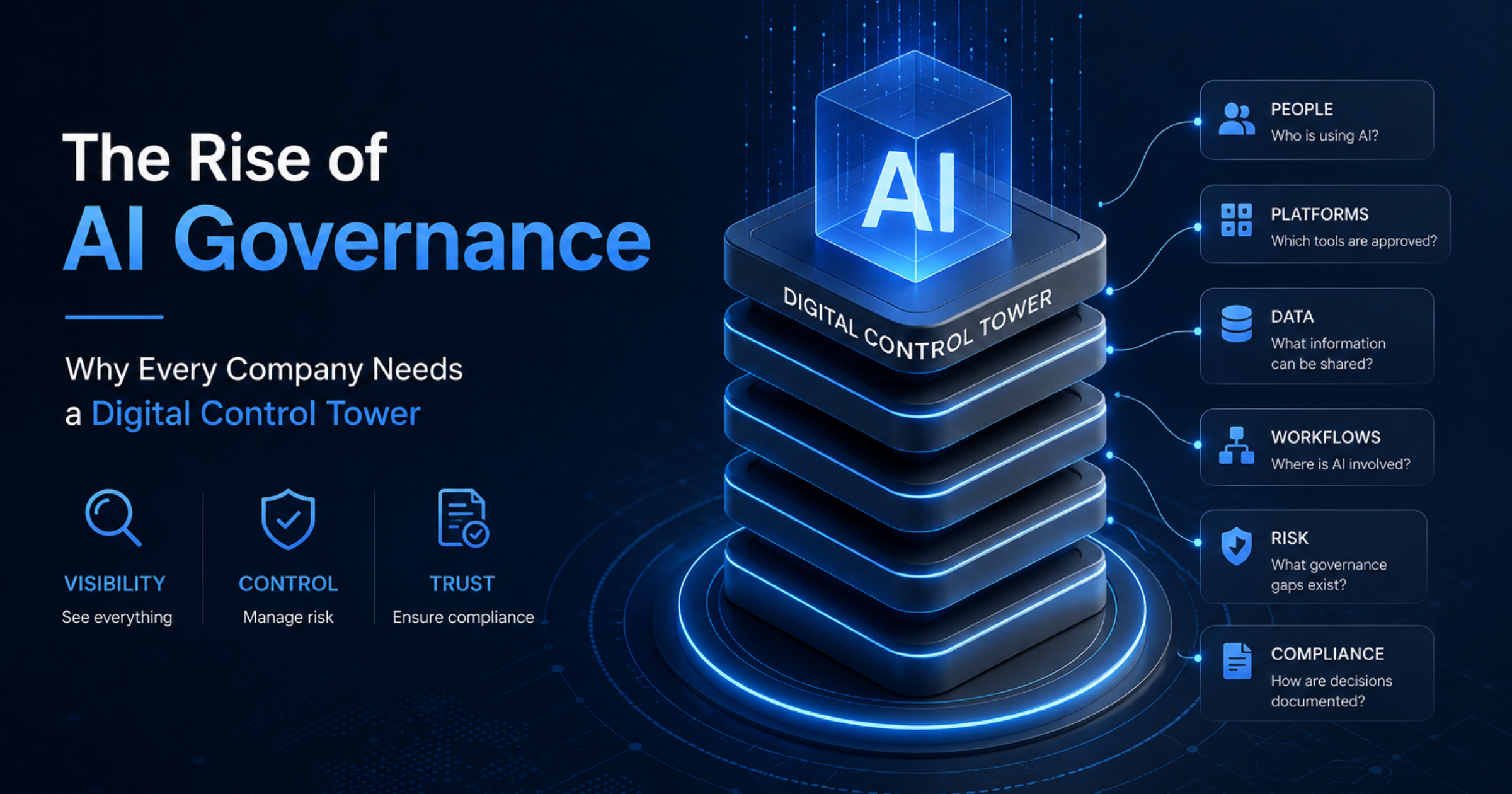
The next evolution of enterprise AI will require organizations to establish what can be described as a Digital AI Control Tower.
A centralized governance framework provides visibility across five critical dimensions:
People
Who is using AI?
Organizations need visibility into user activity, adoption patterns, permissions, and accountability.
Platforms
Which AI tools are approved?
Many businesses now have dozens of AI applications operating simultaneously. Governance helps distinguish approved tools from unmanaged ones.
Data
What information can be shared?
Sensitive customer, financial, healthcare, or intellectual property data requires clear controls and monitoring.
Workflows
Where is AI involved?
Organizations need to understand which business processes depend on AI and how decisions are being generated.
Risk & Compliance
What governance gaps exist?
Risk management requires documentation, auditing, monitoring, policy enforcement, and compliance reporting.
Together, these capabilities create a digital control tower that enables organizations to scale AI safely while maintaining operational visibility.
A U.S. Example: The Governance Challenge at Scale
Consider a large U.S. enterprise with 10,000 employees.
If AI adoption mirrors current workforce trends, approximately 5,000 employees could already be using AI-powered tools in some capacity.
Without centralized governance, leadership may have limited visibility into:
- Which AI tools employees use
- What data is being uploaded
- Whether outputs are reviewed
- Which departments rely on AI-generated recommendations
- How AI-related decisions are documented
The challenge is no longer simply deploying AI.
The challenge is understanding and governing an increasingly complex AI ecosystem.
This issue is becoming so significant that a recent IBM survey found that 77% of technology leaders believe AI adoption is outpacing their governance capabilities, while only 11% feel fully prepared for large-scale AI deployment.
The Next Phase of Governance
Historically, governance focused on:
- Devices
- Applications
- Networks
- Infrastructure
The next phase will focus on:
- AI systems
- Autonomous agents
- Agentic workflows
- Decision-support platforms
- AI-powered business operations
Organizations will increasingly need visibility not only into what employees are doing but also into what AI systems are doing on their behalf.
This shift represents one of the most important governance transformations since the rise of cloud computing.
The New Gold Standard for Enterprise AI
The future is not about deploying the most AI.
It is about deploying AI responsibly, securely, and at scale.
Organizations that build governance early gain several advantages:
- Faster AI adoption
- Reduced operational risk
- Improved compliance readiness
- Stronger customer trust
- Better executive visibility
- Greater confidence in AI-driven decisions
The organizations that succeed in the AI era will not simply be the ones that use AI.
They will be the ones that govern it effectively.
The question is no longer whether AI will become part of your business.
The question is whether your organization is ready to govern it.