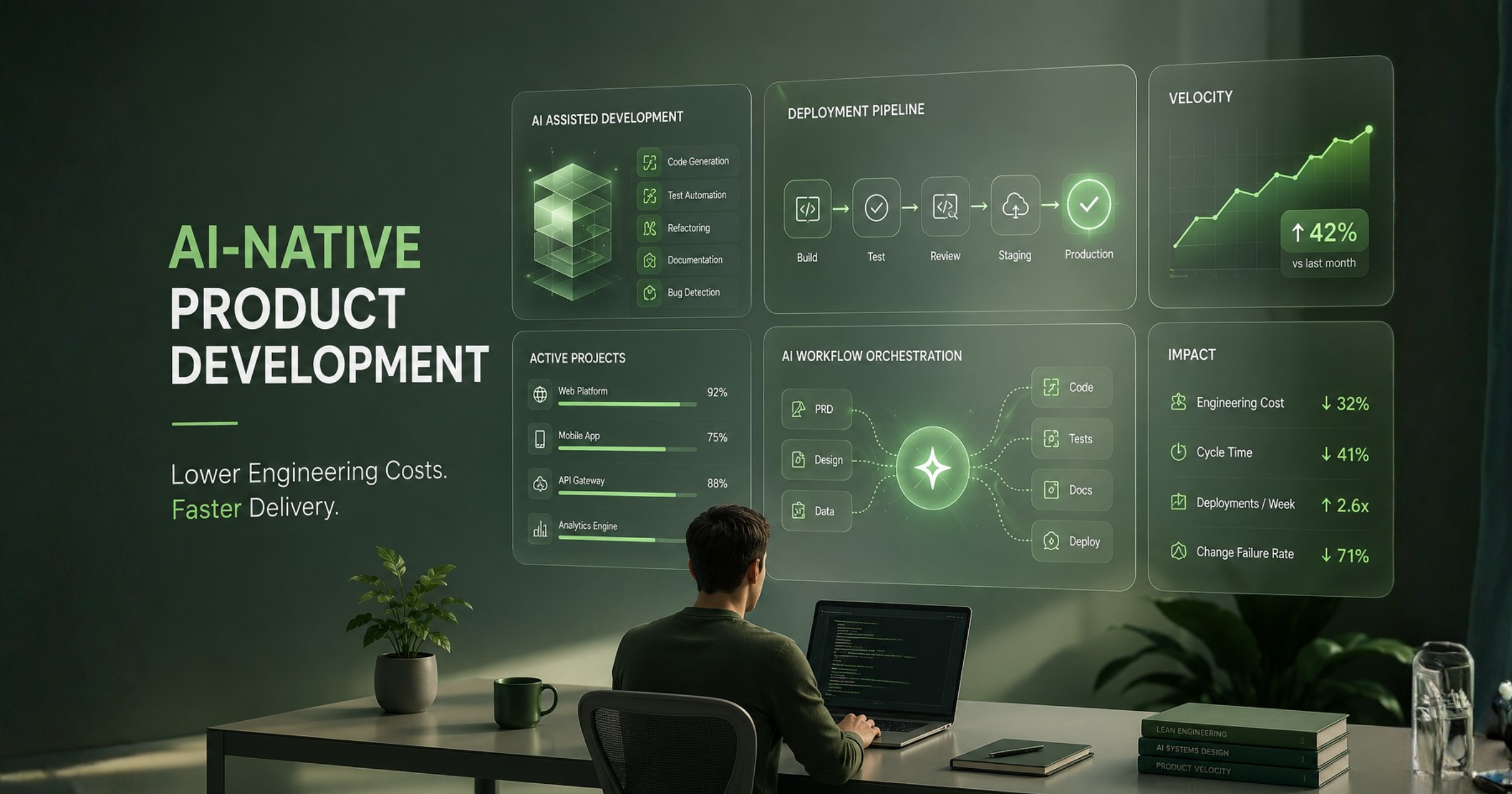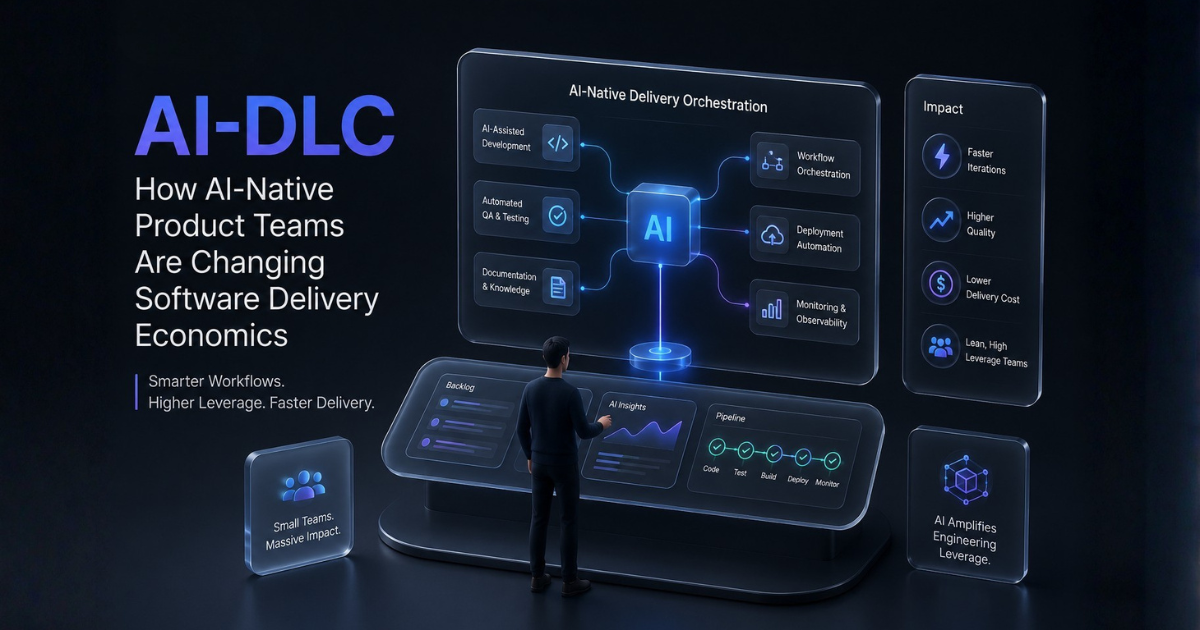
AI-native software development is fundamentally reshaping how modern product teams build, test, and deliver software.
Traditional software development lifecycle (SDLC) models were designed for a different era, one built around larger engineering teams, slower delivery cycles, and heavily process-driven execution.
To scale software delivery, organizations traditionally added:
- more developers
- more managers
- more QA layers
- more coordination structures
- more process
For years, this worked.
But in today’s AI-driven software delivery environment, that model is becoming increasingly inefficient.
The highest-performing engineering organizations are no longer scaling through headcount alone. They are scaling through engineering leverage.
Smaller AI-native engineering teams are now shipping faster than organizations with significantly larger teams, not because AI is replacing engineers, but because AI-assisted software development is changing how execution itself works.
This shift is giving rise to a new operational model:
AI-DLC, AI-Native Software Delivery Lifecycle.
AI-DLC combines:
- AI-assisted development
- workflow orchestration
- automation pipelines
- architecture-aware delivery
- governance systems
- lean engineering operations
The result is a fundamentally different approach to software delivery economics.
Why Traditional Engineering Teams Slow Down
One of the biggest misconceptions in software development is that larger engineering teams automatically create faster delivery.
In reality, larger teams often create larger coordination problems.
Traditional SDLC models slow down because execution becomes increasingly dependent on communication overhead and process synchronization.
As organizations grow, they accumulate:
- review bottlenecks
- fragmented ownership
- dependency chains
- approval layers
- operational silos
- delivery delays
Eventually, coordination becomes more expensive than implementation itself.
This is why many enterprise engineering organizations struggle with:
- slower iteration cycles
- delayed releases
- growing technical debt
- reduced delivery velocity
- operational inefficiency
The issue is rarely coding speed alone.
The issue is delivery friction.
How AI-Native Software Delivery Works
AI-native software delivery changes the equation entirely.
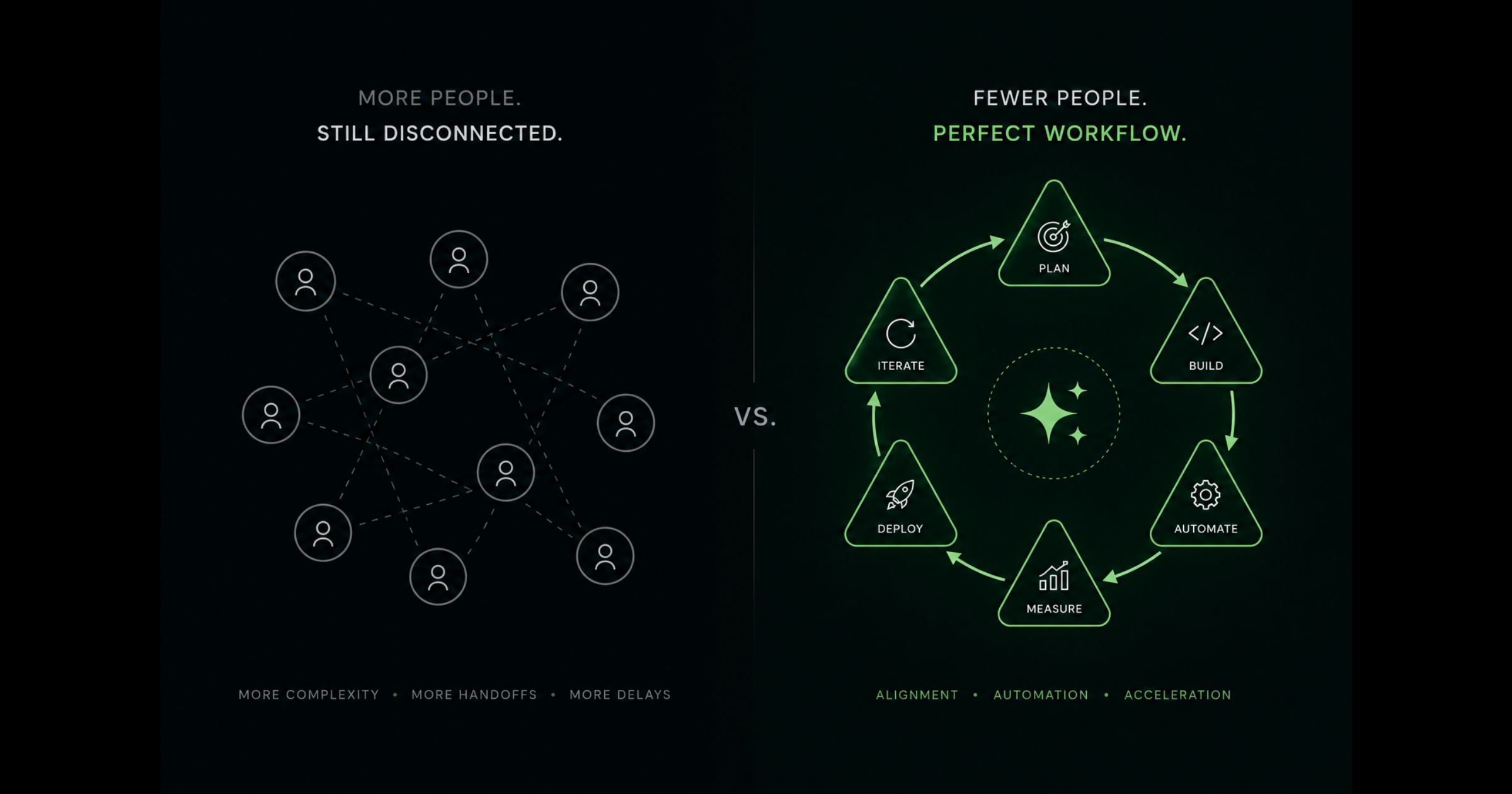
Instead of scaling software output linearly through more people, AI-native engineering teams scale through execution amplification.
The focus shifts from: “more engineering capacity”
to: “higher engineering leverage.”
This is what modern AI-assisted software development actually looks like.
AI-Assisted Development
AI coding assistants are accelerating:
- implementation speed
- debugging
- refactoring
- architecture exploration
- boilerplate generation
- code comprehension
This allows engineers to spend less time on repetitive execution and more time on high-value problem solving.
AI-assisted development does not eliminate engineers.
It increases the operational output of skilled engineering teams.
Automated QA and Validation
Modern AI software delivery pipelines increasingly automate:
- regression testing
- bug detection
- edge-case generation
- security analysis
- performance testing
- validation workflows
This reduces one of the biggest bottlenecks in traditional SDLC environments: manual downstream QA cycles.
Quality assurance becomes embedded directly into delivery workflows.
Workflow Orchestration
The strongest AI-native engineering teams operate through orchestration systems rather than isolated tools.
Modern AI workflow orchestration connects:
- deployments
- testing systems
- monitoring pipelines
- AI agents
- documentation workflows
- operational automations
Instead of manually coordinating execution across disconnected systems, teams increasingly build synchronized delivery environments.
This dramatically improves delivery speed and operational efficiency.
AI-Supported Documentation
Documentation has historically slowed down fast-moving product teams.
AI-native delivery systems reduce this friction through AI-generated:
- technical summaries
- onboarding documentation
- architecture explanations
- release notes
- implementation documentation
This improves knowledge continuity without slowing down execution.
Faster Iteration Cycles
AI-native software delivery dramatically compresses iteration loops.
Teams can now:
- prototype faster
- validate faster
- deploy faster
- learn faster
- optimize faster
The real advantage is not simply faster shipping.
It is accelerated organizational learning.
AI-DLC: The Evolution of AI-Driven Software Delivery
AI-DLC is not simply traditional SDLC with AI tools added on top.
It represents a structural redesign of how software delivery operates.
AI-DLC combines:
- AI-assisted execution
- structured workflows
- governance systems
- orchestration pipelines
- delivery automation
- architecture-aware engineering
In AI-DLC environments, engineers increasingly function as orchestrators of intelligent delivery systems.
Their role evolves from: manually executing every task
to: designing, guiding, validating, and governing accelerated delivery workflows.
This shift is changing software delivery economics across the industry.
How Companies Are Adopting AI-Native Development
Forward-thinking product organizations are already adopting AI-native engineering workflows across multiple operational layers.
Common implementations include:
- AI coding copilots
- AI-powered CI/CD pipelines
- automated QA systems
- AI-generated technical documentation
- AI-assisted DevOps workflows
- deployment orchestration systems
- AI-driven monitoring and observability
The goal is not simply automation.
The goal is reducing delivery friction while increasing engineering leverage.
This allows lean engineering teams to operate with significantly higher output capacity.
Why AI Amplifies Both Strong and Weak Teams
One of the most important realities of AI-native software development is this:
AI amplifies existing operational maturity.
Strong engineering systems become dramatically faster.
Weak engineering systems become dangerously unstable.
Weak Architecture Becomes More Dangerous
Poor architectural decisions used to spread slowly.
AI accelerates implementation velocity, which means technical mistakes now scale faster too.
Weak architecture can rapidly create:
- unstable systems
- fragmented codebases
- operational complexity
- scaling failures
- compounding technical debt
The faster weak systems move, the faster they accumulate failure risk.
Poor Governance Scales Chaos Faster
AI-native delivery without governance can create operational instability at scale.
Organizations adopting AI-assisted engineering workflows need:
- architecture standards
- deployment guardrails
- workflow validation
- security oversight
- operational governance
- quality control systems
Without governance, accelerated delivery can rapidly amplify organizational chaos.
Velocity without structure becomes liability.
The Future of AI-Native Engineering Teams
AI-native product development is reshaping the structure of engineering organizations themselves.
Future engineering teams will likely become:
- smaller
- more specialized
- orchestration-focused
- automation-driven
- systems-oriented
New operational roles are already emerging.
Orchestration-Focused Engineers
Engineers increasingly manage execution systems rather than isolated implementation tasks.
Their responsibilities include:
- workflow coordination
- delivery optimization
- system validation
- operational oversight
- AI workflow management
Workflow Architects
As AI workflow orchestration becomes central to software delivery, workflow architecture itself becomes a strategic capability.
These roles focus on:
- delivery systems
- pipeline orchestration
- automation design
- operational efficiency
- AI-native infrastructure
AI Systems Engineers
Future engineering teams will increasingly require specialists focused on:
- AI infrastructure
- agent-based systems
- AI operational reliability
- model orchestration
- intelligent workflow systems
Operational AI Leads
Organizations will also need leadership roles responsible for:
- AI governance
- workflow standardization
- operational oversight
- AI implementation strategy
- delivery reliability
AI is becoming an operational layer within engineering organizations — not just a productivity tool.
The Real Shift Is Economic
The biggest transformation happening in software development is not purely technical.
It is economic.
AI-native software delivery changes:
- engineering scalability
- delivery costs
- operational efficiency
- iteration speed
- team structure
- software delivery economics
Smaller, highly-leveraged teams can now compete with organizations that historically relied on massive engineering scale.
This does not reduce the importance of engineering talent.
It increases the importance of:
- strong architecture
- operational systems
- workflow orchestration
- governance maturity
- execution leverage
The companies that win in the AI era will not necessarily be the ones with the largest engineering teams.
They will be the organizations with:
- the strongest AI-native workflows
- the highest execution leverage
- the most efficient delivery systems
- the best operational governance
The future of software delivery is not human-only execution.
And it is not autonomous AI replacing engineering teams either.
It is AI-amplified engineering systems.
That is the foundation of AI-DLC.
FAQ
What is AI-DLC?
AI-DLC stands for AI-Native Software Delivery Lifecycle. It refers to modern software delivery systems built around AI-assisted development, workflow orchestration, automation pipelines, governance frameworks, and accelerated engineering workflows.
How is AI changing software development?
AI is transforming software development by accelerating coding, testing, documentation, QA, deployment automation, and workflow orchestration. This allows engineering teams to ship software faster with leaner operational structures.
What are AI-native engineering teams?
AI-native engineering teams are product teams that build software using AI-assisted workflows, automation systems, orchestration pipelines, and AI-powered development processes as part of their core operating model.
Will AI replace software engineers?
AI is unlikely to replace strong software engineers entirely. Instead, AI increases engineering leverage by automating repetitive tasks and accelerating execution, allowing engineers to focus on architecture, systems thinking, and orchestration.
Why are smaller engineering teams moving faster?
Smaller AI-native engineering teams reduce coordination overhead and use AI-assisted workflows to accelerate delivery. This allows them to operate more efficiently than larger teams burdened by process-heavy execution models.
What is AI workflow orchestration in software engineering?
AI workflow orchestration refers to connecting AI systems, automations, testing pipelines, deployments, monitoring tools, and operational workflows into synchronized software delivery environments.