AI models are getting cheaper. But running AI in production is not automatically getting cheaper.
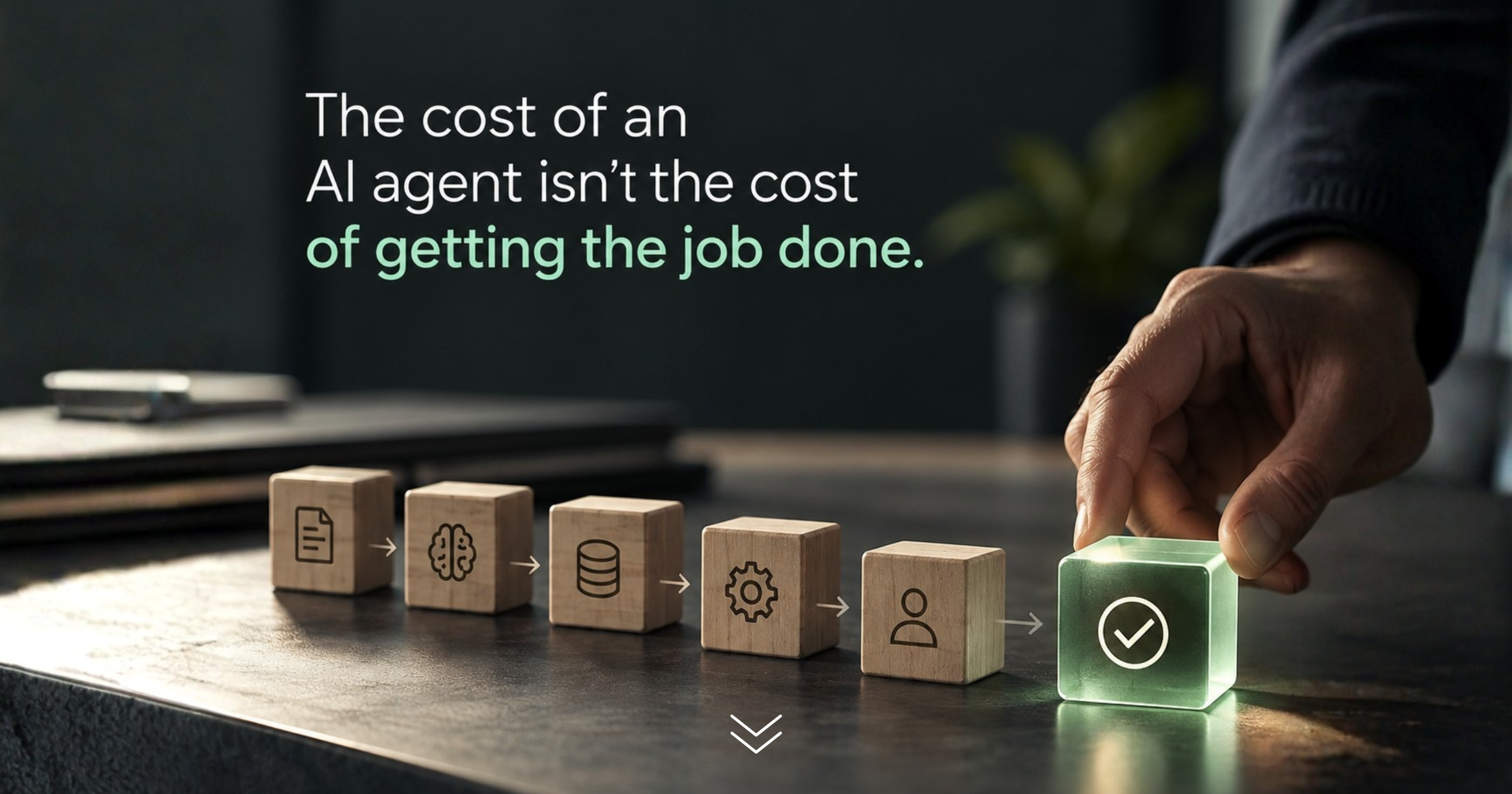
An AI agent may resolve a customer request in seconds. Behind that result, it may have retrieved information, called multiple tools, retried a failed step, and required an employee to review the output.
The model's token price captures only part of the cost.
For enterprise leaders, the more useful question is not simply how much an AI call costs. It is how much the business spends to complete a task correctly, reliably, and with the required level of human oversight.
That shift-from token consumption to completed business outcomes-is central to understanding enterprise AI economics.
1. Why Token Cost Is Only Part of the Equation
Token pricing is an important component of AI spending. However, an AI agent operates within a broader workflow.
Depending on its design, a production workflow may involve:
- Multiple model calls for planning, reasoning, and execution.
- Retrieval-augmented generation (RAG) to access relevant business information.
- API and tool calls to interact with enterprise systems.
- Additional attempts when a step fails.
- Validation against business rules and quality requirements.
- Human review, approval, or correction.
- Infrastructure, monitoring, and ongoing maintenance.
These components do not all incur the same type of cost. Some are variable costs associated with individual executions; others are fixed or recurring operating costs.
McKinsey's August 2026 analysis of agentic workflow economics highlights this distinction, identifying human oversight, infrastructure, and orchestration alongside token consumption as important cost drivers. The relative contribution of each varies by workflow.
The implication is straightforward: reducing the price of an individual model call does not necessarily reduce the total cost of completing a business task.
2. Measure Cost Per Successful AI Agent Action
A more useful operational metric is cost per successful AI agent action, or cost per completed business outcome.
For a defined measurement period, use this calculation:
Cost per successful outcome = Total cost attributable to the workflow ÷ Number of successfully completed outcomes
The numerator should include the costs relevant to the scope of the measurement, such as model usage, tools, retrieval, infrastructure, retries, human review, and failure recovery. A fully loaded business case should also account for implementation and ongoing operating costs.
The denominator is equally important.
An agent that starts 1,000 tasks has not necessarily completed 1,000 tasks. A successful run should count only when the required business outcome has been achieved and verified against predefined criteria.
For example:
- Customer support: The issue is resolved according to policy and the ticket is correctly updated.
- Lead qualification: The lead meets the agreed criteria and the CRM record is complete.
- Invoice processing: Required information is validated and recorded, with exceptions routed appropriately.
- Vendor review: Required checks are completed and findings are documented.
- Executive reporting: The report contains the required information, with accurate figures and traceable sources.
A successful model response is not necessarily a successful business outcome.
This is a proposed measurement approach rather than a universally standardized industry formula. Its value comes from making the definition of success explicit and consistent.
3. Account for the Cost of Failure
An AI workflow can consume resources without producing a usable result.
An agent might return incomplete information, make an incorrect update, stop halfway through a process, or require an employee to redo part of the work.
These outcomes create costs beyond the original model call.
A practical measurement framework should distinguish between:
- Retry cost: Resources consumed by additional attempts.
- Correction cost: Human effort required to fix inaccurate or incomplete work.
- Escalation cost: The effort involved in transferring a task to a person or another system.
- Unresolved-task cost: The cost of work that remains incomplete or causes downstream problems.
Not all failure costs are directly visible on an AI provider's invoice. Some appear as additional labor, delays, or operational risk.
Consider a customer support agent that generates a plausible response but fails to update the ticket. The response may look successful in isolation, yet the business process remains incomplete. An employee must still finish the work.
This is why cost should be measured alongside completion rate, accuracy, human intervention, and the consequences of failure.
A cheaper execution is not necessarily a cheaper outcome if it creates more corrective work.
4. Use the Right Model for Each Task
Not every workflow step requires the most capable or expensive model.
Model routing means selecting a model or execution method according to the complexity, risk, and quality requirements of each task.
For example, a workflow might use:
- Deterministic code for calculations, required-field checks, and predictable business rules.
- A smaller model for straightforward classification or structured extraction, where testing shows that it meets the required quality.
- A more capable model for ambiguous documents or complex reasoning.
- Validation logic to check results before consequential actions are taken.
There is also a place for conventional software.
If a business rule can be expressed reliably in code, calling an LLM to apply that rule may introduce unnecessary cost and variability. For example, a fixed threshold check does not ordinarily require language-model reasoning.
However, simpler is not always cheaper. A lower-cost model may need additional attempts or human correction, while a more capable model may complete a difficult task with less rework.
The appropriate choice depends on measured performance across the complete workflow.
The cheapest model does not necessarily produce the cheapest business outcome.
5. Compare the Cost of Completing Real Work
The metric becomes meaningful when applied to a specific business process.
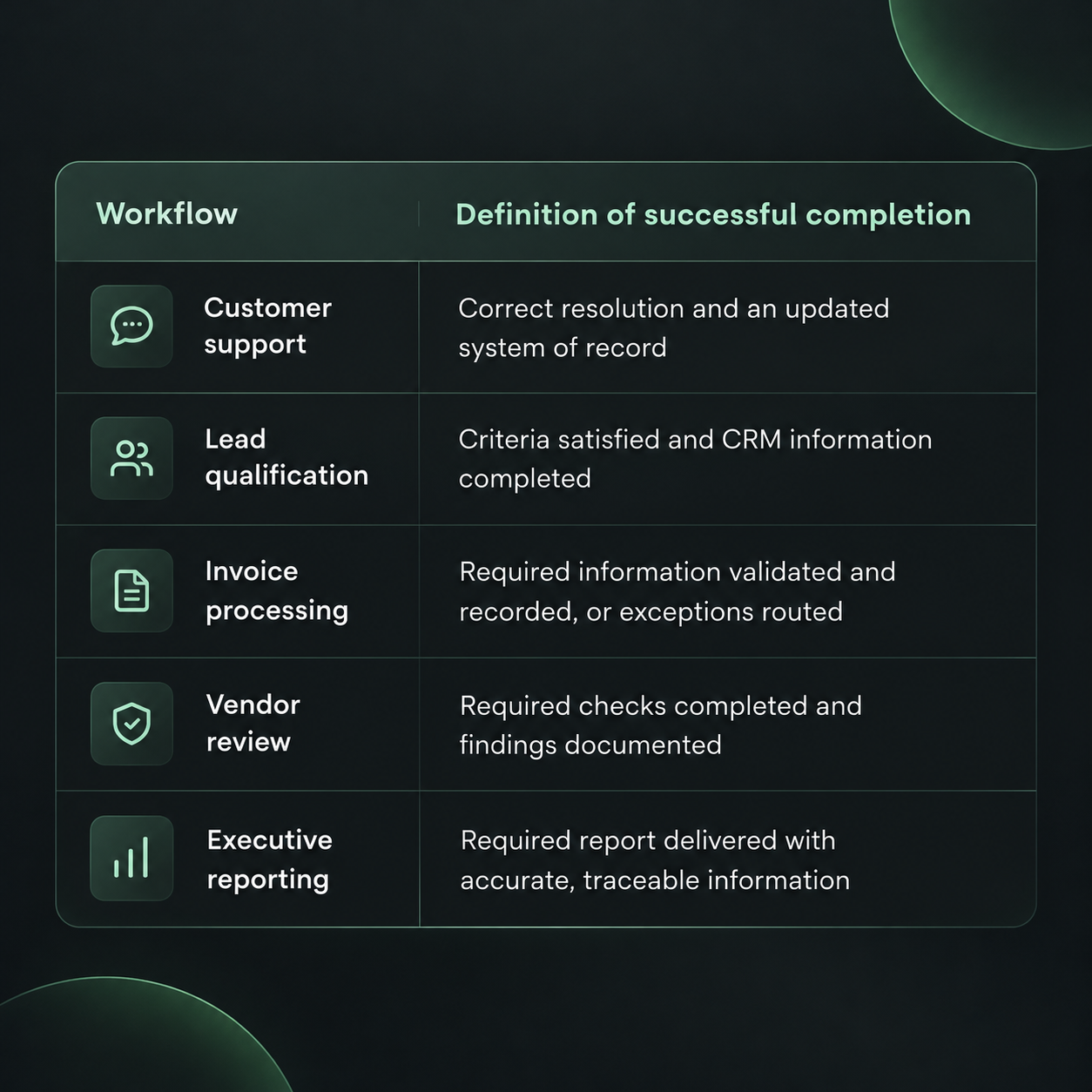
These workflows have different requirements, risks, and cost structures. They should not share an arbitrary cost target simply because they use AI.
First, establish the baseline cost of completing the process without the proposed AI workflow. Include relevant employee effort, software, review, exception handling, and other operating expenses.
Then measure the AI-assisted process using the same outcome definition.
This makes the comparison more meaningful than comparing an AI provider's bill with an employee's hourly rate.
The purpose is not to assume AI will be cheaper. It is to identify the workflows where it creates measurable value-and those where it does not.
6. Connect Cost Per Outcome to AI ROI
Cost per successful action is an operational metric. It becomes a business decision metric when compared with the value delivered.
A useful starting point is:
Net value per outcome = Value created or employee time saved − Total cost of delivering the outcome
This is a simplified calculation, not a complete financial model. A business case should also account for implementation, ongoing maintenance, governance, and other relevant costs not already included in the execution figure.
Suppose an AI agent reduces the time required to process an invoice. The right comparison is the total cost of getting a correctly processed invoice through the existing workflow versus the AI-assisted workflow.
That comparison should include the time spent reviewing results, correcting errors, handling exceptions, and maintaining the system.
The same principle applies to customer support, sales operations, vendor reviews, and reporting.
For each workflow, track:
- Baseline cost: What does the existing process cost?
- Completion rate: What proportion of tasks meets the success criteria?
- Execution cost: What does the AI-assisted workflow consume?
- Human effort: How much review, correction, and escalation remains?
- Business value: What measurable value does the completed work deliver?
A workflow that performs well on all five measures may justify further investment. A workflow with high correction costs or insufficient business value may need redesign or may not justify deployment.
7. Increase Autonomy Only When Reliability Justifies It
Greater autonomy can reduce manual intervention, but it can also increase the consequences of an error.
The appropriate level depends on the task, the ability to verify results, and the potential impact of failure.
For routine, low-risk tasks, an agent may be able to complete work independently once it demonstrates adequate performance. Financial approvals, sensitive customer decisions, and other consequential actions may require additional checks or human authorization.
A measured approach is to:
- Define success and failure criteria before deployment.
- Test against representative tasks.
- Establish validation and approval requirements.
- Monitor completion, correction, and escalation rates.
- Expand autonomy only when the evidence supports doing so.
There is no universal success-rate threshold that makes every AI agent safe to operate autonomously. Acceptable performance depends on the workflow and its risk.
The objective is not maximum autonomy. It is reliable business performance at a cost and risk level the organization can justify.
8. Design AI Around Business Outcomes
Enterprise AI economics is not simply a model-selection problem. It is a workflow-design and operating-model problem.
It requires a clear understanding of the business task, measurable completion criteria, appropriate model selection, reliable integrations, validation, and visibility into operating costs.
At Lektik, our approach to enterprise AI focuses on connecting these decisions to measurable business workflows. Architecture, model selection, integration, governance, and production economics need to be considered together-not as separate steps after an API has been connected.
The starting point should be a business problem with a defined outcome, not a token budget.
When organizations measure the cost and quality of completed work, they can make better decisions about where to deploy AI, where human involvement remains necessary, and where further investment is justified.
The goal is not merely to make AI cheaper to run. It is to make AI useful, reliable, and economically defensible in production.
Enterprises should measure AI by workflow and outcome, not tokens alone.
Frequently Asked Questions
1. What is the cost per successful AI agent action?
Cost per successful AI agent action is the total cost attributable to an AI workflow divided by the number of outcomes that meet predefined business requirements. Depending on the measurement scope, costs may include model usage, tools, infrastructure, retries, human review, and ongoing operations.
2. Why is token cost not enough to measure AI agent costs?
Token cost measures model consumption, not the full cost of completing a business process. An agent may also require retrieval, tool calls, additional attempts, human review, and operational infrastructure. Their contribution varies by workflow.
3. How do you calculate the cost of an AI agent?
Define the workflow and its success criteria. Add the relevant execution costs, including failed attempts and human intervention, then divide by the number of successfully completed outcomes. Include implementation and recurring operating costs when calculating fully loaded economics.
4. What is the difference between cost per AI run and cost per successful task?
Cost per AI run measures the cost of an execution. Cost per successful task measures the cost of delivering a valid business outcome, accounting for unsuccessful attempts and the additional work needed to complete the task.
5. How can enterprises reduce AI agent operating costs?
Enterprises can evaluate model routing, deterministic automation for predictable rules, retrieval efficiency, unnecessary retries, and avoidable human correction. Changes should be tested against quality, reliability, and the total cost of completing the task.
6. What is model routing in enterprise AI?
Model routing selects a suitable model or execution method for each workflow step based on complexity, cost, risk, and quality requirements. It can help avoid using a more expensive model when a simpler approach meets the task's requirements.
7. How should businesses measure AI agent ROI?
Compare the measurable value of completed work with the total cost of delivering it. Include relevant implementation, maintenance, human oversight, failure recovery, and operating expenses. The exact calculation depends on the business outcome being measured.
8. When should an AI agent require human approval?
Human approval may be necessary for consequential financial, legal, compliance, security, or customer-impacting actions, particularly when outputs cannot be adequately verified. The required oversight should reflect the workflow's risk and the consequences of an error.
9. How can enterprises determine whether an AI agent is ready for production?
Establish measurable success criteria, test representative cases, verify integrations and failure handling, and monitor real-world completion, accuracy, escalation, and cost. A successful demonstration alone does not establish production readiness.
10. What metrics should enterprises track when deploying AI agents?
Useful measures include cost per successful outcome, completion rate, accuracy, retries, human intervention, processing time, and business value. Together, these measures provide a more complete view of performance than token consumption alone.