Your company has spent years documenting how work gets done.
There are SOPs for onboarding customers.
Playbooks for handling exceptions.
Policies for approving expenses.
Processes for reviewing vendors, resolving tickets, qualifying leads, and escalating risk.
But most of that knowledge still sits in documents.
People read it. People interpret it. People execute it.
Agentic AI creates an opportunity to change that.
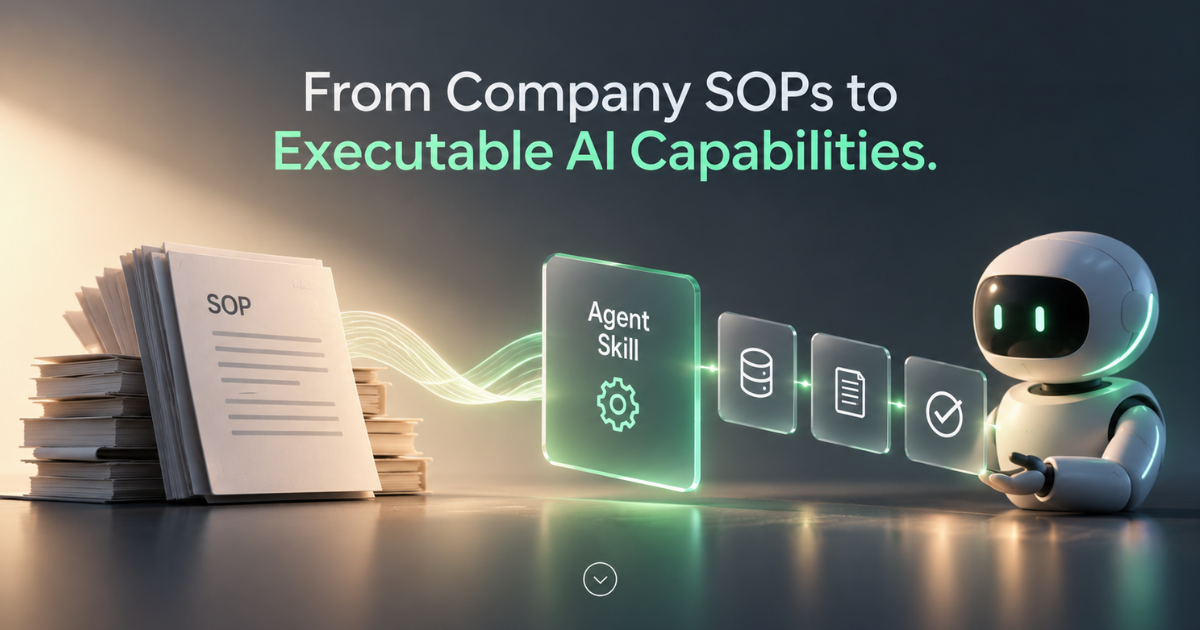
Instead of simply giving an AI agent access to company knowledge, enterprises can turn operational knowledge into executable AI capabilities — or agent skills.
The shift is subtle but important:
From AI that knows how your business works → to AI that can operate within how your business works.
The Problem With SOPs in an AI-Driven Enterprise
Standard operating procedures are designed primarily for humans.
They explain the sequence of activities, the rules to follow, the exceptions to consider, and when someone should make a judgment call.
But an SOP sitting in a PDF or knowledge base does not automatically become an executable workflow.
An agent may be able to retrieve the document and summarize it. That does not mean it can reliably perform the process.
For example, consider a vendor onboarding SOP.
A human employee might need to:
- Collect vendor information.
- Verify required documentation.
- Check the vendor against internal requirements.
- Identify missing information.
- Route exceptions to procurement.
- Request approval.
- Update the procurement system.
- Record the decision.
Giving an AI agent the SOP may help it understand the process.
Giving the agent a skill can give it the ability to execute the process within defined boundaries.
That distinction is becoming increasingly important as enterprises move agents from experimentation into real workflows.
Microsoft, AWS, and IBM all now emphasize governance, tool access, identity, observability, and controlled execution as organizations scale enterprise agents.
What Is an Agent Skill?
An agent skill is a structured, reusable capability that enables an AI agent to perform a defined business task within specific rules and boundaries.
A useful enterprise skill typically defines:
- Objective: What outcome should be achieved?
- Context: What information does the agent need?
- Rules: What business logic must it follow?
- Tools: Which systems can it access?
- Permissions: What can it read, change, or trigger?
- Exceptions: What conditions require different handling?
- Verification: How should the result be checked?
- Escalation: When should a human take over?
- Output: What should the completed task produce?
This makes a skill fundamentally different from a simple prompt.
A prompt tells an AI how to respond.
A skill defines how an AI can perform a business capability.
Emerging work on enterprise “contractual skills” similarly argues that skills need explicit goals, boundaries, permissions, evidence requirements, quality criteria, verification, and human-approval points rather than functioning as instructions alone.
From SOP to Executable Capability
The transformation can be thought of as a simple progression:
SOP → Structured business logic → Agent skill → Tools and systems → Governed execution → Verified outcome
Consider a customer-service escalation process.
The SOP may say:
Escalate complaints that meet specific severity or financial thresholds.
An executable skill goes further.
The agent could:
- Read the customer record.
- Understand the complaint.
- Check the relevant policy.
- Determine whether the escalation threshold has been met.
- Gather supporting information.
- Create an escalation case.
- Route it to the appropriate team.
- Request human approval where required.
- Record what happened.
The AI is no longer simply answering a question about the SOP.
It is participating in the workflow the SOP describes.
That is where agentic AI starts becoming operationally meaningful.
Not Every SOP Should Become an Agent Skill
This does not mean enterprises should convert every documented process into an autonomous agent.
Some processes are poor candidates.
A useful starting point is to look for workflows that are:
- Repetitive
- High-volume
- Relatively structured
- Dependent on multiple systems
- Time-consuming for employees
- Governed by clear business rules
- Measurable by a defined outcome
Processes involving significant financial, legal, safety, reputational, or strategic consequences may require stronger human oversight.
The goal is not maximum autonomy.
The goal is appropriate autonomy.
Current enterprise guidance increasingly treats tool permissions, identity, approval controls, observability, and governance as core parts of agent architecture because an agent's practical risk depends heavily on what it is allowed to access and do.
Why the Model Isn't the Whole Story
The natural instinct when discussing AI agents is to start with the model.
Which model should we use?
How capable is it?
How well does it reason?
Those questions matter.
But enterprise execution introduces another set of questions:
What does the agent know?
What is it allowed to do?
Which systems can it access?
What happens when the process does not fit the SOP?
Who approves high-risk actions?
How is the decision recorded?
A highly capable model without reliable enterprise context and operational controls can still produce unreliable outcomes.
This is why enterprise agent architecture increasingly spans more than the model itself. AWS describes production agentic architectures in terms of multiple layers, with security, observability, and discoverability extending across the system.
The competitive advantage may therefore come less from having access to the newest model and more from how effectively an organization turns its own knowledge and processes into reliable capabilities.
Skills Need Access to the Systems Where Work Happens
An agent cannot meaningfully execute a business process if it is disconnected from the systems involved in that process.
A procurement skill may need access to:
ERP + vendor database + document repository + approval workflow
A customer-service skill may need:
CRM + ticketing platform + knowledge base + communication tools
An employee-onboarding skill may require:
HRIS + identity platform + IT service management + collaboration tools
This is why agent skills should be thought of as an intersection of knowledge, reasoning, tools, and permissions.
The skill tells the agent what capability it is performing.
The tools give it the ability to act.
The governance layer determines where it is allowed to act.
Governance Is Part of the Capability
Governance should not be treated as something added after the agent is built.
It belongs inside the design of the skill.
For every executable capability, an enterprise should be able to answer:
Who can trigger it?
What data can it access?
What actions can it perform?
Which actions require approval?
What evidence supports the decision?
What happens when an exception occurs?
Can the action be audited later?
This becomes particularly important as organizations accumulate multiple agents and skills.
AWS recently introduced an Agent Registry specifically around the need to discover, publish, curate, and govern agents, tools, skills, and related resources at scale.
The implication is significant:
As enterprises build more agents, the challenge shifts from “Can we build an agent?” to “Can we manage an ecosystem of capabilities?”
Building a Reusable Enterprise Skill Layer
The long-term opportunity is not to create hundreds of isolated agents.
It is to create reusable capabilities that different agents and workflows can call upon.
For example:
Verify customer identity
↓
Check eligibility
↓
Retrieve account information
↓
Apply business policy
↓
Generate approval request
↓
Update the system of record
These capabilities can become building blocks for broader workflows.
One customer-service agent may use them.
A claims agent may use some of the same capabilities.
An operations agent may use others.
This creates a layer between the organization's systems and its AI agents:
Enterprise Systems → Skills → Agents → Business Workflows
That layer can become increasingly valuable because it captures something that generic AI does not have:
the organization's own way of operating.
The Lektik Perspective: From AI Pilots to Operational Capabilities
This is where the enterprise AI conversation needs to move.
Many organizations have already experimented with chatbots, copilots, RAG systems, and AI assistants.
The next question is more consequential:
Where can AI actually take responsibility for a defined piece of work?
At Lektik, we see this as a shift from AI experimentation to operational capability.
The starting point is not necessarily the model.
It is the business process.
Lektik's approach is to look at how work actually moves through an organization:
Map the workflow → identify the decision points → structure the business knowledge → define the agent skill → connect the required systems → establish governance → measure the outcome.
That can turn an existing SOP from a static document into a foundation for an executable capability.
The objective is not to automate people out of a process simply because automation is possible.
It is to identify where AI can remove repetitive coordination, accelerate decisions, reduce operational friction, and allow people to focus on work that genuinely requires human judgment.
The Bigger Shift
The most valuable enterprise AI may not be the AI that knows the most.
It may be the AI that knows what it is allowed to do, understands how the business operates, and can reliably execute within those boundaries.
That requires more than a model.
It requires institutional knowledge.
It requires structured skills.
It requires access to enterprise systems.
It requires governance.
And it requires a clear definition of what success looks like.
The organizations that build this foundation will be better positioned to move from isolated AI use cases toward a more capable agentic operating layer across the enterprise.
The future of enterprise AI is not simply about giving machines more intelligence.
It is about giving intelligence the right capabilities to act.
Frequently Asked Questions
What is an AI agent skill?
An AI agent skill is a structured, reusable capability that enables an AI agent to perform a defined task or business process using specific knowledge, rules, tools, permissions, and escalation paths.
Unlike a simple prompt, an agent skill is designed around an operational outcome.
How do you turn an SOP into an AI agent skill?
An SOP can be converted into an agent skill by identifying its objective, inputs, business rules, decision points, exceptions, required systems, permissions, approval requirements, verification steps, and expected output.
The resulting capability can then be connected to the tools and systems required to execute the workflow.
What is the difference between an SOP and an AI agent skill?
An SOP documents how a process should be performed.
An AI agent skill operationalizes that process so an AI agent can execute defined parts of it using approved tools and rules.
The key difference is documentation versus executable capability.
Can AI agents execute company workflows?
Yes. AI agents can execute defined business workflows when they have appropriate access to enterprise data and tools, along with clear permissions, policies, and controls.
However, the level of autonomy should depend on the risk and complexity of the workflow.
What should an enterprise AI agent be allowed to do?
An enterprise AI agent should only have the permissions and tools necessary for its assigned capability.
Organizations should define what the agent can read, modify, trigger, approve, or escalate. High-risk actions can require human approval.
Microsoft's current guidance similarly emphasizes governing agent access at the tool level because tools determine what an agent can actually do.
Why are AI agent skills important for enterprise AI?
Agent skills provide a structured way to convert organizational knowledge into reusable capabilities.
They can help enterprises move beyond AI that retrieves information toward AI that can perform defined operational work.
Should every business SOP be automated with AI?
No.
The strongest candidates are generally processes that are repetitive, structured, high-volume, measurable, and governed by relatively clear rules.
Processes requiring significant human judgment or carrying high consequences may require human-in-the-loop controls rather than full autonomy.
What is AI agent governance?
AI agent governance is the set of policies, controls, permissions, monitoring practices, identity mechanisms, approval processes, and lifecycle controls used to manage how AI agents operate within an organization.
As agents gain access to enterprise systems and take actions, governance becomes an operational requirement rather than simply a compliance exercise.
What is the role of human-in-the-loop AI agents?
Human-in-the-loop systems allow AI agents to handle defined tasks while requiring people to review or approve actions that are ambiguous, sensitive, or high-risk.
This allows organizations to increase automation without treating every business decision as suitable for autonomous execution.
How can companies build AI agents from their existing business processes?
Companies can begin by identifying high-value workflows, mapping the current process, extracting business rules from SOPs and institutional knowledge, defining reusable agent skills, connecting approved enterprise tools, establishing governance, and measuring operational outcomes.
The important starting point is the business process, not the AI model.
What is the future of enterprise AI agents?
Enterprise AI is moving from systems that primarily generate or retrieve information toward systems that can reason, use tools, execute workflows, and coordinate work under defined controls.
The emerging opportunity is to build reusable AI capabilities around the organization's own knowledge, processes, and operating model.