Over the past two years, organisations across industries have accelerated AI adoption, deploying copilots, chat interfaces, and isolated automation tools across teams.
These tools have improved individual productivity. But they have not fundamentally changed how most businesses operate.
The reason is structural.
Most organisations are scaling AI tools, while the real transformation lies in building AI systems embedded inside operations.
That difference determines whether AI delivers incremental efficiency-or becomes part of the organisation’s operational backbone.
A practical example: financial reconciliation
Consider financial reconciliation, one of the most common workflows inside finance teams.
In most companies today, reconciliation remains:
- spreadsheet-driven
- partially automated
- reactive
Systems may detect mismatches between invoices, payments, and ledger entries. But resolution still depends heavily on manual investigation and human judgement.
Even modern automation platforms largely assist the workflow rather than operating it.
Now consider the same process redesigned as a decision system.
Such a system continuously detects mismatches across financial records, interprets anomalies using historical transactions and accounting rules, determines whether discrepancies can be resolved automatically, executes corrections across systems, and learns from overrides to improve future decisions.
In that model, reconciliation is no longer a periodic task.
It becomes a continuous decision layer operating inside finance operations.
Financial institutions and large enterprises are already experimenting with similar approaches as part of broader AI-enabled finance transformation initiatives.
The evolution of AI inside organisations
AI adoption inside enterprises is progressing through three distinct stages.
Stage 1: AI as tools
In the first stage, AI operates primarily as a productivity layer for individuals.
Examples include chatbots, copilots, and simple automation scripts that help employees complete tasks faster. While these tools improve efficiency, humans remain responsible for decisions and outcomes.
Stage 2: AI as workflow intelligence
In the second stage, AI begins operating within business workflows.
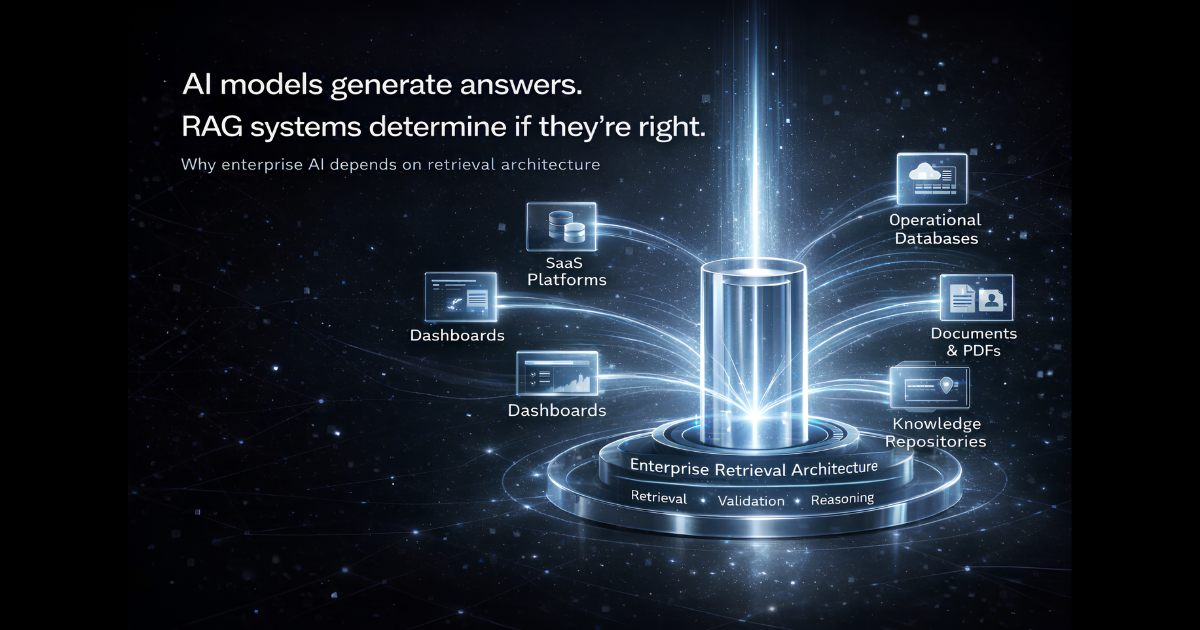
AI agents, automation pipelines, and retrieval-based systems connect internal data sources and automate portions of operational processes.
This improves speed and data utilisation, but decision-making often remains fragmented across systems and teams.
Stage 3: AI as decision infrastructure
In the emerging third stage, AI becomes embedded directly into operational systems.
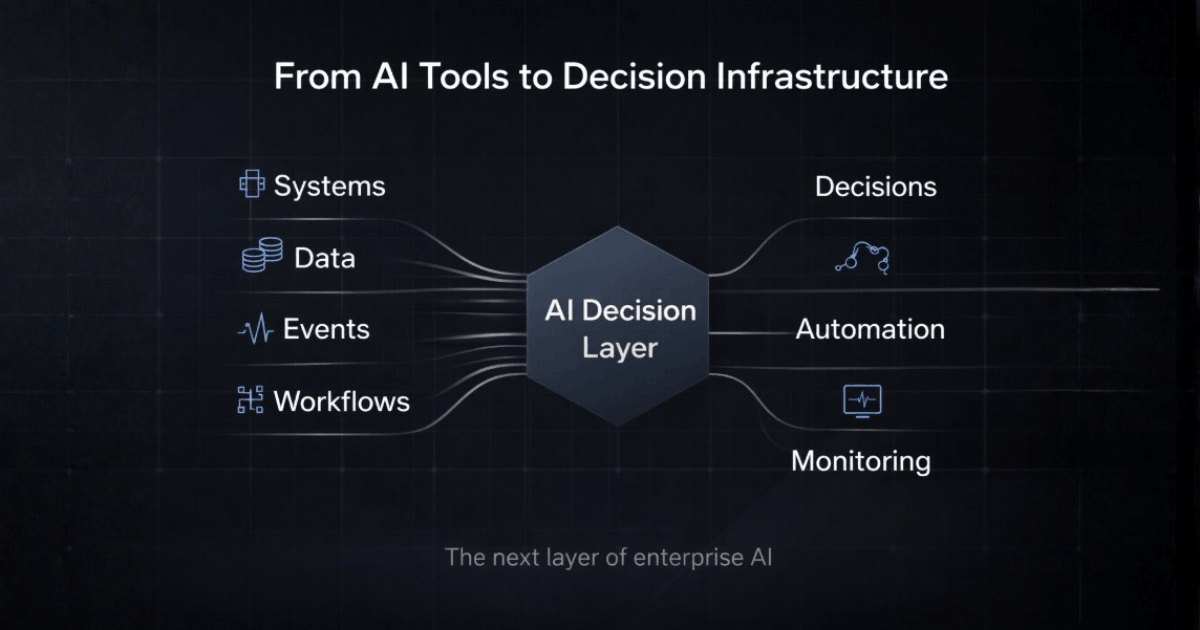
Instead of merely answering questions, AI connects enterprise systems, operational signals, business data, and execution workflows to continuously run decision loops inside the organisation.
At this stage, AI shifts from assisting decisions to executing them within defined operational boundaries.
Where decision infrastructure is emerging
This model is beginning to appear across several enterprise domains.
Finance Continuous reconciliation, anomaly detection, and transaction validation.
Operations Real-time monitoring systems capable of adjusting resource allocation and workflow execution.
Customer operations Lifecycle orchestration, dynamic segmentation, and adaptive engagement.
Compliance and risk Continuous monitoring of transactions, policies, and regulatory rules.
These systems do not simply analyse data. They operate decision loops that continuously shape operational outcomes.
The architecture of decision systems
Operational AI systems increasingly follow a common architectural pattern built around five layers:
Signal - identifying events or anomalies requiring attention Context - interpreting those signals using historical data and business rules Decision - determining the appropriate response Execution - triggering actions across operational systems Feedback - learning from outcomes to improve future decisions
This structure distinguishes traditional automation from true decision infrastructure.
Automation executes predefined tasks. Decision infrastructure owns operational outcomes.
Implications for enterprise software
The next generation of enterprise platforms will not be defined primarily by dashboards or user interfaces.
Instead, they will be defined by decision loops embedded inside operational systems.
Over time organisations will move from software designed to store and display information toward systems that continuously interpret signals, evaluate context, and execute decisions across business operations.
This architectural shift is already shaping the next wave of enterprise platforms.
Designing such systems requires integration across data, workflows, and operational logic-an area where companies such as Lektik are increasingly working with organisations exploring how AI can move beyond isolated tools and become part of operational infrastructure.
The future of AI inside organisations
Artificial intelligence will not remain an external layer assisting employees.
It will increasingly become embedded within the operational infrastructure of organisations, continuously interpreting signals, coordinating systems, and executing decisions across workflows.
In that future, AI will not simply help organisations make decisions.
It will become the decision infrastructure through which many operational decisions are made.